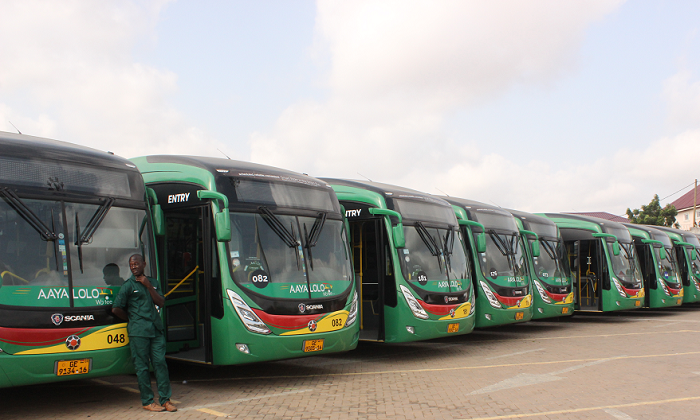

Acting Managing Director of the Ghana Passenger Transport Executive (GAPTE), Awudu Dawuda has given an update on the agency’s number of Aayalolo buses in operations as part of efforts to solve the nation’s persistent problems with public transportation.
Mr. Dawuda made the disclosure while briefing the Vice President Professor Jane Naana Opoku-Agyemang when she paid a visit to the GAPTE office in Accra on Friday, January 16, 2026.
He stated that GAPTE presently operates 245 Aayalolo buses across several locations, with additional vehicles deployed to meet increased passenger demand.
He pointed out that the number of buses operating on the Accra Transit Corridors have been increased from 80 to 105 buses. 60 buses currently operates in Kumasi while 10 operates in Tamale.
Mr. Dawuda further explained that 11 buses are grounded for repairs while 28 buses are going under maintenance at the workshop.
“The Accra transit corridors, we have moved from 80 buses to 105 buses which are in service. There are 12 buses at University of Cape Coast, University of Health and Allied Sciences, we have 5 buses, Tamale Transport Operation, we have 2 buses, Swiss Port at KIA, we have 5 buses, Aviance Commuter, 2 buses, Civil Aviation Commuters, we have 2 buses, Ghana Airports Company Limited, we have 3 buses.
“We have 11 buses grounded at the depo or workshop. Those ones that we think we have to change the engine and so on and so fort. Then, we have depo holding 28 under maintenance. When you put all the figures together you have 175. Remember, I mentioned 60 sent to Kumasi and 10 to Tamale. So, in total we have 245,” he stated.
He clarified that the expansion of the fleet is part of GAPTE’s plan to help public transportation given the current transportation crisis.
“The records must reflect that it is because of the issues that we have that we have increased our fleet in terms of the number of vehicles that we operate on our corridors,” Mr. Dawuda added.
GAPTE currently run six major transit corridors, although two more have been added to handle growing passenger demand and reduce traffic.