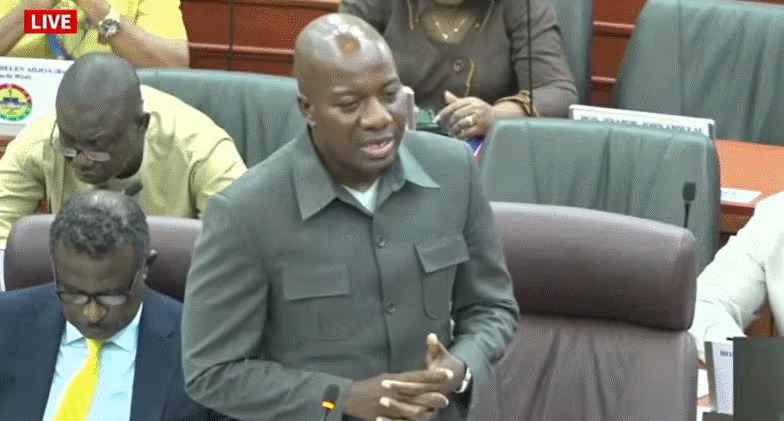

The Majority Leader, Mahama Ayariga, has refuted the view of the Minority Leader, Alexander Afenyo-Markin, that the 2026 budget statement was full of lamentations.
Mahama Ayariga said it is not lamentations, but rather the continued unearthing of the bad economic management of the previous New Patriotic Party (NPP) administration.
“It is not the lamentations; it is the continued unearthing of the bad economic management of the NPP that is being revealed every day. It is obvious from the budget statement that the NPP government was the worst case study of bad economic management. The NPP was bad in government but even worse in opposition,” he said on the floor of parliament after the budget presentation on Thursday, November 13.
Prior to his comment, Afenyo-Markin had stated that the 2026 budget statement presented to Parliament by the Finance Minister, Dr Cassiel Ato Forson, was full of lamentations and even described the document as ‘Part II of the lamentations’.
Speaking in parliament after the budget presentation on Thursday, November 13, Afenyo-Markin said, “After several months on the job, he came to repeat the same lamentations, part II of the lamentations.”
He added, “The minister has failed to consider the work of parliament; he provides a paltry sum to parliament when parliament is the only body that does oversight. Parliament is an important organ of the state. When the Minister himself is a member of parliament and fails to recognise parliament and its work, look at the ministers and their faces. In 2025, he should tell us the releases he gave them. When he was mentioning the figures, the ministers were looking as if this was the first time they were seeing the figures. Was there any consultation?”

Afenyo-Markin also said that the 2026 budget statement failed to account for other critical issues as well.
For instance, he said, the budget failed to account for the GHS 20,000 that the Director of Operations at the Presidency, Mustapha Gbande, said President John Dramani Mahama sends to each constituency to support the National Democratic Congress (NDC).
“The minister attempted to provide some figures, he gave a tall list of allocations, what he failed to to add that in the 2025 budget that he brought to this house, we had director of operations at the Jubilee House who publicly said every month the presidency gives GHS20, 000 to each constituency, it totalling 66 million, where did they get that money from? Mr Mustapha Gbande, the Deputy General Secretary of the NDC, and Director of Operations at the Presidency, publicly said every month the Presidency gives 20,000 Cedis to each constituency, but the Minister of Finance has not accounted for this. How that is money is given, time will tell.”
The Finance Minister, Dr Cassiel Ato Forson, has announced four macroeconomic policy objectives for the 2026 financial year.
Presenting the 2026 budget and economic policy to Parliament on November 13, he said the macroeconomic policy objectives for 2026 and the medium-term are clear and focused,
Dr Forson listed the objectives as follows:
• preserve macroeconomic stability;
• sustain debt sustainability;
• sustain growth; and
• deliver prosperity that every Ghanaian can feel part of.
He noted that, “Our reform agenda charts a bold path toward resilience, competitiveness and opportunity. It is about transforming the current stability into long-term prosperity. Resetting for Growth, Jobs, and Economic Transformation 2026 Budget.”
To achieve these objectives, the Finance Minister stated that Government will focus on five key macroeconomic
objectives:
• we will sustain fiscal discipline and debt sustainability by implementing prudent debt management strategy, improving revenue mobilisation, and
keeping spending efficient and targeted;
• we will build and sustain a resilient and inclusive economy with growth powered by productivity, innovation, and private sector enterprise and
create decent jobs especially for our youth;
• We will deepen structural reforms to modernise the economy, boost productivity, attract private investment, and make growth more broad-based and inclusive;
• we will strengthen social protection so that the most vulnerable, particularly women, children and the poor are shielded from hardship and benefit from Ghana’s recovery; and
• We will maintain a flexible exchange rate regime and prudent monetary policy to preserve price stability, protect savings and support investment.
“Mr. Speaker, these priorities reflect our conviction that stability is only meaningful when it improves lives. Together, these policies reflect one simple truth, that macroeconomic stability is not an end in itself, but the foundation for a fairer, stronger and more resilient Ghana where every citizen has a real chance to succeed,” he noted.