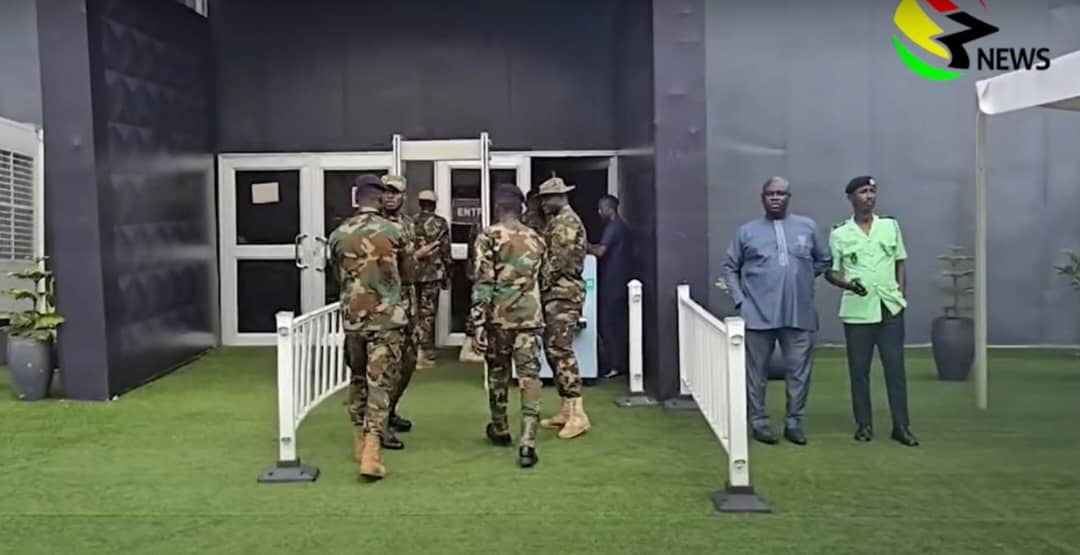

Military assaults on civilians have become far too common in Ghana. These incidents often occur during operations where the military has been deployed for purposes that are not within their traditional remit.
One of the most recent cases involved a journalist allegedly assaulted by soldiers during the demolition of a warehouse reportedly owned by businessman Daniel MacKorley, popularly known as MacDan.
As a broadcast journalist myself, I have had a personal experience with military brutality. In 2021, during a clean-up exercise at Tema Station in Accra, I was assaulted by a group of soldiers. These soldiers were led by a captain and had been deployed to oversee the exercise, which was taking place just a few months after the COVID-19 outbreak.
Together with my cameraman, we were on the ground to cover the clean-up. I introduced myself as a professional journalist with Media General. Yet, we were ordered not to film simply because the soldiers were present. I found the instruction unreasonable, especially given our constitutional mandate as journalists to inform the public.
Within moments of refusing to stop filming, I was attacked, physically assaulted by these soldiers. My cameraman was not spared either. Our camera was smashed, and our phones were damaged beyond repair. I was outraged, shocked, and deeply hurt. But these were armed men in uniform, how could we fight back? We had no choice but to retreat, report the incident on TV, and raise public concern.
But over time, I began to ask a deeper question: Are the soldiers entirely to blame for these assaults, or is there a bigger problem at the top?
The primary responsibility of the military is national defense, protecting the country against external threats, engaging in warfare if necessary, and sometimes assisting in peacekeeping missions. Soldiers are trained to fight and subdue enemies. They are not social workers. They are not public sanitation officers. They are not bouncers at Parliament. They are certainly not demolition contractors.
So, it begs the questions:
What is the military doing at a warehouse demolition site?
Why were they deployed to supervise a clean-up exercise at Tema Station?
Why were they sent to Parliament to separate fighting MPs?
Why are they used to guard ballot boxes during elections?
These are clearly tasks that fall within the jurisdiction of the Ghana Police Service, the National Fire Service, or even civilian contractors. The overuse and misuse of soldiers in civilian operations is what places them in conflict with the very citizens they are meant to protect.
Soldiers Obey Orders – But Who Gives Those Orders?
We must understand that the military is a highly disciplined institution built on a strict hierarchy of command. Soldiers do not act independently in these situations; they follow orders. So, if a soldier is sent into a marketplace to enforce a demolition or is ordered to assault a civilian journalist, the real question should be: Who sent them there?
This is where political accountability becomes crucial. Civilian authorities including ministers, municipal executives, and other government officials must be held responsible for the unlawful deployment of the military in civilian matters. You cannot misuse the military and then criticize the soldier for doing what he was commanded to do. The soldier’s training and instincts are designed for combat and defense, not negotiation and civilian engagement.
When we continuously deploy soldiers for tasks outside their mandate, we risk weakening the very foundation of our national defense. Over time, the lines between military and civilian functions blur, eroding the professionalism and effectiveness of the armed forces.
If we keep turning the Ghana Armed Forces into an all-purpose enforcement agency overseeing clean-ups, guarding ballot boxes, chasing hawkers, and demolishing buildings we will end up with soldiers unprepared for real combat when the time comes. They will lose their edge, their focus, and their purpose.
Let’s Address the Root Cause
We must stop treating the military like a school cadet corps that can be deployed at the whim of any politician. There must be a clear distinction between military and civilian roles in a democratic society. The Ghana Armed Forces should only be deployed for tasks that genuinely require their expertise such as border protection, counter-terrorism, and national emergencies beyond the capacity of the police.
Let us not destroy a noble institution through political misuse. When a soldier is found assaulting a civilian in a non-combat environment, the real blame must go to the political authority that ordered the deployment in the first place.
If we want to stop military assaults on civilians, we must first stop sending soldiers where they do not belong.
Joseph Armstrong Gold-Alorgbey is a Broadcast Journalist who holds a Master of Science in Defence and International Politics