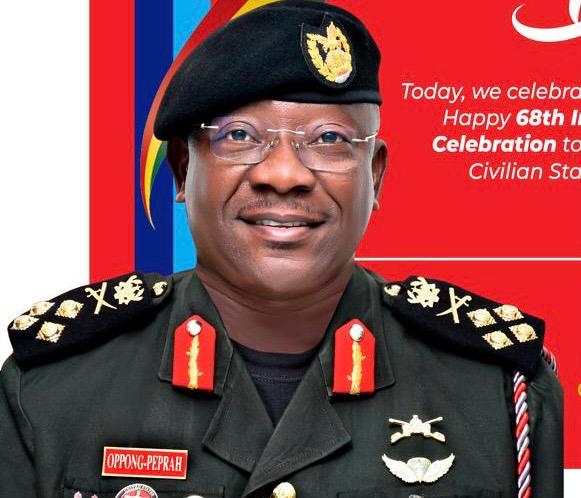

The appointment of the immediate past Chief of the Defence Staff (CDS) of the Ghana Armed Forces, General Thomas Oppong-Peprah (Rtd), as Ghana’s Deputy High Commissioner to Canada has ignited a flurry of public commentary, some thoughtful, others unfortunately tinged with narrow partisan interpretations.
In the heat of this discourse, it becomes imperative to clarify the context, rationale, and strategic significance of such a posting.
As someone who has observed the defence and diplomatic space closely for years, my first instinct was not to question the appropriateness of the appointment, but to reflect on the unfortunate speed with which we reduce such important national decisions into fodder for political conjecture.
It is time to look beyond simplistic binaries and embrace the broader picture.
Firstly, let us be clear: there is absolutely nothing demeaning or diminishing about this new role. Public service does not lose its honour because one trades a uniform for a suit.
On the contrary, the appointment of a retired four-star general to a senior diplomatic post is a logical extension of a lifetime dedicated to national service. It is not a step down, it is a step forward, into a different but equally vital domain: diplomacy.
Ghana, like many nations, benefits when its seasoned public servants continue to lend their experience and discipline to national assignments beyond their core careers. General Oppong-Peprah is a proven leader, not only in military strategy but also in institutional management, international relations, and inter-agency coordination. These are precisely the skills required in a diplomatic setting.

Secondly, some have asked why Canada? The answer is rooted in strategic alignment, not random allocation. General Oppong-Peprah is reported to have received aspects of his professional military and leadership training in Canada. He has studied their systems, interacted with their institutions, and built familiarity with their culture.
This unique background makes him an ideal candidate to help strengthen bilateral relations, especially in the areas of defence cooperation, peacekeeping collaboration, and security policy. This is not a case of political convenience; it is one of strategic foresight.

Thirdly, and perhaps most crucially, this appointment fits into a broader, deliberate diplomatic succession plan. Most current High Commissioners and Ambassadors were appointed under the previous administration. In the world of diplomacy, terms of service are fixed, and abrupt recalls of career diplomats before the end of their tenure are not just frowned upon, they risk destabilising established relations.
By appointing deputies now, particularly ones with exceptional leadership backgrounds, the state is ensuring a smooth transition when the tenure of current ambassadors concludes. Deputies are expected to understudy their principals, build networks, learn operational protocols, and prepare to eventually step into the role of High Commissioner or Ambassador when the time comes.
From this perspective, General Oppong-Peprah’s appointment is not just ceremonial, it is preparatory, and deeply strategic.
Beyond Politics: The Need for National Maturity
Unfortunately, many of the criticisms levelled at this appointment stem from a limited understanding of diplomacy, or worse, from a tendency to view every national decision through a partisan lens.
Ghana cannot continue down this path. We must mature as a nation and learn to celebrate competence, continuity, and calculated foresight.
Appointing a respected former CDS to a key diplomatic role is not a partisan reward, it is a national deployment. It reflects confidence in the capacity of Ghanaian professionals to serve in multiple domains, and it underscores a commitment to continuity in foreign policy execution.
In conclusion, from command posts to chancelleries, the mission remains the same: to serve the flag and advance Ghana’s interests. Whether in uniform or in a tailored suit, true patriots understand that the call to serve transcends titles, administrations, and political affiliations.
Let us rise above the noise and recognise this appointment for what it truly is: a thoughtful, strategic deployment of national experience to advance our collective diplomatic agenda.
Because in the end, true patriots serve the Republic not the regime.
The author, Joseph Armstrong Gold-Alorgbey holds a Master of Science in Defence and International Relations. He is the Dean of the Defence Press Corps.