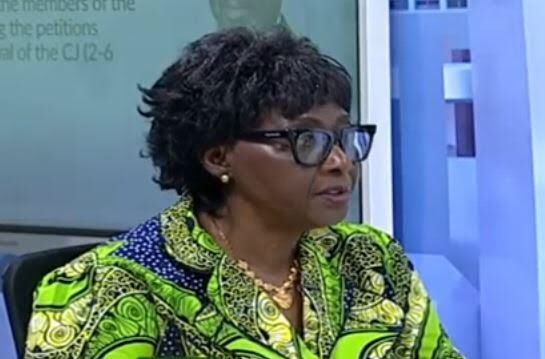

Public Interest Advocate Rodaline Imoru Ayarna says Ghana does not need to extend presidential terms or allow a third term for any president.
Instead, she believes the country’s development challenges stem from the lack of a unified national development plan that every government must follow.
Speaking about it on TV3’s New Day on October 30, Mrs. Ayarna argued that four years is enough for any president to make meaningful progress if systems work properly.
“First and foremost, I would have to say that four years is okay for any one term,” she said.
“The reason why we are having these problems is because we do not have a national development plan where every party will go according to that plan and then you bring your manifesto in and do whatever is left to be done.”
She explained that the frequent changes in policies with each new administration have slowed Ghana’s progress.
“In a country where every time there is a change of government, there is a change of policy in education, a change of policy in health, and almost every sphere of life, how is that country going to develop?” she asked.
Mrs. Ayarna compared Ghana’s situation to the “Asian Tigers,” noting that unlike them, Ghana’s progress is held back by tribal and political divisions.
“In this country, we are even living it, where a particular region is purported to belong to a particular party. And it shows when the voting comes,” she observed.
“How do you then go around and get someone out of this lot to go a third term?”
According to her, the key issue is not how long presidents stay in office but whether good policies and competent people are maintained across administrations.
“I don’t see any reason why if someone is in a position and performing, that person cannot be maintained,” she said.
“Is it always that you have to change someone just because another person saw good in that person, put him in a position, and he is delivering?”
She suggested that when governments change, they should focus on continuing what works rather than starting afresh.
“If someone is building a school, you have to finish it. If someone is building a hospital, you have to finish it. Don’t leave it and go and start another one. It’s our money. It is taxpayers’ money,” she emphasized.
While rejecting the idea of a third presidential term, Mrs. Ayarna said Ghana could consider extending the presidential term from four to five years to allow more time for continuity and results.
“We do not want to come to a situation where we will be introducing dictatorships in this country. Five-year term for me is the ideal and not a third term,” she stressed.
She referenced Ghana’s 1960 Constitution, which allowed for five-year presidential terms, noting that the country achieved significant progress within that period.
“The 1960 constitution that Kwame Nkrumah came with starts from 1960 to 1965, that was a five-year term. And if you look at President Mahama’s four years, a lot of the things he did, he did it in four years, which means it can be done.”
Mrs. Ayarna believes a constitutionally enshrined national development plan is the way forward one that binds all governments to continue national projects regardless of political differences.
“A national development plan should involve health, education, and energy. It should be entrenched in the constitution that you must follow it,” she said.
“So that if someone is building a school, you have to finish it. If someone is building a hospital, you have to finish it.”
She dismissed the notion that past plans, such as the 40-year development plan, were sufficient, arguing they were not binding enough.
“Those were plans by governments as they come. I’m saying put it in the constitution that you must abide by it.”
Mrs. Ayarna cautioned that calls for a third term could gradually lead Ghana into authoritarianism.
“Let us not rush into third terms. Because if we are not careful, we will be going to a fourth term. If the person comes and he is good, would we like the person to go?” she questioned.
“But we cannot always say one person has all the intelligence that it takes. Somebody might come after Mahama who will be greater.”
She warned that extending presidential terms could eventually fuel one-party dominance.
“Before we will even have the need to say it, we’ll be hearing people saying we are going to do one-party states. That’s the fear of people. If you allow this argument, especially those on the side of a third term, you end up seeing what we’ve seen in other African countries.”
Mrs. Ayarna concluded that Ghana’s greatest challenge is not the people, but the leadership.
“It’s the leadership that we are afraid of,” she said.
“The machinations, the manipulations, that’s where the problem lies.”