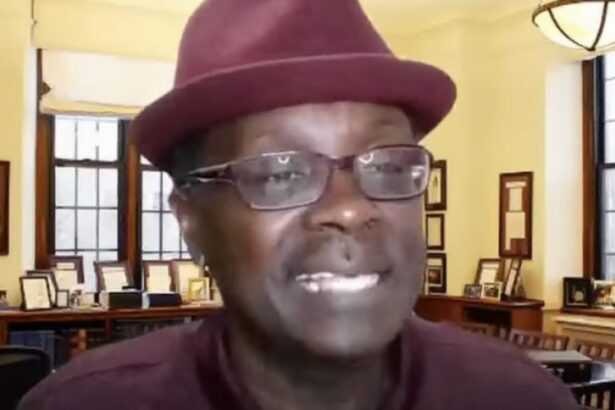

Professor Stephen Kwaku Asare is concerned about the judge’s decision in the case between the Office of the Special Prosecutor (OSP) and Charles Bissue.
On Wednesday, November 5, the Criminal High Court adjourned proceedings to 19 November 2025 after hearing arguments on a motion for the testimony of the State’s first witness to be heard in camera.
The adjournment was to allow the court to rule on an objection raised by Charles Cromwell Nanabayin Onuawonto Bissue, the first accused, who is seeking that the testimony of the witness, an undercover journalist- be heard in open court.
Mr Bissue, the former Secretary to the now-dissolved Inter-Ministerial Committee on Illegal Mining, is standing trial alongside two others. They are accused of taking bribes and other illicit benefits to expedite the issuance of a mining concession sticker for an unlicensed company.
The accused persons face six counts of using public office for profit and three counts of corruption by a public officer. The court is expected to deliver its ruling on the objection on the next adjourned date.
Commenting on this development on his Facebook page, Prof Asare said that there is no justification for halting a trial for two weeks just to decide whether a witness should testify in open court.
“Such procedural pauses may look technical, but they have real costs: witnesses forget, lawyers regroup, and public confidence erodes. Justice delayed is not merely justice denied — it is justice diluted,” he said.
He also noted that “a well-managed court should hear objections promptly and rule immediately, or at the very latest, the next day. That is how trials proceed in systems that take justice seriously.
“Adjournments should be the exception, not the norm. A case that begins on Monday should, barring extraordinary circumstances, end by Friday. Efficiency is not the enemy of fairness; it is one of its guardians.”
Below is his full statement…
In OSP v. Bissue, the court’s decision to adjourn for two weeks to rule on a simple objection — whether an undercover journalist should testify openly — perfectly illustrates what is wrong with our trial culture. That ruling could have been delivered the same day or the next morning.
But this is our trial culture: adjournments, delays, and interlocutory motions — often engineered to stall momentum, exhaust witnesses, and drain public interest. Every day of delay is a day justice stands still.
When a trial starts, it should continue until it ends. The essence of a trial is momentum — evidence flows, arguments build, and the facts gradually take shape.
Interrupt that flow, and the search for clarity and justice dissolves into confusion, fatigue, and delay.
Case management may take months, but the trial itself should take days.
It is perfectly acceptable, even necessary, for judges to spend time before trial managing pleadings, discovery (disclosures), and pre-trial motions. That is where complexity should be handled and timelines agreed upon.
But once the trial begins, proceedings should move continuously. Witnesses should be heard back-to-back, objections ruled on promptly, and the evidentiary phase concluded within a reasonable span — usually a few days.
The length of a trial should reflect the complexity of facts, not the comfort of the lawyers or the convenience of the calendar. Prolonged trials are not signs of diligence; they are symptoms of dysfunction.
There is no justification for halting a trial for two weeks just to decide whether a witness should testify in open court.
Such procedural pauses may look technical, but they have real costs: witnesses forget, lawyers regroup, and public confidence erodes. Justice delayed is not merely justice denied — it is justice diluted.
A well-managed court should hear objections promptly and rule immediately, or at the very latest, the next day. That is how trials proceed in systems that take justice seriously.
Adjournments should be the exception, not the norm. A case that begins on Monday should, barring extraordinary circumstances, end by Friday. Efficiency is not the enemy of fairness; it is one of its guardians.
Our justice system must learn to distinguish between due process and procedural indulgence. Trials are not Kumawood dramas with long commercial breaks; they are solemn determinations of guilt or innocence.
The law empowers judges to control proceedings — to ensure order, speed, and focus. When they fail to use that authority, they surrender justice to delay.
GOGO has been saying this for decades, but to no avail. Occasionally, he is told that “justice rushed is justice crushed” — a slogan that entirely misses the point about effective trial management.
The problem is not speed; it is structure. The culture of adjournments and procedural indulgence endures not because the law demands it, but because the system tolerates it.
Until judges, lawyers, litigants, and the public decide that justice must move, nothing else will.
This is why the first election petition dragged on for nine months, while the second was completed in forty-two days — not because the issues were simpler, but because the rules of court imposed a timetable. Deadlines discipline justice; open calendars destroy it.