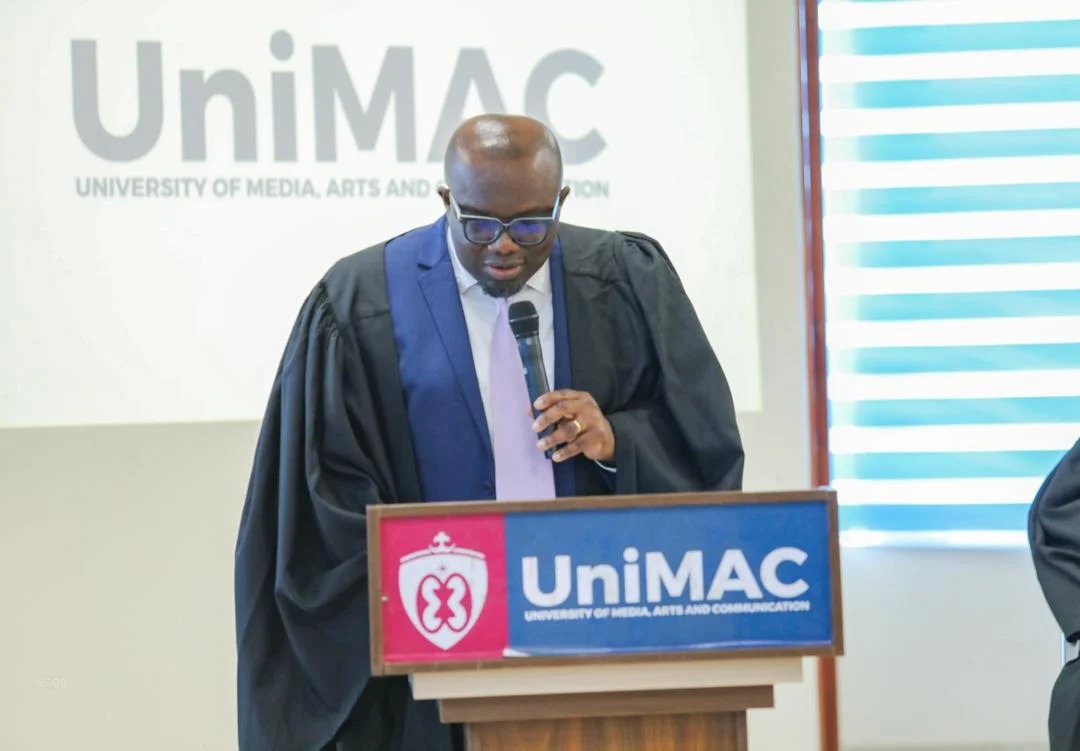

The Vice-Chancellor of the University of Media, Arts and Communication (UniMAC), Prof. Eric Opoku Mensah, has bemoaned the fact that despite the contribution of its Institute of Film and Television (UniMAC-IFT) to the creative arts sector in Ghana, the school operates from a rented facility.
He noted that an institution of the status of UniMAC-IFT deserves to be operated from a permanent campus.
“A national strategic institution cannot remain in rented premises while it trains the labour force for a sector government seeks to expand, modernize, and use to drive the national identity agenda,” Prof. Opoku Mensah said at an Open Day organised by UniMAC-IFT on November 14, in Accra.
He was therefore happy that the Finance Minister, Dr Cassiel Ato Forson, made some provisions for the creative arts sector in the 2026 budget.
“Just yesterday, Thursday, 13th November 2025, the Minister for Finance, Hon. Dr. Cassiel Ato Forson, delivered the 2026 Budget Statement, and for us in the creative arts ecosystem, it was refreshing and inspiring. The Minister affirmed that: “Tourism and the creative arts continue to drive national identity, youth creativity and foreign exchange earnings. Government will establish a Film Fund to revive the film industry and all film
associations,” he referenced the Finance Minister’s statement.
“A Creative Arts Fund will be established for the arts, music, fashion, food, and related sectors and to this effect, a GH¢20 million to it and another GH¢20 million has been allocated to the Creative Arts Sector,” Prof Opoku Mensah quoted.
The Vice-Chancellor of UniMAC, however, noted that these measures do not address the specific needs of UniMAC-IFT. He indicated that in order for the Minister’s policies to yield the desired impact, UniMAC-IFT must be given special attention.
“…if Ghana is truly committed to repositioning the creative economy, then the training hub, the engine room, the place where the storytellers, cinematographers, producers, animators, editors, sound engineers, and creative leaders are formed—MUST be strengthened. And that place, without any contradiction, is UniMAC–IFT.
We humbly appeal to the government to send some of these allocations to IFT’s way to revamp the creative arts education,” he urged.
According to him, “If government seeks to reset the creative economy, then:
✓ UniMAC–IFT must be at the very centre of that reset.
✓ IFT must be seen as a critical national asset, not a peripheral institution.
✓ IFT deserves a permanent, modern, well-equipped campus.
✓ IFT needs investment in retooling, studios, digital labs, sound stages and production infrastructure.”
He stressed that, “A Film Fund without a strong Film School will yield only half its potential. A Creative Arts Fund without investment in the training institution that supply the human capital will not reach its full impact.”
The Vice-Chancellor, therefore, appealed to the government to pay urgent attention to the needs of UniMAC-IFT.
“I wish to make a strong, heartfelt, and strategic appeal to the Government—particularly to the Hon. Minister for Tourism, Culture and Creative Arts: It is time to allocate substantial and sustained funding to UniMAC–IFT,” he said.
Prof Opoku Mensah contended that “IFT is not just another school; It is the hope of Ghana’s creative future. IFT has trained and continues to train many of the industry’s leading voices, innovators, award-winning filmmakers, and media professionals, many of them have been celebrated in Africa and on the world’s stage.”
The event, which was attended by students, alumni and Senior High School students, was held under the theme, “Reel Connections.”