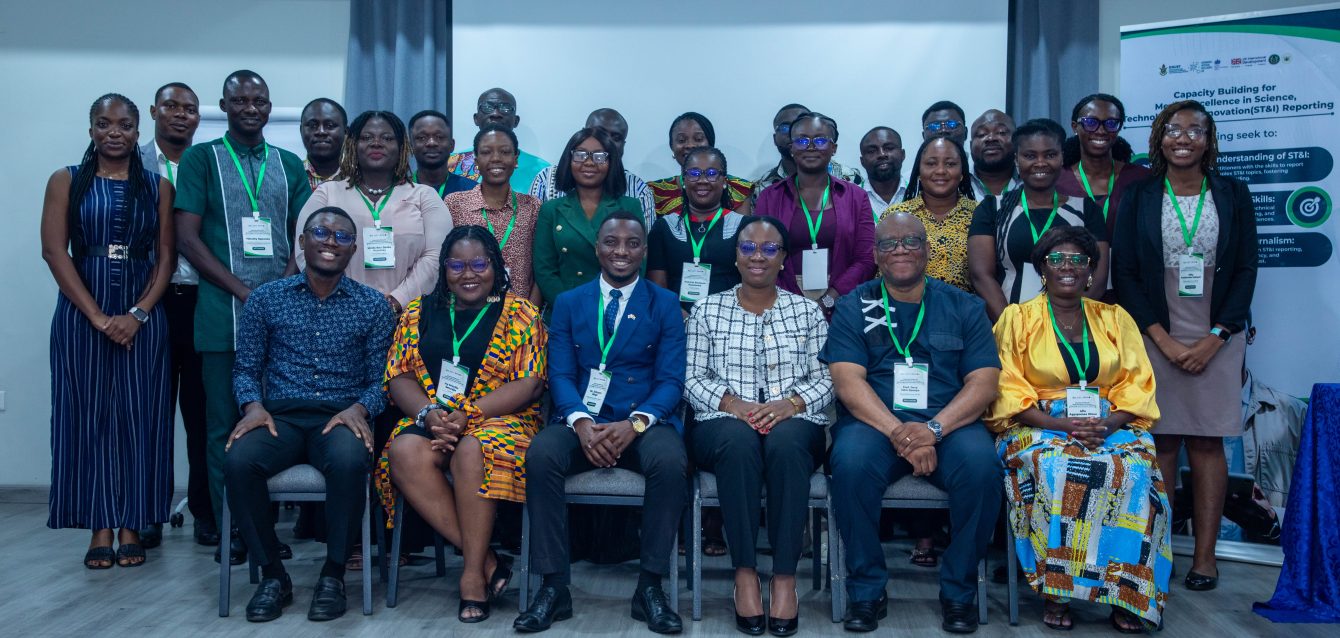

Twenty-five journalists and content creators selected across the country have received a high-level training aimed at strengthening public understanding of science, technology and innovation under the UK-Ghana Science, Technology and Innovation (ST&I) Media Capacity Programme.
The four-day capacity-building workshop, running from March 10 to March 13, 2026, is organised by the British High Commission Accra in partnership with the Responsible Artificial Intelligence Lab (RAIL) at the Kwame Nkrumah University of Science and Technology [KNUST], the Ministry of Environment, Science and Technology and the Ministry of Communications, Digital Technology and Innovations.
This year’s training, which is the third since its inception, seeks to equip participants with the skills required to translate complex scientific and technological concepts into accurate, engaging and accessible content for the Ghanaian public.
It forms part of a five-year UK–Ghana Science, Technology and Innovation Strategy (2023–2028), which recognises the critical role of the media in science communication.
Journalists from Media General [TV3/3FM], Ghana Broadcasting Corporation, Ghana News Agency, Citi FM, Multimedia Group, Graphic Communications, Business and Financial Times, and others are participating.
Providing an overview of the initiative, Johnson Singir, Science and Innovation Officer at the British High Commission Accra, highlighted the United Kingdom’s continued commitment to supporting Ghana’s development through frontier technologies.
He revealed that selected journalists who pitch the most innovative story ideas during the training will have the opportunity to travel to the UK to engage with leading institutions such as Imperial College London. In addition, a grant scheme has been established to support the best ideas developed through the programme.
According to him, the initiative has already had a “tremendous impact” since its first phase, noting that several alumni, including TV3’s Godwin Asediba who won the GJA 2025 Journalist of the Year, have gone on to receive recognition at the Ghana Journalists Awards
“A lot of research is being conducted, but the critical question is whether a farmer in a rural community knows about the innovations that could transform their lives,” the Administrator of the Ghana National Research Fund, Prof. Abigail Opoku Mensah, observed while noting that science journalists as “significant figures in Ghana’s knowledge ecosystem.”
“There is a significant communication gap, and the science, technology and innovation reporter serves as the bridge across that gap,” she said.
Prof. Opoku Mensah praised the collaboration behind the initiative, stating that the Ghana National Research Fund is proud to support efforts that align with its core mandate.
“Our responsibility is not only to fund research but also to ensure the transfer of knowledge and technology. The process does not end when a research paper is published; it ends when the knowledge reaches the people who need it most. And that is where the media comes in,” she said, urging newsrooms to give greater prominence to science reporting.
Principal Investigator and Scientific Director of RAIL, Prof. Jerry John Kponyo, highlighted the crucial role communication plays in the research ecosystem.
He explained that RAIL is a multidisciplinary laboratory focused on leveraging Artificial Intelligence (AI) to support the Sustainable Development Goals (SDGs) in sectors such as agriculture, healthcare, energy and education, while also developing solutions to bridge accessibility gaps for persons with disabilities.
“It is one thing to do groundbreaking research, but it is another thing entirely to communicate its results effectively,” Prof. Kponyo said.
“Research is of no use if people cannot benefit from it. This workshop is important because it tackles two sides of the same coin: building journalists’ capacity to understand and report on science and building academics’ confidence to communicate their work publicly.”
“Together, we can break down these innovations and even translate them into local languages so that the ordinary Ghanaian can understand and benefit from them.”
He commended the British High Commission for the initiative’s growing impact and reaffirmed KNUST’s commitment to sustaining and expanding the programme.
The workshop aims to foster stronger collaboration between researchers and journalists, ensuring that scientific innovation is effectively communicated to the public and translated into tangible, real-world impact.
The UK-Ghana ST&I Strategy
Ghana and the United Kingdom have entered a five-year strategic partnership on deploying UK and Ghana expertise to shape stronger Science, Technology and Innovation related policies and ecosystem institutions.
Other objectives include capacity building programmes that emphasise knowledge transfers and also promote, facilitate and establish joint university/research partnerships that encourage open science practices, among others.
The UK enjoys a reputation as a global leader in ST&I and has ambitions to further its impact through international partnerships. Ghana equally has a thriving ST&I community that is driving great innovation in medical research, financial services, agriculture and others.
Both countries envisage this partnership will create a sustainable platform needed for the health, wealth, prosperity and security of their citizens with clear guidelines on how these targets could be achieved.
“Our strategy is based on the understanding that opportunities can be missed, and impacts limited by poor knowledge and coordination across actors in the ST&I space. Improvement is possible by better understanding the landscape, coordinating related efforts, creating opportunities to develop and exploit new partnerships, and tackling the obstacles that sometimes get in the way,” parts of the object of the strategy indicate.
By Christian Yalley