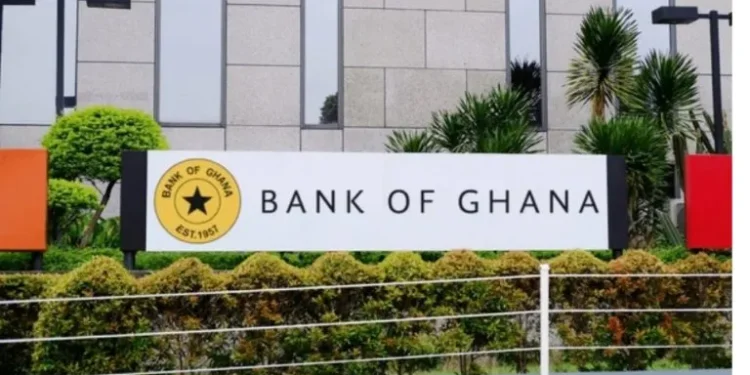

The Bank of Ghana’s (BoG) 2025 financial results present a paradox that merits careful public examination.
On one hand, the institution delivered a remarkable macroeconomic stabilisation: inflation was brought down from 23.8% to 5.4%, gross international reserves were rebuilt to 111 tonnes of gold, and the cedi appreciated by approximately 41% against the US dollar.
These are genuine achievements by any standard, and they deserve acknowledgement before any critique proceeds.
On the other hand, the balance sheet reveals structural fragilities that extend well beyond a one-off stabilisation cost. The central bank recorded a standalone net loss of GH¢15.63 billion and negative equity of GH¢93.82 billion.
Several aspects demand independent scrutiny — not to diminish what we accomplished, but to ensure that we maintain the financial foundations required to defend those gains.
This analysis proceeds section by section, grounding each argument in the reported figures. Where assumptions or estimates are introduced, they are clearly labelled as such.
1. The Gold Windfall Masks, Rather than Resolves, an Income Crisis
The BoG recorded a net gain of GH¢9.57 billion from selling 870,000 ounces of refined gold — a sum that single-handedly prevented the headline loss from breaching GH¢25 billion. This raises a fundamental question: what happens when gold sales slow, prices retreat, or reserves approach a prudential floor? The gold purchase programme has been a genuine success in building reserves, but treating large-scale asset liquidations as a recurring profit-and-loss patch transforms a reserve management tool into an income dependency. No central bank can sustainably fund its operating deficits by monetising a finite, price-volatile stock of national wealth.
Financial Basis
Reported standalone loss: GH¢15.63 billion
Underlying loss without gold gain: GH¢25.20 billion
Gold gain as % of underlying loss: 38% (GH¢9.57bn ÷ GH¢25.20bn)
Gold sold: 870,000 oz ≈ 24% of year-end reserves of 111 tonnes (≈3.57 million oz)
Implied average realised price: ≈ US$4,140/oz (derived from reported US$3.6 billion revenue ÷ 870,000 oz)
NOTE ON PRICE ASSUMPTION: The US$4,140/oz implied price is materially above most 2025 spot market averages, suggesting either that (a) BoG achieved advantageous forward pricing, (b) sales were concentrated in a period of elevated prices, or (c) one of the two reported inputs (revenue or volume) differs from the final audited figure. Readers should verify both inputs against the published 2025 Annual Report before applying the sensitivity below.
Price sensitivity: a 10% price correction from US$4,140/oz would erode approximately GH¢1 billion of the reported gain, widening the effective loss significantly.
Converting a quarter of the country’s newly accumulated gold reserves into a one-off accounting relief is not a durable substitute for core operational income. The 2025 profit-and-loss statement is, in effect, propped up by asset monetisation that offers no medium-term fiscal anchor for the central bank itself.
2. The Revaluation Loss Paradox: Policy Success Feeds Balance-Sheet Damage
The central bank booked a GH¢23.6 billion exchange revaluation loss on its foreign-currency assets because the cedi appreciated approximately 41% against the US dollar. Policymakers simultaneously celebrated this appreciation as a core achievement of the stabilisation programme. This creates a structural paradox: the stronger the cedi, the larger the revaluation loss and the deeper the central bank’s negative equity. A central bank whose balance sheet deteriorates when its signature policy succeeds is trapped in a structural asset-liability mismatch that accounting opinions cannot resolve.
Analytical Note: This revaluation loss is an unrealised, accounting-driven entry. The underlying foreign assets remain on the balance sheet and retain their dollar-denominated value. The loss does not represent a cash outflow. Nonetheless, it directly erodes stated equity and, if sustained, progressively deepens the recapitalisation burden over time. This distinction is relevant for policy communication but does not neutralise the structural concern.
Financial Basis
Negative equity movement: GH¢58.62bn → GH¢93.82bn (increase of GH¢35.2bn)
Revaluation loss contribution: GH¢23.6bn = 67% of the equity erosion
Implied sensitivity: GH¢23.6bn ÷ 41% appreciation ≈ GH¢0.58bn loss per 1% cedi strengthening
Stress test: A further 10% cedi appreciation under continued IMF programme conditions implies an additional ≈ GH¢5.8bn revaluation loss
Structural position: The balance sheet is structurally short cedi against a large pool of foreign-currency assets, meaning policy success and capital destruction are linked by accounting convention.
This paradox is not unique to Ghana — several emerging market central banks, including the Czech National Bank and the Swiss National Bank, have operated with negative equity for periods without triggering market crises. What distinguishes the BoG’s position is the combination of revaluation losses with simultaneously elevated sterilisation costs and impaired interest income, creating compounding negative pressures from multiple directions.
3. The Cost of Liquidity Absorption is Destabilising the Bank’s Own Finances
Open Market Operations (OMO) costs nearly doubled to GH¢16.7 billion, with sterilisation liabilities to commercial banks ballooning by 186%. This reflects an aggressive mopping-up of excess liquidity to sustain disinflation. While the inflation outcome is an undeniable success, the question is not whether the policy was effective but whether the method of financing it is structurally sustainable. The central bank is borrowing short-term at high interest rates from the same commercial banks it regulates, creating a vast interest expense that compounds its losses each year.
There is no near-term plan to reverse this burden without reigniting inflation. The risk is a self-perpetuating cycle: the bank’s weakened balance sheet could eventually undermine confidence in the very instruments it issues to manage liquidity.
Financial Basis
OMO/sterilisation cost: GH¢16.7 billion (reported)
Sterilisation liabilities (year-end): GH¢93.6bn — implies prior year-end stock of ≈ GH¢32.7bn (derived: +186% growth)
NOTE: The 186% growth figure and the implied prior-year stock are derived from the reported year-end balance and the stated growth rate. Both should be verified against the 2024 published accounts.
Average stock (simple): ≈ GH¢63.15bn | Implied average rate: GH¢16.7bn ÷ GH¢63.15bn ≈ 26.4%
This implied rate is approximately equal to the monetary policy rate, confirming the BoG is borrowing from commercial banks at the prevailing policy rate
OMO cost as % of total Group assets (GH¢237bn): 7% — a material share of balance-sheet capacity spent on liquidity management alone
Structural implication: Unless the liquidity overhang is permanently drained through sustained fiscal surpluses, these deficits will recur every year that disinflation is defended.
4. “Policy Solvency” is an Untested, Quasi-Fiscal Construct
KPMG’s going-concern opinion is grounded in the logic that a central bank can operate with negative equity because it can create money and because its mandate is public policy rather than profit. This doctrine is not without academic basis: economists including Peter Stella and Ardo Hansson have demonstrated that operationally solvent central banks can maintain their monetary functions despite negative accounting equity, provided market confidence holds. The concept is debated but not invented.
Nevertheless, negative equity of GH¢93.82 billion, which is more than 15 times the BoG’s pre-DDEP capital base, is unprecedented in Ghana’s modern history. The “policy solvency” conclusion implicitly assumes continued government and IMF backing, continued market tolerance for BoG paper, and a continued ability to roll over sterilisation liabilities. Should any of those pillars crack, for instance, if commercial banks demand higher yields to hold BoG bills due to concerns about the central bank’s creditworthiness, the institution could face a liquidity event that monetary policy tools alone cannot resolve. The auditor’s opinion is a statement of legal permissibility under current conditions, not a guarantee of financial resilience under stress.
Financial Basis
Negative equity: GH¢93.82bn = 57% of gross international reserves
Reserves basis: US$13.8bn × estimated GH¢12/US$ ≈ GH¢165.6bn
NOTE ON EXCHANGE RATE: The GH¢12/US$ rate is an estimate used for illustrative conversion only. Given the cedi’s 41% appreciation, the year-end market rate should be confirmed from the BoG’s published 2025 Annual Report. A rate of GH¢10/US$ (for example) would put negative equity at 68% of reserves, worsening the ratio.
Leverage ratio: Total liabilities GH¢333bn ÷ Total assets GH¢237bn = 1.41× (GH¢1.41 owed for every GH¢1 of assets)
Recapitalisation cost (illustrative): Restoring zero equity would require a capital injection equivalent to more than 50% of Ghana’s external buffer — a contingency with no current budget provision.
Central bank negative equity comparators: The Czech National Bank and Chile’s central bank have sustained negative equity without triggering crises, but both operated within robust institutional frameworks with explicit government recapitalisation commitments.
5. The DDEP Burden Has Been Socialised onto the Central Bank Indefinitely
The Domestic Debt Exchange Programme (DDEP) continues to depress the Bank’s interest income by over GH¢12 billion annually, with no sunset clause. While the DDEP was a necessary sovereign fiscal intervention, the BoG — which held government bonds as part of its statutory operations — was drawn into the restructuring and is now bearing a permanent income shock. This is a form of quasi-fiscal support that is not transparently budgeted, and it undermines claims of zero monetary financing. A central bank that earns far less on its statutory holdings of government debt while simultaneously covering the government’s liquidity management costs is de facto subsidising the budget through balance-sheet deterioration, even if no new money is created.
The negative carry this creates is the document’s most structurally important finding. The BoG is borrowing from commercial banks at approximately 26% to sterilise excess liquidity, while earning severely curtailed returns on a government bond portfolio that has been permanently restructured at below-market coupons. This spread will persist for as long as the restructured bonds remain on the balance sheet, a process likely spanning a decade or more.
Financial Basis
Foregone income (DDEP-impaired): > GH¢12 billion per annum
As a share of OMO cost: GH¢12bn ÷ GH¢16.7bn = 72%
Interpretation: If the BoG’s bond portfolio still earned pre-DDEP coupons, it would cover nearly three-quarters of the cost of sterilising the liquidity overhang created by past fiscal dominance
Negative carry dynamic: Borrowing from commercial banks at ~26% (OMO rate) while earning impaired returns on restructured bonds — this spread is a recurring; structural loss crystallised each financial year
Duration of exposure: The restructured bonds will run off over the medium-to-long term; until they mature, the income impairment is locked in. No explicit timeline for relief has been publicly communicated.
6. Accountability: An Unacknowledged Contingent Liability on the Sovereign
It is correct that a central bank should not be judged by commercial profit standards. But this principle is being deployed to deflect from a harder question: a GH¢15.63 billion annual loss, compounding negative equity of GH¢93.82 billion, represents a claim on future public resources. Whether through eventual recapitalisation, retained future earnings permanently diverted from the Treasury, or the hidden tax of inflation if monetisation eventually occurs, these losses are a real public cost which is simply deferred and unacknowledged.
Section 64 of the Bank of Ghana Act, 2002 (Act 612) provides that where the Bank incurs a loss that reduces its capital below the required level, the Government shall, within three months of the Bank’s financial year-end, pay to the Bank the amount necessary to restore its capital. To date, no formal recapitalisation agreement has been announced, and no budget provision is publicly visible. Citizens deserve clarity: at what negative equity threshold is recapitalisation triggered, which budget line will bear the cost, and over what timeline will it be executed?
Until that roadmap is published, the losses remain an unquantified contingent liability of the Republic of Ghana.
Financial Basis
Cumulative negative equity: GH¢93.82bn
Ghana nominal GDP (2025 estimate): ≈ GH¢1.1 trillion
IMPORTANT — GDP ESTIMATE: This figure is author-computed as an illustration. It is derived from a working assumption of a 45% public debt-to-GDP ratio and an estimated GH¢500 billion public debt stock. This is NOT an official figure from the Ghana Statistical Service, and it should be treated as unauthoritative.
Illustrative ratio: GH¢93.82bn ÷ GH¢1.1 trillion ≈ 8.5% of GDP — broadly equivalent to a full year of government capital expenditure.
Dividend cost: The ongoing losses deprive the Treasury of seigniorage transfers and dividends that would otherwise partially support the fiscal balance.
Legal basis: Bank of Ghana Act, 2002 (Act 612), Section 64 — Government is legally obligated to recapitalise the Bank when losses reduce capital below required levels.
Conclusion
The Bank of Ghana’s 2025 results show an institution that has succeeded in its immediate stabilisation mandate — driving down inflation from 23.8% to 5.4%, rebuilding gold reserves to 111 tonnes, and achieving a meaningful exchange rate recovery.
These are real and significant accomplishments that provide a foundation for the next phase of Ghana’s economic recovery.
However, the cost of that stabilisation has pushed the bank’s own financial foundations into deeply negative territory, and the mechanisms sustaining the current position are not durable.
The reliance on gold asset sales to offset operating losses, the structural revaluation damage inflicted by the very policy successes being celebrated, the compounding sterilisation burden, the permanently impaired DDEP income stream, and the absence of a formal recapitalisation pathway together form a constellation of structural risks that will not self-correct.
Without a medium-term recapitalisation plan based on the Bank of Ghana Act, a clear timeline for leaving the DDEP income trap, and a credible plan to reduce the sterilisation burden as fiscal consolidation deepens, the Bank risks winning the battle against inflation while quietly weakening the balance-sheet strength needed to fight the next crisis.
Ghanaians, financial markets, and policymakers deserve a frank public accounting of these trade-offs and a clear roadmap for resolving them.
By Daniel Afari-Djan
MSc International Business
A student of finance and economics
Analytical Disclaimer
This document is an independent analytical commentary prepared for informed policy discussion. All figures are drawn from publicly reported BoG data unless explicitly labelled as estimates or author-derived.
Where assumptions are used, they are flagged in the Financial Basis boxes. Readers are encouraged to verify key inputs — particularly the gold sale revenue, year-end exchange rate, and sterilisation liability baseline — against the Bank of Ghana’s officially published 2025 Annual Report and audited financial statements.