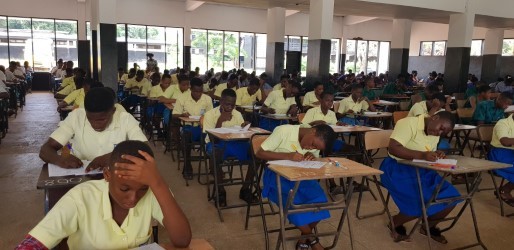

Since its introduction in 1990, the BECE has served as the gateway for placement into Senior High Schools across Ghana.
Over the years, the examination has evolved with changes in curriculum, assessment methods and grading systems, but in contemporary time, the number of subjects written in a day has remained largely unchanged.
Some stakeholders however argue, the 5-day period within which candidates are expected to write their papers tends to put pressure on them.
The Executive Secretary of EduWatch, Kofi Asare is one of the educational experts pushing the argument.
“The structure of BECE that was relevant pre-senior high school is no longer relevant today. So it is important that we revise BECE to speak to its current and continued relevance, which is an examination that determines school placement and not an examination that determines who will go to secondary school.”
For him it is high time policy makers consider effective measures to take the pressure off the candidates.
“We’ve called for a pulling down of the subject from 10 or 11 to four. Maths, English, General Science, and then a general paper which contains all the other subjects so that students will not focus on a few subjects. With this four, we reduce the stress level, we reduce the BECE budget of about 200 million a year by about half, and we reduce time and efforts spent in doing six days of BECE.”
The General Secretary of the National Council of Parent-Teacher Associations (PTA), Gapson Kofi Raphael, however, believes the argument is flawed.
“I just have a challenge with that whole argument that because they don’t have much time to inadequate preparation leads to poor performance. If you are adequately prepared, they can even put you in the hottest place. The brain is there to produce it. So, I believe that that issue is a minor. Let’s not talk about the symptoms. Let’s talk about the root causes of the whole issue.”
But what are the concerns of candidates and does the two paper a day put any pressure on them?
Speaking to some candidates, they shared their thoughts on the ongoing debate.
“The subject combination this year, I can admit that it’s very good. Yes, so it doesn’t really put pressure on the students,” one said.
For another candidate the limited timetable adds on to the pressure.
“Yes, a lot of pressure. I feel like if we could use a span of two weeks to write the papers, and we could write one paper in each day, it would be much better. For prep, maybe you feel anxious, you feel nervous, you have two subjects, and maybe the realization hits you like you’re not prepared for all those subjects at once.
If it extends to 10 days, then people get enough time to rest, revise, and cover a lot of topics.”
Frederick Senyo Ampoh is an educationist and the Headmaster for Datus International School.
“Those of us who manage the students have a lot of reasons why it has to be spaced. In fact, I dare say it’s a contributory factor to the malpractices. How do you have two papers in a day and you run it for one week? Students suffer a lot. Issues of revision, ill health, it’s even a factor. So just as they are managing the WASSCE examination, where students are made to write exams over a period of time, I think it’s a long overdue. They should extend this to cover the basic examination as well.”
Dennis Asrifi is a parent to a candidate. He also believes the duration of the exams needs to be adjusted.
“If we holistically look at the thing, irrespective of the fact that this is how we’ve been doing it for some time, we can think through and adjust and test that one too and see if it helps,” he added.
As the exams officially ends on Monday, discussion on whether Ghana’s examination structure still meets the needs of today’s students, or whether it is time for a new approach will confront policy makers.
By Samuel Yeboah Adams