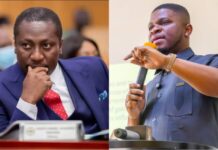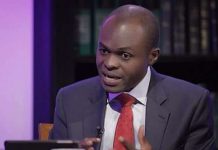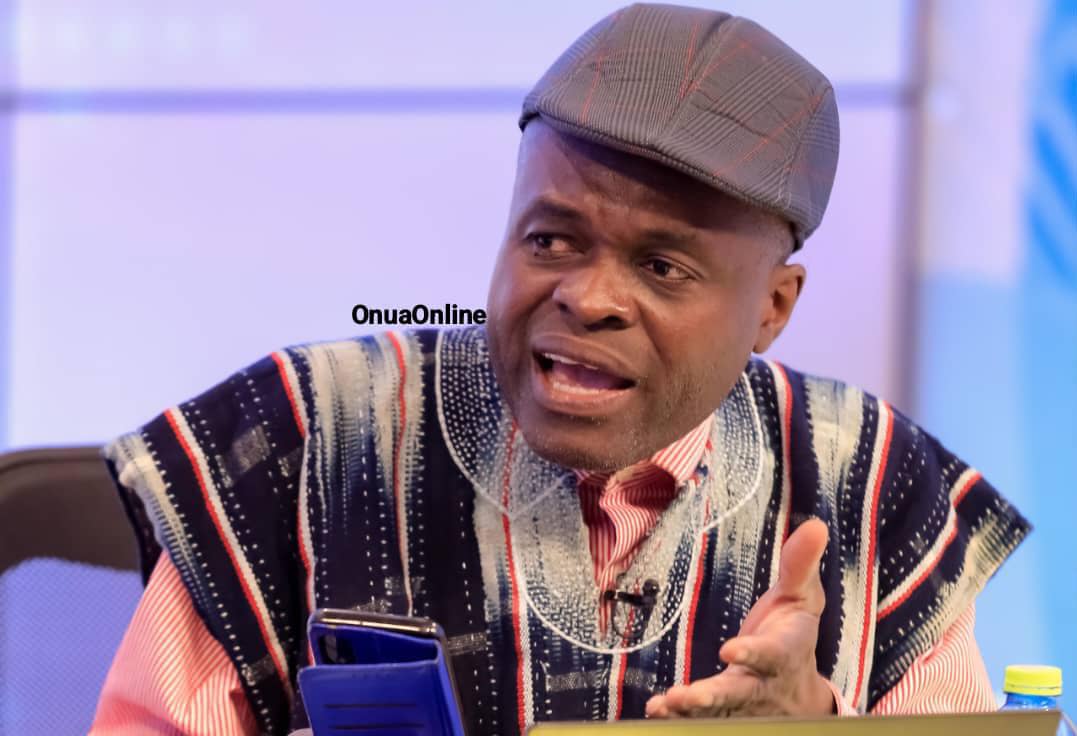

Legal practitioner, Martin Luther Kpebu, has said the fourteen (14) Civil Society Organisations (CSOs) that have joined the petition challenging the constitutionality and prosecutorial powers of the OSP did so to protect their own interest.
Speaking on Ghana Tonight on TV3 Tuesday, May 19, 2026, he said some of those CSOs are official partners of the OSP and derive some funding through their association with the Office, the reason they have joined the suit to protect the system that cushions them in a way.
The CSOs motion for leave to join the suit against the OSP as amicus curie was granted by a seven-member panel of the Supreme Court on Tuesday, May 19, 2026, following a demonstration by their lawyer, Kizito Beyuo, that the CSOs were instrumental in the creation of the OSP.
They had argued that the foreknowledge of the CSOs is going to be vital in the determination of the matter by the apex court.
The CSOs are Transparency International Ghana, Ghana Anti-Corruption Coalition, Ghana Centre for Democratic Development (CDD-Ghana), IMANI Africa, Democracy Hub, STAR-Ghana Foundation, NORSAAC, Penplusbytes, ACEP, Odekro, A Rocha Ghana, Parliamentary Network Africa, One Ghana Movement, and Africa Education Watch.
The Court has granted the CSOs 14 days to file their processes.
Commenting on the development, Mr. Kpebu, a renowned lawyer and petitioner for the removal of the current holder of the Office, William Kissi Agyebeng, said some of the Organisations in question are not independent as they seem.
“A lot of them when you go into details you see that they are collaborators with the OSP. They are not independent as such. Some of them, even their collaboration with the OSP enables them to get funding so they are actually beneficiaries of the OSP system,” he noted.
According to Mr. Kpebu, due to the benefits some of these CSOs derive from the OSP setup, “as soon as there is anything that is likely to shake that system, they will panic and would want to protect their own stomachs.”
He revealed that some previous annual reports of the OSP contains logos of some of these CSOs as official partners of the anti-graft agency, being the reason they have joined the suit at the Supreme Court.
“So these CSOs are organisations that have benefitted from the setup of the OSP so naturally they would not want to be labelled as fair weather friends, today that the OSP is in trouble, they naturally have to get up to fight,” he indicated.
Background
On December 12, 2025, one Noah Ephraim Tetteh Adamtey invoked the exclusive original jurisdiction of the Supreme Court to interpret the constitution by filing a suit for the court to declare the exercise of prosecutorial powers by the OSP as unconstitutional.
He is seeking, among other reliefs, a declaration that the OSP Act, 2017 (Act 959) is unconstitutional to the extent that it confers “original or insulated prosecutorial authority on the Office of the Special Prosecutor, is inconsistent and in contravention of Articles 1(2), 88(3), (4), 93 (2) and 296 of the Constitution and is, therefore, null, void and of no effect”.
Again, he is seeking a declaration that “sections 3(3) and 4 of Act 959, in purporting to make the Office of the Special Prosecutor independent of the Attorney-General in the initiation, conduct and termination of prosecutions, violate the Constitution.”
A-G’s position
In his draft statement of case, the A-G argues that Article 88 (3) of the 1992 Constitution solely vests prosecutorial powers in the A-G alone, and therefore Parliament acted unconstitutionally by passing the OSP Act, 2017 (Act 959), which made it compulsory for the A-G to delegate part of its prosecutorial powers to the OSP.
Article 88 (3) of the 1992 Constitution stipulates that “The Attorney-General shall be responsible for the initiation and conduct of all prosecutions of criminal cases”, while Article 88 (4) provides that: “All offences prosecuted in the name of the Republic of Ghana shall be at the suit of the Attorney-General or any person authorised by him in accordance with law”.
Again, the A-G contends that Act 959 has unconstitutionally varied the prosecutorial powers of the OSP in many ways.
“First, it compels the Attorney-General to abandon its constitutional duty to be responsible for the prosecution of all criminal offences—he is, by the terms of the Act, now only responsible for the prosecution of offences which the OSP is not prosecuting.
We need to look at things dispassionately – Gyampo on OSP powers