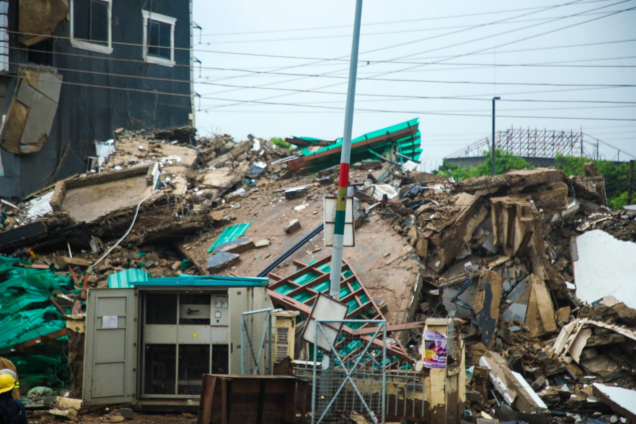

Preliminary investigations into recent building collapses in Adenta, Avenor, and Newtown have revealed a disturbing trend; weak foundations, substandard materials, and construction carried out without engineering approval.
An investigation conducted by the Ghana Institution of Engineering (GhIE), Institution of Engineering and Technology, Ghana (IET-Gh), and the Local Government Service Engineers Association (LoGSEA) have disclosed.
The investigation was carried out at three sites where buildings collapsed; Avenor on June 7, 2026, Adenta (June 5, 2026), Newtown (March 29, 2026), and other related sites.
Joshua Allotey, Chairman of the Structural Subdivision of the Ghana Institute of Engineering (GhIE), warns that these deficiencies pose grave risks to lives and property.
In 2026 alone, six lives have been lost, with several others injured and properties destroyed due to building collapse.
Investigations uncovered a consistent pattern of construction without proper design, supervision, certification, or valid permits.
In Adenta, foundations lacked adequate depth and in Avenor, shallow foundations were laid in a high-water-table area, using poor-quality materials.
“Allotey explained that projects often commenced without statutory approval, architectural drawings, structural designs, or valid building permits. In many cases, stop-work orders issued by metropolitan, municipal, and district assemblies were ignored. At one site, unauthorized vertical extensions added dangerous loads to structures never designed to carry them. Many collapsed buildings had no professional supervision,” the report states.
The conversion of residential homes into churches, schools, and warehouses was also flagged as a serious structural risk.
Contrary to public perception, Allotey insists the rainy season is not to blame. Instead, he points to weaknesses in state institutions and enforcement systems.
“A key challenge within the sector is the circumvention of regulatory processes by some developers. Enforcement remains weak, with insufficient inspection and delayed responses to violations, including breaches of stop-work orders. Both developers and authorities must fully discharge their obligations. Production in the informal sector remains largely unregulated,” he emphasized.
The Ghana Institute of Engineering is calling for urgent reforms to strengthen compliance and oversight:
- Enforcement of building regulations with stricter compliance measures.
- Regular structural assessments of aging and high-occupancy buildings.
- Oversight of building conversions and abandoned structures.
- Stage-by-stage inspection with continuous involvement of engineers and architects.
- Certification of artisans such as masons and steelbenders.
- Securing collapse sites by NADMO to preserve evidence and support material testing.
The Institute further proposed a national directive introducing a 6–12 month compliance window.
“During this period, owners of buildings two stories and above must submit architectural and structural drawings, assessment reports, analysis models, and retrofitting proposals — all certified by licensed professionals. Unsafe buildings should be restricted, partially closed, or evacuated until remediation is complete.”
GhIE highlights the urgent need to regulate block production in the informal sector, which continues to undermine construction quality nationwide.
Full report below
JOINT PRESS STATEMENT ON PRELIMINARY Final
By Beatrice Sowah