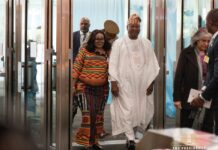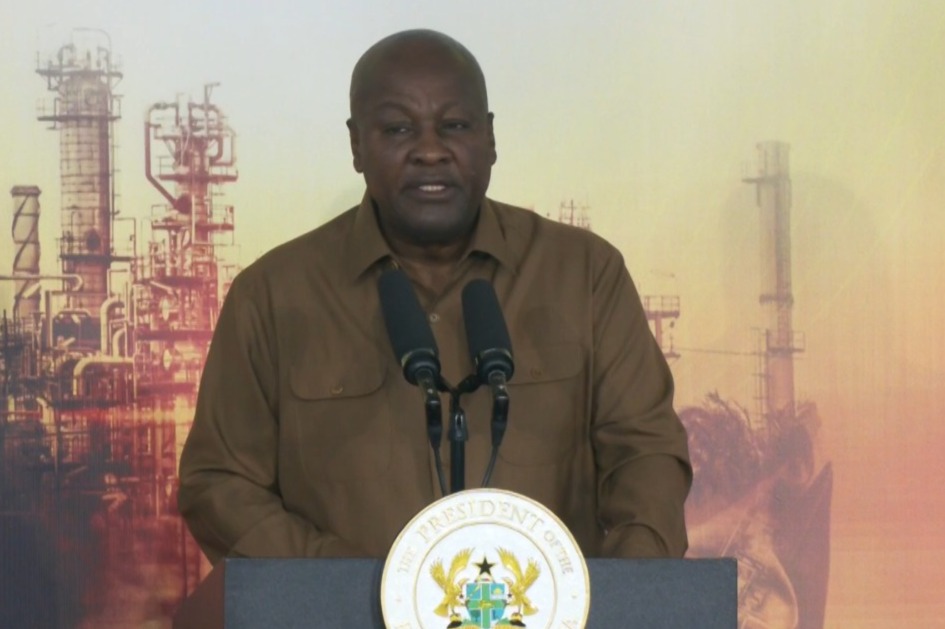

President John Mahama has cut the sod for Phase II of the Sentuo Oil Refinery project.
The event took place on the company’s premises on June 25.
Below is the full speech read by the President during the ceremony:
My friend, Chairman Xu Ningquan, His Excellency, the Ambassador of China to Ghana, our traditional leaders, staff of Sentuo Group, our clergy, and let me just say, distinguished ladies and gentlemen,
It’s a great pleasure and an honor for me to join you today for this important ceremony, marking breaking of ground for phase two of the Sentuo Oil Refinery Expansion Project.
I extend my warmest congratulations to the founder, management, staff, and partners of Sentuo Oil Refinery for their vision, their determination, and unwavering confidence in Ghana. At a time when our nation is pursuing a deliberate program of economic renewal and industrial transformation, this investment stands as a powerful vote of confidence in our future and in the vast opportunities that Ghana continues to offer.
The global energy landscape continues to face significant challenges. Geopolitical tensions, supply chain disruptions, fluctuating crude oil prices, and growing uncertainty in international markets have underscored the importance of energy security for every nation.
Against this backdrop, Sentuo Oil Refinery’s decision to expand its refining capacity by 60,000 barrels per day, which will raise the total capacity from 40,000 to 100,000 barrels per day is both bold and strategic.
This expansion is not merely an investment in infrastructure, it is an investment in Ghana’s future, it is an investment in our energy security, in our industrial growth, in our job creation and economic resilience.
By increasing domestic refining capacity, we reduce our dependence on imported refined petroleum products. We strengthen the reliability of our oil supply chains. We retain more value within our economy and create opportunities for Ghanaian businesses and Ghanaian workers.
More importantly, this project positions Ghana to meet growing domestic and regional energy demand while enhancing our competitiveness within the West African sub-region. This milestone comes at a particularly important moment in our national journey.
Over the past several months, Ghana’s economy has begun to turn around, macroeconomic stability is steadily being restored, investor confidence is returning and the foundations for sustainable growth are being strengthened.
Businesses are planning with renewed certainty and predictability, and investment is beginning to flow back into our productive sectors. International partners are once again looking to Ghana with optimism and confidence.
And so the expansion of central refinery is both a reflection of that renewed confidence and a contributor to its continued growth.
Ladies and gentlemen, investments in our upstream petroleum sector also reflect this new optimism. In the upstream industry, we’ve secured commitments totaling more than 3.5 billion US dollars. This includes approximately 2 billion dollars from the Jubilee and TEIN partners for drilling up to 20 new wells, as well as 1.5 billion from the OCTB partners to support additional field development and exploration activities.
And this is what the Minister for Energy was talking about. We’ve committed the upstream players to invest more money to drill new wells to raise the volumes of oil and gas that we’re producing.
We’ve also initiated the process for the commercialization of the Afina Discovery, approved strategic amendments to the OCTB plan of development to enhance production, and ratified a new petroleum agreement in the offshore Canal West Basin to support future reserve groups and long-term production.
These interventions are already yielding results. For the first time in several years, Ghana is poised to record an increase in crude oil production, reversing the decline that has characterized the sector for several years now.
Production from the Jubilee field has increased significantly, from approximately 60,000 barrels per day to about 85,000 barrels per day currently. The TEIN and Sankofa fields have also recorded measurable increases in output.
These gains demonstrate that through targeted investments, sound policy interventions, and effective collaboration between government and industry, we can revitalize the sector, sustain existing assets, and unlock new growth opportunities.
I’m also happy to report that ExplorCo, which is the operating arm of GNPC, is poised to begin onshore drilling in the Voltain Basin before the end of this year. And when I say onshore, it means on land.
So far, all our discoveries have been offshore- in the sea. We’ve discovered a lot of potential onshore, and so GNPC is going to, through ExplorCo, start drilling wells to explore that oil before the end of this year.
Ladies and gentlemen, our objective is clear. We’re building an energy sector that is productive, competitive, resilient, and globally relevant. That vision lies at the heart of what we have called the Accra Reset.
The reset is about repositioning Ghana from a nation that primarily exports raw materials to one that processes, manufactures, refines, and creates value within its own borders. It’s about ensuring that a greater share of the wealth generated from our natural resources remain in Ghana to create jobs, support businesses, build industries, and improve livelihoods.
Whether it is crude oil, it is gold, bauxite, lithium, cocoa, or any agricultural produce, the future belongs to nations that move beyond the export of raw materials and embrace value addition. The future belongs to nations that refine, manufacture, and export their finished products.
And this is why the expansion of Sentuo Refinery is so important. It represents precisely the kind of investment Ghana needs at this stage of our development. It strengthens our industrial base, it deepens our energy value chains, it creates employment opportunities, it supports local industries, and it advances our broader objective of transforming Ghana into a modern industrial economy.
The benefits extend far beyond the refinery itself. Every refinery creates a wider ecosystem of economic activity. It supports transportation and logistics companies, it creates opportunities for local contractors and manufacturers, it stimulates demand for engineering services, technical expertise, fabrication, maintenance, and professional services.
It generates opportunities across multiple sectors of the economy and creates a multiplier effect that benefit communities and businesses alike. For this reason, local participation must remain central to this project. Our local content agenda must be viewed not merely as a regulatory obligation, but also as a critical pillar of our national development strategy.
We expect meaningful participation by Ghanaian companies throughout the value chain. We expect deliberate investment in skills development. We expect strong partnerships with our universities, technical institutions, and training centers.
And we expect the transfer of technology and expertise that will enable future generations of Ghanaians to lead and innovate within the energy sector. Energy security remains fundamental to national development, and no nation can industrialize successfully without reliable, affordable, and sustainable energy.
The government therefore remains committed to supporting investments that expand domestic refining capacity, strengthens energy infrastructure, and improves the resilience of our energy system. In the downstream petroleum sector, we’ve pursued important reforms to improve efficiency, transparency, and sustainability.
The petroleum downstream sector has done its work and submitted recommendations which are now being implemented. At the same time, I’m pleased to report that the Tema Oil Refinery has completed its first major turnaround maintenance exercise in four years and has resumed crude oil processing.
Plants are also on the way to enhance its operational efficiency and increase its refining capacity. And my understanding is that in July, we will start refining crude oil again. Despite the geopolitical tensions and volatility that have characterized global energy markets, in recent years, Ghana has maintained stability in the supply of petroleum products.
The Ministry of Energy and Green Transition, working closely with the National Petroleum Authority, Bulk, industrial operators, and other stakeholders, has ensured that the maintenance of adequate strategic oil stocks and uninterrupted supply across the country continues.
And on this occasion, I want to thank Mr. Xu Ningquan for helping us maintain enough stocks for refining during the crisis. And like he said, we planned in order that we’ll be able to cushion Ghanaians.
And so the Minister of Energy asked him to order as much crude and stock it as possible. And so we had enough crude oil even throughout the two months of the crisis. The refineries never stopped working. Thank you very much, Chairman Xu Ningquan.
In that sense, with the recent decision to allocate one million barrels of crude oil from Jubilee Field for refining in Sentuo was deliberate and strategic. These decisions reflect a consistent policy direction and our firm belief that Ghana must increasingly process its own resources, support its own industries, and create value within our local economy.
I wish to assure all investors, industry players, and our development partners that government remains committed to this path. Our vision is straightforward, but ambitious. Ghana should not be known merely as a producer of crude oil.
Ghana should be recognized as a nation that refines, processes, and adds value to its resources, and also become a net exporter of petroleum products. A nation that transforms its natural wealth into broad-based prosperity for its people, that is a reputation we want to carve for our country.
And as President, I look forward to the day when Ghana achieves a high degree of self-sufficiency in the supply of refined petroleum products. And I look forward to the day when a revitalized oil refinery works alongside efficient private sector refineries, such as Sentuo, to meet domestic demand and serve other regional markets.
And this is what the Minister talked about. When Sentuo finishes phase two and our oil refinery is fully operational, we will have more than enough to feed local demand, and we shall export the rest to our neighboring countries.
That future will strengthen our currency. It will improve our balance of payments. It will deepen industrial capacity. It will create opportunities for thousands of young Ghanaians and it will firmly establish Ghana as a leading petroleum manufacturing and industrial hub in West Africa.
Let us therefore continue to build an economy that produces, innovates, and competes. Let us continue to build an energy sector that drives growth, investment, and prosperity. And let us continue to build a nation that creates opportunities for all its people.
Through the reset agenda, through industrialization, and through strategic investments such as this, we can transform our natural resources into lasting prosperity and secure a brighter future for generations yet unborn.
I congratulate Sentuo Oil Refinery on this significant milestone and wish the project every success.
I thank you for your kind attention and may God bless our homeland, Ghana.