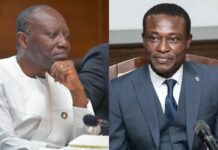

CEO of the National Petroleum Authority (NPA), Godwin Edudzi Tamekloe, has pointed out that Mr Ken Ofori-Atta is the only Finance Minister to have run away from accountability after serving since 1992.
He made the point that all the finance ministers had stayed in Ghana after leaving office to subject themselves to accountability with the exception of Ofori-Atta.
“Since 1992, Ofori-Atta has been the only finance minister to have left the country,” he said on the Key Points on TV3 Saturday, June 27.
Edudzi Tameklo further said the appointees of former President Nana Addo Dankwa Akufo-Addo carry themselves as though they are above the law.
He made the point that the previous appointees have the idea that they can get into office, dissipate the state resources and leave the country without subjecting themselves to accountability.
He further argued that the persons defending the decision of former Finance Minister Ken Ofori-Atta to leave Ghana without subjecting himself to accountability have no conscience.
“It’s not every problem you solve with legislation. People simply don’t have a conscience, otherwise Ken Ofori-Atta wouldn’t have behaved the way he has,” Edudzi, also a lawyer, said.
Prior to his comment, a private legal practitioner, Kofi Bentil, had said that it is important for all appointees to remain in Ghana after a government comes to an end.
He makes the point that this would make it easier for them to be held accountable for their actions when in office.
“As part of a code of conduct, I am proposing that future Presidents must ensure that all their appointees stay in the Country for at least one year after leaving office,” he said on the Key Points on TV3 Saturday, June 27.
“When a person is in power, it is difficult to deal with their infractions. It is only when they leave power that you can do that.
“As part of the asset decarartion, the people who handle our county must stay in the country after leaving office
“The president must make a requirement that all his appointees must stay in Ghana at least for one year to account for their stewardship. This should be added to the code of conduct.”
Also speaking on the same show, another lawyer, Martin Kpebu asked President John Dramani Mahama the whereabout of the asset declaration bill he promised in the state of the nation address is.
Kpebu argued that the constitution directs that before parliament debates the bill, it must first be published at the Assembly Press.
However, he said he has not been able to obtain a copy of the draft bill from the Assembly press.
He said, “Where are we on the new asset declaration law?
He said he had given the bill to parliament, but even if parliament gets to debate it, it must first be gazetted at the assembly press. I have been there several times, but can’t get it.
“The Bill he mentioned in SONA in February, we are interested in, and we are chasing the bill.
“Why are we interested in the bill? Are there provisions that say when a public officer declares his assets, those assets will be published online? Mr President, we need to see that Bill.”
Also speaking on the same show, another lawyer, Kofi Bentil, said that as part of the asset declaration, the president must issue a fiat that all his appointees should remain in Ghana for at least twelve months after he leaves office for them to account for their stewardship.
“When a person is in power, it is difficult to deal with their infractions. It is only when they leave power that you can do that.
“As part of the asset declaration, the people who handle our county must stay in the country after leaving office
“The president must make a requirement that all his appointees must stay in Ghana at least for one year to account for their stewardship. This should be added to the code of conduct.”
Their comments come at a time when the cabinet directed the Attorney-General and Minister of Justice, Dr Dominic Ayine, to draft a bill that will provide guidance on how to protect state assets.
This was disclosed by President John Dramani Mahama at the Civil Society Forum held at the University of Ghana on June 25.
The President said the draft bill will be submitted to Parliament accordingly.
“I’m happy to announce to you that yesterday, the Cabinet took a decision directing the Attorney-General to draft a bill for the protection of state assets. It’s called the State Assets Protection Bill,” he said.
According to President Mahama, the Bill “shows the guidelines under which any state assets can be disposed, including lands, buildings, state assets, factories, industries, so that no government just capriciously disposes of state assets.”
It is recalled that in January 2025, the President tasked the Lands Commission to stop the sale, lease and processing of transactions relating to state and public lands. The embargo was lifted in September 2025 after elaborate verification procedures were established.
The President also announced that Cabinet has approved a new National Ethics and Anti- corruption Action Plan to be rolled out from 2026 to 2030.
“And I wish to use this platform to restate my commitment to transparent and accountable governance. In my past presidency, I had the privilege of launching the 10-year National Anti-Corruption Action Plan in 2015. And I’m pleased to report to you that just yesterday, cabinets approved the new National Ethics and Anti-Corruption Action Plan for onward transmission to Parliament,” he revealed.
President Mahama said the approval of the plan is evidence of commitment by the Government to enhance transparency in governance as well as rebuild public trust.
The NEACAP 2026–2030 was developed through thorough stakeholder engagement across the country. It aims to tackle weaknesses associated with the previous strategy, which was implemented from 2015 to 2024.