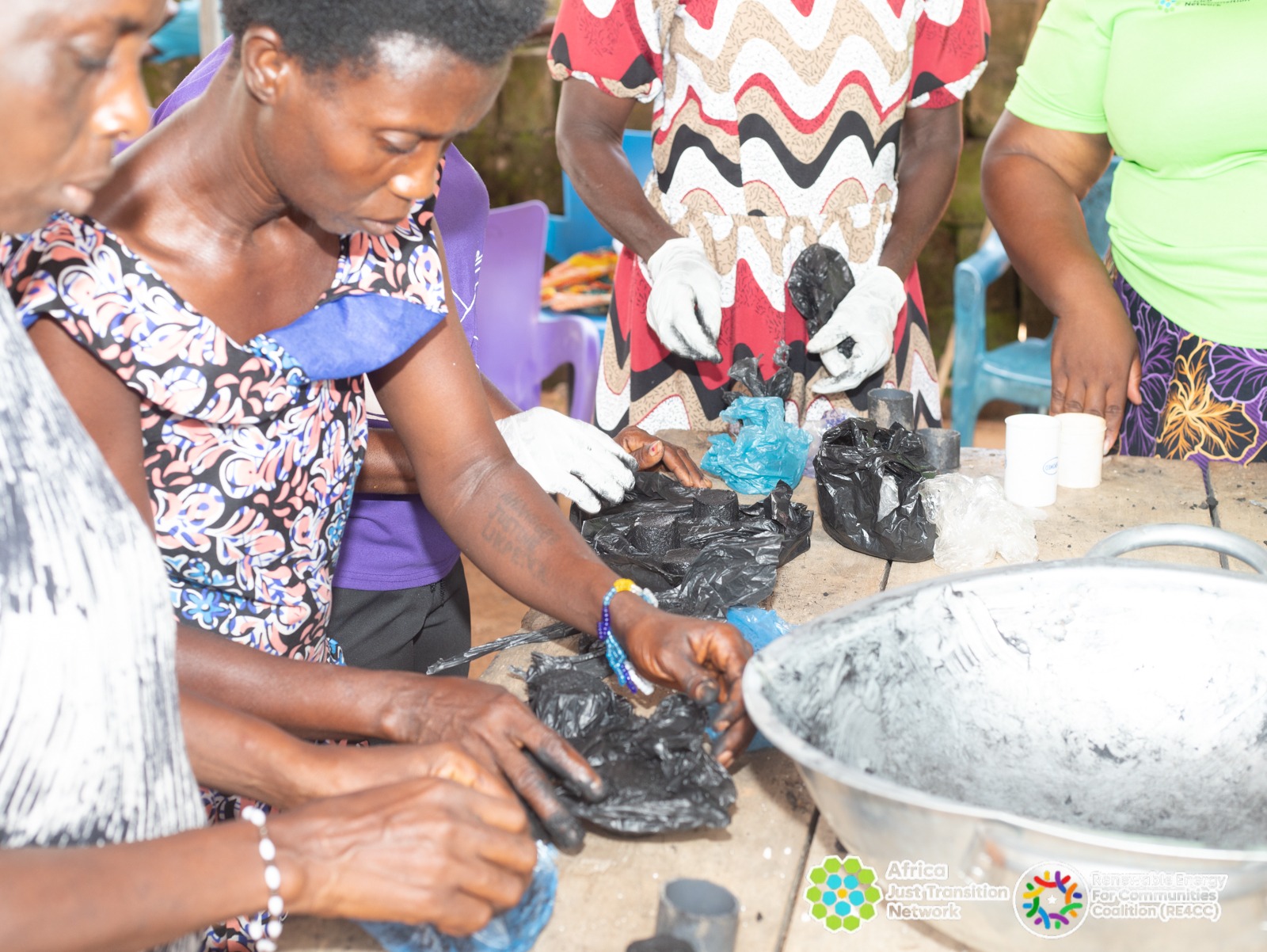

Women in Wusuta in the North Dayi District of the Volta Region have acquired practical green skills through a briquette production training programme aimed at promoting clean energy solutions, sustainable livelihoods, and climate action.
The training was organized by the Renewable Energy for Communities Coalition (RE4CC) in collaboration with the African Just Transition Network under the theme, “Empowering Women with Green Skills for a Stronger and Resilient Community.”
The initiative equipped participants with the knowledge and practical skills to produce environmentally friendly briquettes from coconut husks, an agricultural waste product commonly discarded in the community.
Through hands-on demonstrations, the women learned how to convert the waste into clean-burning fuel suitable for household cooking and other domestic energy needs.
Organizers said the programme forms part of broader efforts to promote renewable energy solutions while empowering women to become economically independent through green entrepreneurship.
Facilitators explained that coconut husk briquettes burn efficiently, produce less smoke, and provide a cleaner alternative to charcoal and firewood. They noted that the innovation has the potential to reduce deforestation, improve household health, and significantly lower carbon emissions.
Beyond its environmental benefits, the training highlighted the economic opportunities associated with briquette production. Participants were encouraged to establish small-scale businesses by producing and selling briquettes within their communities and neighboring markets, creating new sources of income while supporting Ghana’s transition to cleaner energy.
The programme also demonstrated how renewable energy initiatives can generate green jobs and strengthen community resilience against the growing impacts of climate change.
Participants expressed appreciation to the organizers for the practical training and pledged to share the knowledge with other women and young people in nearby communities to expand the adoption of clean cooking solutions.
According to the organizers, empowering women with climate-smart technologies is essential to achieving a just energy transition that leaves no one behind.
The Renewable Energy for Communities Coalition reaffirmed its commitment to supporting Ghana’s Nationally Determined Contributions (NDCs) by promoting renewable energy and reducing carbon emissions through community-based initiatives.
The Coalition further called on government, development partners, civil society organizations, and the private sector to intensify efforts to combat climate change by investing in and advocating for clean cooking solutions across Ghana and the African continent.
By Kingsley Adusei-Amakye