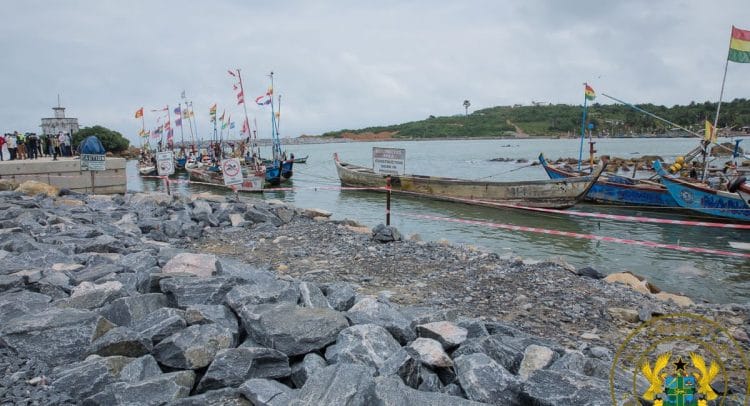

The chiefs and people of the Lower Dixcove Traditional Area have appealed to President John Dramani Mahama’s government to expedite work on the Dixcove Landing Beach, warning that its slow progress is depriving the fishing community of infrastructure needed to improve fish handling, sanitation, safety and economic activity.
Speaking on behalf of Owanwani Nana Kwesi Agyemang IX at a mini durbar at the Lower Dixcove palace as part of the 2026 Lower Dixcove Kundum Festival celebrations, Nana Mensah Kuma III, Gyasehene of the Lower Dixcove Traditional Area, said work on the project had progressed at a very slow pace.
“Work on the Dixcove Landing Beach has progressed at a very slow pace. We respectfully appeal to your government to expedite its completion,” he said.
He acknowledged the initiative to c onstruct landing beach facilities in Axim, Dixcove and Shama but expressed concern over the pace of work on the Dixcove facility and appealed to government to mobilise the contractor to ensure the project is completed without further delay.
A completed and fully operational landing beach, the traditional council said, would improve fish handling, enhance sanitation, support local businesses and create employment opportunities for residents.
The chief also raised concerns over the inadequate supply of premix fuel to fishermen in Dixcove, arguing that the current weekly allocation does not meet the needs of the large number of fishermen and canoe owners operating in the community.
“Considering the large number of fishermen and canoe owners operating in Dixcove, the present weekly allocation is insufficient,” the traditional council said.
He appealed for transparency, fairness and regularity in the distribution of premix fuel to ensure that fishermen receive their allocations without unnecessary challenges.
Beyond these concerns, the traditional council warned that destructive fishing practices could undermine the industry the community is seeking to protect. The chief condemned the use of chemicals, explosives, light fishing and unauthorised nets, warning that such practices were depleting fish stocks, destroying marine habitats and threatening the livelihoods of coastal families.
“We must all accept responsibility for protecting the sea,” the traditional council stressed, calling on fishermen, traditional authorities, government agencies, security services and civil society organisations to work together to end illegal and unsustainable fishing.
On the government’s Marine Protected Area initiative, the chief welcomed the move but urged authorities to engage fishing communities meaningfully before and during its implementation, saying the legitimate concerns and livelihoods of fishermen must be considered.
The traditional council acknowledged the government’s sea defence project, saying it had helped protect lives, homes and properties from the destructive impact of tidal waves.
It maintained that completing the Dixcove Landing Beach, increasing access to premix fuel and protecting the marine environment were critical to securing the future of fishing-dependent families in the community, and said they remained ready to collaborate with government and relevant stakeholders to protect Dixcove’s fishing industry.
By Portia Cudjoe