

The Association of Certified Driving Instructors of Ghana (ASSODRIVE) has expressed grave concern about the comments attributed to the Chief Executive Officer of the Driver and Vehicle Licensing Authority (DVLA), Julius Neequaye Kotey, on its operations.
The Association said on Sunday, August 16, 2026, Mr. Neequaye Kotey reportedly said that private driving schools are not training drivers to the Authority’s satisfaction, and that, this informed the establishment of a new skills development center.
In a press release signed by its National President, Inst. Marshall MK Bobobee, the Association of Certified Driving Instructors of Ghana said “It has now been over a week. If the CEO had been misquoted by the media, the ordinary and expected response would have been a swift, public correction. None has come”.
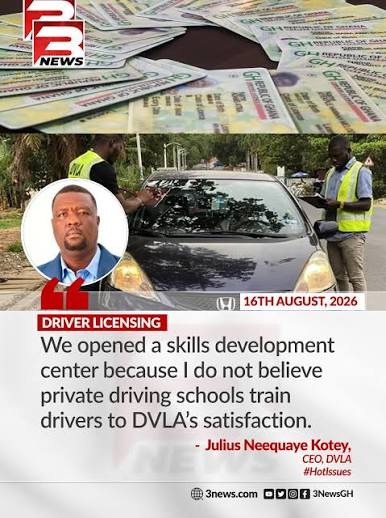
“His continued silence in the face of a publication that directly dents the professional image of certified driving instructors leaves us with no choice but to conclude that he meant exactly what was published, and to respond to it as such. We also find it troubling that, the Ghana National Association of Driving Schools (GHANADRIVE), which is the umbrella body of driving schools, has itself said nothing publicly for a week on a statement that questions the very quality of the training its member schools provide, the statement added.
It added that “Silence from an association whose members are directly accused is not neutrality; it invites the public to assume agreement”.
“ASSODRIVE calls on the DVLA CEO to either substantiate his comments with data or publicly correct the record, and on GHANADRIVE to break its silence and state its position,” the statement concluded.
Read below the full statement from GHANADRIVE: 1
PRESS STATEMENT
FOR IMMEDIATE RELEASE
RE: DVLA CEO’S COMMENTS ON DRIVER TRAINING STANDARDS — A QUESTION OF LAW, RESPONSIBILITY AND SILENCE
The Association of Certified Driving Instructors of Ghana (ASSODRIVE), the professional body for driver trainers in Ghana, notes with grave concern the comments attributed to the Chief Executive Officer of the Driver and Vehicle Licensing Authority (DVLA), Mr Julius Neequaye Kotey, on 16th August 2026, that private driving schools are not training drivers to the Authority’s satisfaction, and that, this informed the establishment of a new skills development center.
It has now been almost a week. If the CEO had been misquoted by the media, the ordinary and expected response would have been a swift, public correction. None has come. His continued silence in the face of a publication that directly dents the professional image of certified driving instructors leaves us with no choice but to conclude that he meant exactly what was published, and to respond to it as such. We also find it troubling that, the Ghana National Association of Driving Schools (GHANADRIVE), which is the umbrella body of driving schools, has itself said nothing publicly for a week on a statement that questions the very quality of the training its member schools provide. Silence from an association whose members are directly accused is not neutrality; it invites the public to assume agreement.
We ask both DVLA and GHANADRIVE to note the following facts and law.
1. DVLA, not driving schools or instructors, is responsible for licensing drivers in Ghana.
Under section 3(1)(d) of the Driver and Vehicle Licensing Authority Act, 1999 (Act 569), it is DVLA that issues driving licenses. Instructors teach; DVLA alone tests and certifies fitness to drive by issuing the license. If a licensed driver later proves unsatisfactory, that outcome passes through DVLA’s own testing and licensing gate under section 3(1)(d), a gate no driving school or instructor controls.
2. Standards, syllabi and certification are DVLA’s own instruments.
Section 3(1) of Act 569 mandates DVLA to establish standards and methods for the training and testing of driving instructors and drivers – section 3(1)(a), provide the syllabi for driver training and the training of instructors – section 3(1)(c), and license driving instructors – section 3(1)(f). Every ASSODRIVE member is a certified instructor trained and licensed by DVLA and NVTI, and bound by our Constitution to teach strictly within DVLA’s own syllabus. If graduates fall short, the fault traces back to the standards, syllabi and certification process that DVLA itself designs, issues and administers under sections 3(1)(a)–(c) and 26.
2
3. Section 3(1)(m) of Act 569 places supervisory responsibility squarely on DVLA.
The Authority is legally charged to “ensure strict compliance with this Act and the Regulations. So, a public verdict against instructors and schools, issued without prior engagement with us, reads more as an admission of DVLA’s own supervisory gap than a fair assessment of our professionalism.
4. The law requires collaboration, not unilateral pronouncements.
The Road Traffic (Amendment) Act, 2025 (Act 1153) repeatedly requires the Licensing Authority to “collaborate” with other bodies with relevant knowledge and expertise in road safety, when developing standards (amended sections 13, 15, 16 and 17 of Act 683). ASSODRIVE, as the certified instructors’ representative body, is precisely one of such stakeholders, and section 3(1)(l) of Act 569 requires DVLA to be advised on policy formulation by bodies such as ours. So, a parallel skills center and a public indictment of our profession, both announced without consulting us, depart from this statutory model.
A way forward proposal: a live, end-to-end digital licensing ecosystem.
Rather than trade blame, ASSODRIVE proposes that DVLA lead the development of a single national digital platform tracking every learner from first payment to license: online fee payment, booking of a licensed school and DVLA-certified instructor, logged training hours and lesson content, scheduling of the DVLA test, the identity of the testing officer, and the test outcome, all tied to one applicant record. Such a platform would give DVLA live, nationwide data to identify exactly where any training or testing gap truly lies, hold every actor, schools, instructors and DVLA’s own testing officers, individually accountable, and replace unverified public statements with evidence.
ASSODRIVE calls on the DVLA CEO to either substantiate his comments with data or publicly correct the record, and on GHANADRIVE to break its silence and state its position.
We remain, as always, ready to engage DVLA on curriculum review, refresher training, joint audits and the digital platform proposed above.
Inst. Marshall MK Bobobee
National President
Association of Certified Driving Instructors of Ghana (ASSODRIVE)
By Timothy Antwi-Otoo|3news.com|Ghana