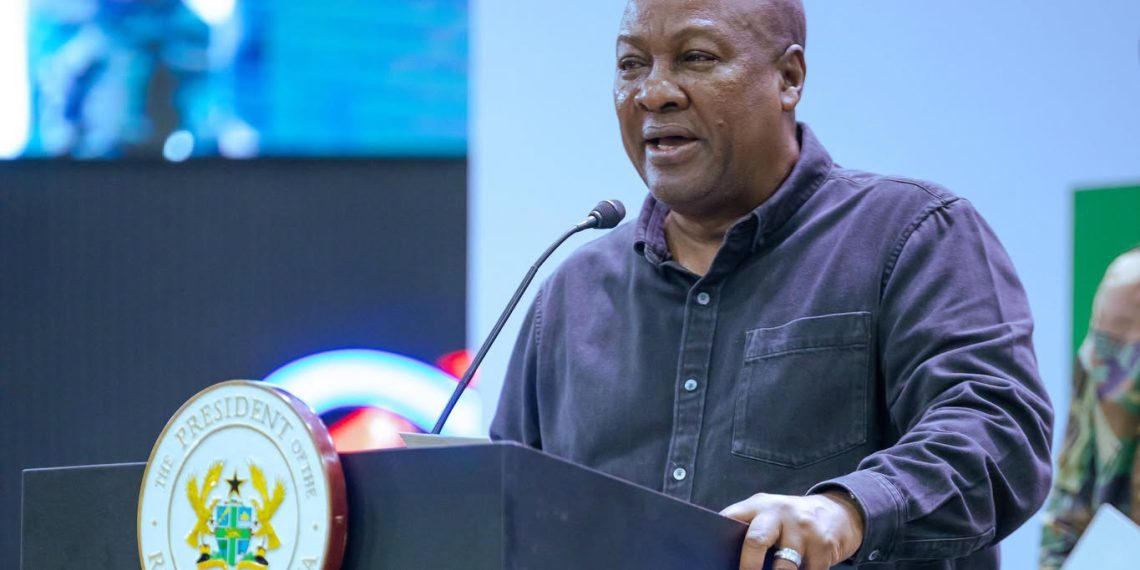

President John Dramani Mahama has expressed confidence in the revival of northern Ghana’s industrial sector, with textiles and garments taking centre stage, following the commissioning of Northshore Apparel Ghana in Savelugu, Northern Region.
Speaking at the opening ceremony, President Mahama described Northshore Apparel as the beginning of efforts to restore northern Ghana to its former industrial glory. He recalled that the region once had an integrated textile and agricultural value chain, with cotton farmers supplying raw materials to textile companies that processed them for the local market, alongside several processing plants producing goods such as shea butter that created employment for young people.
He said these industries gradually collapsed due to a combination of inadequate power supply, weak value chains and poor transport infrastructure.
“The glorious past of northern industry declined. Today I have a pleasant feeling in my heart because I believe that we’ve planted the first seed that will restore the north to its glorious industrial past, and that’s what Northshore is just about doing,” he said.
The newly commissioned factory has created 3,000 immediate jobs and is expected to employ up to 10,000 people once it reaches full operational capacity, according to the Chief Executive Officer of the Ghana Export-Import Bank (GEXIM), Sylvester Adinam Mensah, who disclosed the figures at the commissioning ceremony on Friday, August 28. GEXIM is the sole funding source of the factory.
“Phase One of this facility alone generates 3,000 immediate jobs upon commissioning. When the facility reaches full operational capacity, employment is projected to increase to 10,000 direct jobs,” Mensah said. “This is what transformative industrial investment looks like.”
He said Northshore Apparel had already trained more than 2,000 prospective operators, equipping them with market-ready skills for permanent employment at the factory.
The facility comprises 50 sewing lines, a 4,000-square-metre cutting and design centre, and 8,000 square metres of warehousing for raw materials and finished products. It also features a 500-kilowatt peak solar power system, an on-site clinic and crèche, disability-friendly washrooms, a biodigester for waste management, and a 600,000-litre underground mechanised water facility.
Mensah said the factory’s employment impact would extend beyond its production floor, generating business opportunities in transportation, food services, accommodation, maintenance, packaging and logistics.
“As the factory grows, it will create direct employment on the production floor and generate additional opportunities in transportation, food services and other vending activities, accommodation, maintenance, packaging, logistics and other supporting activities,” he said.
He added that wages earned by workers would support households, finance children’s education, improve access to healthcare and strengthen local businesses.
“Every young person trained and employed here represents a life given a new stream of life, a new direction,” he said. “That worker earns an income, supports a family and contributes to the local economy. The worker also pays taxes, contributes to social security and helps produce garments that can earn foreign exchange for Ghana.”
GEXIM partnered with the Investing for Employment facility of Germany’s KfW Development Bank, alongside the project’s promoters, to finance and operationalise the factory. Mensah said the investment reflected GEXIM’s mandate to support Ghanaian enterprises capable of expanding productive capacity, adding value, generating employment and competing in international markets.