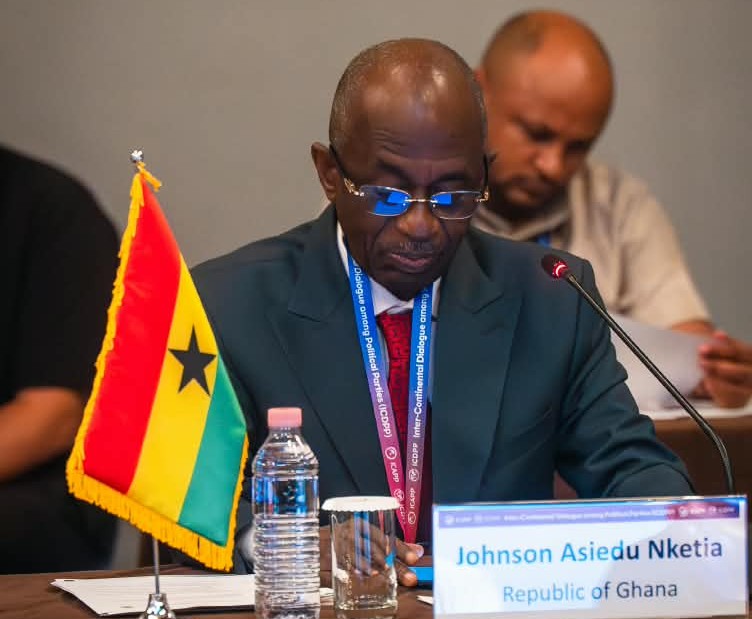

The National Chairman of the National Democratic Congress (NDC), Johnson Asiedu Nketiah, has urged leaders of African political parties to take succession planning seriously.
He said it is not good for political parties to be built around individuals.
“Leadership succession also tells us a great deal about institutional strength. A political organisation that becomes anxious whenever leadership changes has probably invested too little in building itself beyond individuals,” he said in his remarks at Inter-Continental Dialogue among Political Parties held in Korea on September 7.
“The durability of a political party is ultimately found in its capacity to produce leadership beyond the generation that currently controls it. Political history and electoral success matter, but neither can compensate indefinitely for weak institutions,” he stressed.
PLEASE READ THE FULL SPEECH BELOW:
CONGRATULATORY REMARKS BY HON. JOHNSON ASIEDU NKETIAH
National Chairman, National Democratic Congress of Ghana Speaking on behalf of the participating political parties of the African Political Parties Initiative Inaugural Meeting of the Inter-Continental Dialogue among Political Parties Seoul, Republic of Korea | 7 September 2026
Excellencies, distinguished leaders of political parties, colleagues, ladies and gentlemen, I am pleased to join you for this inaugural meeting of the Inter-Continental Dialogue among Political Parties and to speak on behalf of the political parties participating in the African Political Parties Initiative.
I also speak as National Chairman of the National Democratic Congress of Ghana, one of the parties that has participated in APPI from its inception. I commend the International Conference of Asian Political Parties, the Permanent Conference of Political Parties of Latin America and the Caribbean (COPPPAL), and the Africa Governance Centre for bringing this Dialogue into being.
I wish particularly to acknowledge the Africa Governance Centre for establishing APPI and for the sustained work that has gone into developing it into an institutional platform through which African political parties can engage one another and build relationships with parties in other regions.
What we are inaugurating is important because political parties exercise enormous influence over the direction of our countries, yet they seldom have structured opportunities to compare their experiences across continents and reflect seriously on the institutions they themselves have become.
I have spent a large part of my adult life in party politics — at the grassroots, in Parliament, in government, as General Secretary of my party and now as its National Chairman. One lesson from that experience is that the quality of government is often determined much earlier than we imagine.
Long before people enter ministerial office or take seats in parliament, political parties have already decided who receives opportunity, which qualities are rewarded, what standards of conduct are accepted and how seriously ideas and policy are treated.
We spend considerable time discussing the institutions of government, and rightly so, but the people who eventually lead those institutions are very often produced by political parties. A country therefore pays a heavy price when its political parties become highly effective at winning elections but insufficiently serious about preparing people to govern.
Weaknesses in party organisation have a way of appearing later in public administration, political leadership and the quality of decision-making. Winning an election can sometimes disguise those weaknesses. Government tends to reveal them.
A party that begins serious policy preparation after taking office has prepared itself for an election rather than for government. A party that has not developed enough people capable of assuming responsibility eventually discovers the limits of relying on a small circle of familiar personalities.
Leadership succession also tells us a great deal about institutional strength. A political organisation that becomes anxious whenever leadership changes has probably invested too little in building itself beyond individuals.
The durability of a political party is ultimately found in its capacity to produce leadership beyond the generation that currently controls it. Political history and electoral success matter, but neither can compensate indefinitely for weak institutions.
This question is becoming more pressing because the relationship between citizens and political parties is changing. Established loyalties are becoming less predictable, younger citizens are more questioning of political authority, and people increasingly expect political organisations to explain what they stand for beyond the immediate contest for office.
No political party can assume that the support earned by one generation will automatically be transferred to the next. Political relevance has to be renewed; it cannot simply be inherited. Parties therefore have to remain places where leadership is formed, policy is taken seriously, new ideas can enter the political system and people of ability can find a meaningful path into public life.
There is another practical lesson from political experience. Parties must be capable of functioning both in government and in opposition. Electoral fortunes change. Parties that have governed for many years can lose, and opposition parties can suddenly find themselves carrying responsibilities they previously criticised from outside government.
Both experiences require institutional maturity. A serious party should understand opposition as a period in which it continues to develop policy, leadership and organisational capacity, rather than simply waiting for the governing party to fail.
Governing parties, for their part, must remain connected to the constituencies and communities whose confidence brought them into office. Elections can bring a party into government; only performance, organisation and continuing public confidence can sustain its political relevance.
This is where the Inter-Continental Dialogue can make a genuine contribution. There is limited value in political parties gathering merely to exchange formal statements about their achievements.
We have more to learn when we discuss the realities political organisations actually face: how parties renew leadership, how they rebuild after electoral defeat, how they maintain internal cohesion, how they develop serious policy capacity, how they remain connected to citizens after entering government, and how long-established organisations adapt when the political environment changes around them.
Every political tradition represented in this Dialogue has experienced success and failure. Both are useful sources of knowledge. Political institutions learn very little when they study only their victories. Our different histories make this exchange more useful, not less.
Political parties represented through this Dialogue have operated under very different constitutional arrangements, economic conditions and political cultures. Some have long traditions in government; others have experienced repeated transitions between government and opposition.
Some have played central roles in national liberation or democratic transition; others have emerged from newer social and political movements. The purpose of bringing these experiences together is to understand how political organisations in different settings have confronted similar problems and to allow each party to draw lessons appropriate to its own circumstances.
I would therefore hope that this Dialogue develops into a working relationship among political parties rather than simply a succession of meetings. The real value will lie in whether our parties begin to know one another better, whether party institutions can exchange experience directly, whether emerging political leaders gain exposure to political traditions outside their own countries, and whether the relationships established through this platform continue as the Dialogue moves from one host country to another.
Each meeting should add something to the relationship, deepen the discussion and create greater confidence among the institutions involved. That continuity is important. Political leaders change, governments change and parties themselves evolve.
An inter-continental platform becomes significant when the relationship is strong enough to survive those changes. Progress will be seen in whether, over time, parties continue contributing their experience, listening to others and developing areas of practical cooperation.
On behalf of the political parties participating in the African Political Parties Initiative, I congratulate everyone whose work has made this inaugural meeting possible. We come into this relationship with experiences worth sharing, but also with the recognition that no political institution has completed the work of renewing itself.
Political parties spend much of their existence seeking the confidence of citizens. Maintaining that confidence requires us to keep asking whether our organisations remain equal to the societies we hope to lead. Political victories come and go.
The lasting contribution of a political party is the quality of leadership, institutions and political culture it leaves behind. I believe that is a conversation worth having across continents, and I hope this inaugural meeting establishes the foundation for many years of serious political exchange. I wish the Inter-Continental Dialogue among Political Parties every success. Thank you.