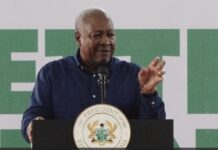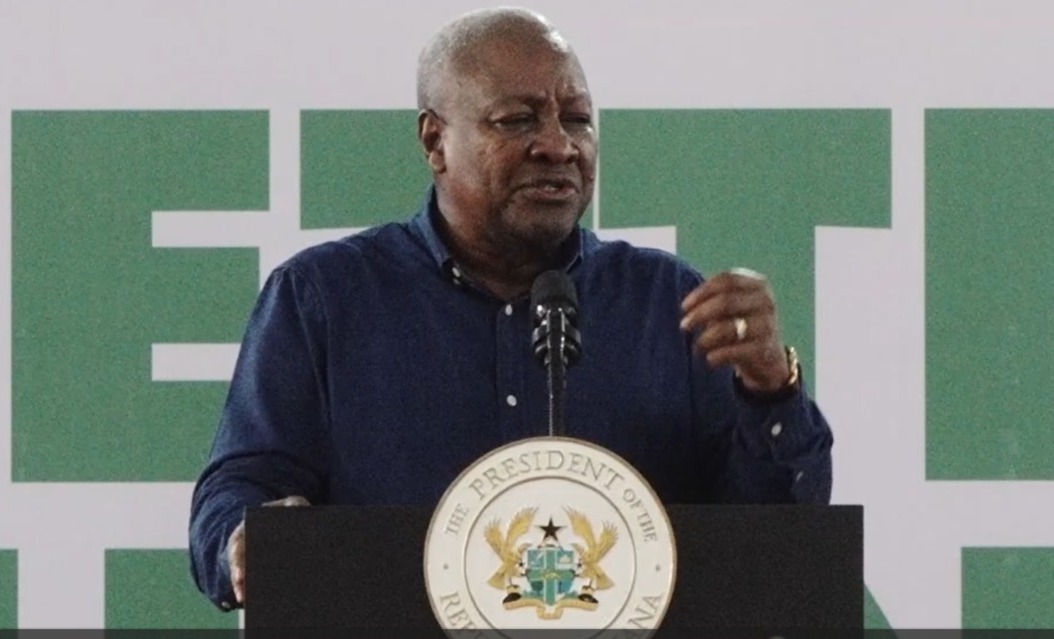

President John Mahama on September 12 addressed a town hall meeting in Wa.
In his remarks before opening the floor for questioning, the President touched on a wide range of issues. From, free SHS through Constitution review and current state of the economy, the President also mentioned interventions in the health sector as well as the disbursement of the District Assembly Common Fund.
Please read on:
My brothers and sisters, let me welcome you to this townhall meeting as part of our resetting Ghana tour.
When we were campaigning during the 2024 election, one of the promises I made was that I was going to run an accountable government.
An accountable government means that the people should be able to interrogate you and find out about important issues that have to do with their lives. And so we started this resetting Ghana tour and so far we visited 11 regions.
This one has been structured in such a way that we can have a little more time for interaction, otherwise several other people would have spoken before me.
So, I’ll just say a few words to top up what the Minister of Roads said and after that I’ll touch on a few key sectors where the ministers are currently not available so that after that we’ll open the Q&A session.
With regards to the road network, the big push, is actually titled the big push for infrastructural development.
The World Bank estimated that Ghana has a deficit of 1.5 billion in investment in infrastructure every year. 1.5 billion deficit in infrastructure every year. And so, we decided to go ahead of this deficit and so if you remember in the manifesto, we said the big push is a five-year program and it is going to invest two billion dollars every year in infrastructure.
Now these investments are supposed to go into different sectors, agriculture, education, health, tourism and all the other sectors. But unfortunately, when we came into office, we realized that the biggest need in infrastructure was the road network. Everybody was complaining.
There was no chief whose palace I went to, during the campaign, all the traditional areas in this country. There’s no chief whose palace I went to who the first thing they complain about is the road. And it was quite embarrassing because you get there and all he needs to ask you is, did you see the road you drove on to come to this palace? And so we realized that look we must get a handle on development and infrastructure.
Let’s start with the road network because it said that one of the catalysts of development for any country is for goods and people and goods to be able to move freely across a nation. America became great because of the highways first and then because of the railways that connected the east coast and the west coast of America. That is what catapulted America’s development.
So we said okay let’s start with the road network. Now if you start with the road network, where are you going to start? Are you going to start from say, let me be careful whose village I use. Sabuli.
Are you going to start from Sabuli to start building the roads? You have to do the major trunk roads first. And so Hamile all the way to Kumasi must be a good road. And if you do Hamile all the way to Kumasi, imagine the number of districts that road passes through and the number of people who will benefit from that road.
Then you look and say oh the eastern corridor, from south to north, there are 26 districts along the eastern corridor. And so, you start with the trunk roads and when the trunk roads are in good condition then now you can go to Sabuli and link Sabuli to the main road. You can go to Doremon and link Doremon to Wa and the main road.
So for those who have not had their road work done yet, this is only phase one. Like the minister said, we have phase two. After we have stabilized the trunk roads, we will come to the feeder roads that go into the constituencies and all that.
But we haven’t ruled out working in the feeder roads. For some of them that are very critical, the minister has onboarded them and is doing something about them. And so I can assure you most of these projects are supposed to be finished by 2027, end of 2027.
I can assure you that by end of 2027 a lot of the complaints we hear about our roads will abate because people will see the progress of work that has been done. Upper West, as he said, is getting its fair share. And like he said, somebody said the Bolga to Wa road can never ever be done.
It was not meant to be done. God decreed that that road should never be done because every government comes in, gives it on contract, and then as soon as the government leaves power, the road comes to a standstill. Another government comes, gives it on contract.
But this time I’m certain that with the kind of work that is going on and the correction of the mistakes that we did in the past. That road will be completed in the shortest possible time. This time we’ve not given it to one contractor.
We have divided it into lots and given it to several contractors. I think there are about six contractors working on that road. And so if you give to one contractor, he will go and start from Chichuliga and becoming like a tortoise.
He will never get to Wa before the government’s life ends. But this time, six contractors, everybody working on a certain number of kilometers. So you can see that the road work is going much faster.
The important road to the people of Wa is the one that comes from the south to Sola Wa, Wenchi, Sola. And they’ve been concerned about the slow pace of work. The minister himself was on the road last week and he gave warning to three of the contractors.
And he has given notice that he would terminate, reduce the size of their contract and put more active contractors on it. And so I’m sure that you see a speed up in the road work. Aside from that, the one working on Sawla to Wa, you can see that he’s done good work from Sawla to Jirapa.
But from there, the road still needs work. So, we’re asking him to put a new gang to start working from Wa to meet those coming from Sawla. So that the work will go faster and we’ll be able to finish the road in good time.
We were in Honorable Toobu’s constituency, and he took very serious advantage of it. And so, the Wa-Doremon-Wichauga road, he managed to get the road minister to go and look at it. And he has ordered his engineers to go there tomorrow.
So I think that that road will also be taken care of. But let me talk also about what we did yesterday. We went and launched the free primary health care at Fian.
And that’s a very important initiative and I want all Ghanaians to take advantage of it. From health kiosks to CHPS compounds, to polyclinics, to health centers. Any Ghanaian who goes there for treatment or diagnosis, you don’t need an ID card and you don’t need to pay any money.
It’s free of charge. So if you are going to your local CHPS compound or to a health center or to a polyclinic, you don’t need to go with your NHIS card. It’s not needed there.
That level of treatment is free. The medicine you get is free. You only need the NHIS card from the district hospital.
So if you decide to go to the Upper West Regional Hospital, you need your NHIS card. Why we did this was, when we came, just about 60% of Ghanaians had NHIS cards. It meant that almost 40% did not have access to health care because they didn’t have NHIS card.
Now every country needs universal health coverage. It means that all your citizens must have access to health care. As the saying goes in English, health is wealth.
Indeed, your health is your most precious treasure. Precious possession. And every day you go to sleep and wake up, you must thank God for giving you good health.
It’s your most precious possession. They say we go to sleep on our own will, but we wake up by the grace of God. It’s God who wakes you up.
You might go to sleep and if God doesn’t wake you up, you find that you reached, you arrived in heaven while you were asleep. And so we believe that a healthy, healthy people make a healthy nation. And so to cover the remaining 40%, in actual fact, we have increased the NHIS subscribers currently to 76%.
So it means that 76% of Ghanaians have access to NHIS. So what of the remaining 24%? We have to find a way of covering them. And so that’s why we introduced the free primary health care.
It covers all minor illnesses, malaria, typhoid, diarrheal diseases, treatment of wounds, and all that kind of thing. You know, migraines and all that. It also covers antenatal and postnatal.
And so for all our pregnant women in the village, it’s free of charge. You go to the health kiosk or to the CHIPS compound. We are giving the health workers in this CHIPS compound ultrasound scans.
And so they can look at your stomach and see how the child is developing. They can listen to the child’s heartbeat and all that. They’ll take your blood pressure and make sure your blood pressure is okay.
They’ll test your blood sugar, make sure everything is okay with the mother, because you need a healthy mother to deliver a healthy child. And so you can do your antenatal at the free primary health care level. You don’t need to come all the way from Tsanguli to Wa to come and do your antenatal.
Just go to your CHIPS compound. They’ll do it there for you and you’ll be okay. Then when you had your child successfully, they also do postnatal.
So you go, they’ll monitor you, they’ll monitor the child, they’ll weigh the child, make sure the child is growing properly and all that. So all that is part of the free primary health care. But when they find a case that goes beyond their ability to treat, that is when you need your NHIS card, because then they’ll refer you to the district hospital or to the regional hospital.
And when you come there, you need your NHIS card. But that is not all. We realize also that beyond free primary health care, beyond NHIS, there are some sicknesses that are not covered by NHIS and are very expensive to treat.
For instance, cancers. People who get cancers, heart attacks, strokes, diabetes, kidney failure, all those diseases. Kidney failure, you need to do dialysis, sometimes twice a week.
And twice a week you have to pay for every dialysis session. And so a lot of people were dying because they could not afford treatment. So at that level, we also introduced the Ghana Medical Trust Fund, which covers that level of care.
I told a story yesterday of a poor teacher. His son was diagnosed of triple hole in heart. Most cases, if you hear hole in heart, it’s just one hole in the heart.
This child had three holes in the heart. Triple hole in heart. And so they took the child to the regional hospital.
The cardiologist looked at it. They examined the child. They referred them to Korle Bu Teaching Hospital.
So, when they came, they did the examination and they said the teacher should go and bring GHC154,000. Now the teacher earns GHC5,000 a month. So how many months’ salary will he save at 5,000 a month to be able to get GHC154,000, to go and pay for his child’s surgery? Luckily, somebody mentioned to them that, oh, why don’t you try the Ghana Medical Trust Fund? So he was guided.
He registered his son. They sent the diagnosis, everything. And the Ghana Medical Trust Fund onboarded the child onto their program and paid the total cost of the surgery.
And I’m happy to announce that the surgery was done successfully. And the little boy, five-year-old, is playing football now. So these are about people’s lives.
These are some of the little things that government can do to protect and help its citizens. With regards to education, there are many challenges in the education sector. And so we moved to solve a lot of them.
One was that the Free Senior High School was introduced, but no arrangement was made for dedicated funding for the Free Senior High School. So it meant that every year, budgetary provision had to be made. And you know what happens with budgetary provision.
The releases delay in coming. And so we had a situation where the headmasters will always complain, and it takes time before the releases go. Apart from that, the feeding of the children became a problem because the headmasters will complain there’s no food.
The food has to come from buffer stock before the children will eat. Headmasters have to go and credit Gari, or sometimes they’ll send maize and they’ll do it into TZ (Tuo Zafi) flour. So, if it’s only the maize that has come, they’ll eat cocoa in the morning, they’ll eat TZ in the afternoon, they’ll eat banku in the evening.
The next day they’ll eat kenkey. The following day, everything to do with corn, they’ll keep eating until rice comes. Then rice, they’ll start eating rice water.
They’ll eat rice in the morning, they’ll eat rice balls in the evening, and they’ll keep eating it until some other food comes. Today, we have resolved many of those problems. We have dedicated funding for senior secondary schools.
And so you hear very little noise from the headmasters. And then the food has also improved because we have dedicated funding for paying for the feeding of the children. The only other issue with the free SHS is the double track.
There are still a few schools that are practicing double track. And so we have worked with the World Bank. We have a $300 million facility coming.
It is to end double track by the end of 2027. And so by end of 2027, no school in this country will be practicing double track. All the children will go to school at the same time, vacate at the same time.
This will improve the contact hours with the teachers so that the children can do much better. The children’s results for WASSCE have just been released. And there are all kinds of talks about whether the education system is deteriorating or is improving and all that.
I don’t want to go into that detail. I’m sure that the figures are there. Anybody can take a look at it.
I mean, in several of the areas, mathematics, social sciences and others, there was an improvement in the performance. We just asked them to interrogate social studies. You know why there was a slight decline in social studies.
But one thing that I’m happy and proud of is that we’re seeing our children’s true results. We are seeing our children’s true results. That time when connivance took place between headteachers and other officials to cheat the system, give support to our young people to go and write exams, they will write the exams and somebody will say, you see A, A, A, A. And then he goes to university.
They give him mathematics. He can’t work algebraic fractions. He has never heard of trigonometry.
He doesn’t know what an isosceles triangle is. And so today we’re seeing the real results of our children because invigilation has improved and the mass cheating in exams, you know, has been curtailed. I mean, before the children felt a sense of entitlement.
And so if there was a teacher who prevented them from teaching, they go and beat the teacher up. That won’t happen now. The children must learn.
The teachers must teach them. And when they write the exam, they must write it because they have learned it in school. And so, we’re seeing the true results of our children now.
I’ll just touch on two more things. The District Assembly’s Common Fund, the DCEs are all happy because they are receiving their monies on time. As the minister said, we’ve paid up to second quarter.
We’re just in the third quarter. So the third quarter is not due yet. But you can see the advantages of decentralization.
If you send the money to the districts, the districts have their own development challenges and they know what they want to use the money for. And so that time when the money is to be kept in Accra, the DCE will be sitting here in Wa and then a contractor will come and they come and greet you. DCE, how are you? Something development authority said I should come and build a toilet here.
And the DCE says we don’t need a toilet there. Who says you can’t build a toilet there? What we rather need is to fix the feeder road between this place and that place. Those days are gone and they are gone for good.
You receive your money and you decide what you want to use the money for. For now, we’re giving you guidelines because we want to increase the stock of certain infrastructure. And so we say every year build two CHIPS compounds, every year build two dormitory classroom blocks.
And so every 261 districts are all building two CHIPS compounds every year. You can bet that within four years, a number of CHIPS compounds will have across the country will help to improve the health needs of our people. If every district assembly is building two classroom blocks in four years, you can imagine the number of schools and the trees we would remove.
And so let me commend all the District Chief Executives and their members of parliament. You are the drivers of decentralization and you work closely with the grassroots. And so you must continue the good work you’re doing.
With regards to the economy, the economy is doing well. In the past, Ghana’s economy used to stand on broomsticks. As soon as something happens in the world, it comes crashing down.
Today, Ghana’s economy is standing on concrete pillars. So even when there’s an earthquake, the country is still standing. In the past, this Iran-Israel-U.S. war, if that happened some years back, by now, the economy would have come crashing down. But happily, it’s been well managed. We would have made more progress this year than even last year.
I’m sure the growth would have hit 7 percent. But of course, we live in this world and we can’t help but be affected. So the economy is solid, but the kind of how fast we wanted to move has been slowed down a bit because of what is happening in the external economy.
There’s going to be the new budget in 2027. And the budget hearings have currently started. And I’m sure that we’ll capture as many of the essential things that we need to capture as possible.
Under governance, we formed the Constitutional Review Implementation Committee. And so, they’re going to start the process of implementing the recommendations that were made by the Constitutional Review Committee. The Constitutional Review Committee finished its work and submitted a report to me.
And then we studied it and we came out with what we call the government position paper. So now the government position paper and the recommendation of the Constitutional Review Committee have both been given to the Constitutional Review Implementation Committee. So now they are responsible for implementing.
It will involve amendments to our constitution. There are two types of amendments. We have non-entrenched clauses and we have entrenched clauses.
Non-entrenched clauses are easy to amend. You just need a parliamentary majority to amend them. So they are going to isolate the non-entrenched clauses and they will take them to Parliament for amendment.
And once they amend it, they become effective. The entrenched clauses are more difficult to deal with. And those ones, you not only have to send to Parliament for approval, but after that, you have to give it to the Electoral Commission.
And the Electoral Commission must hold a referendum. If you remember when we had to increase the number of regions, the issue about creation of regions is an entrenched clause. So, if you remember, we had to hold a referendum to say yes or no to the new regions.
It’s the same with this one. The entrenched clauses have to be submitted to a referendum. In the referendum, not less than 40 percent of registered voters must come out and vote.
And out of the 40 percent, 75 percent of them must say yes. And so our constitution drafters did it such that for any amendments to the constitution, we need to work for bipartisan consensus. Because if you want 75 percent of the electorates, then you need bipartisan consensus to be able to achieve it.
So with the non-entrenched clauses, they’ll be passed first. But with the entrenched clauses, they’ll have to be passed next year. Because the intention is to combine them with the district assembly’s election so that they are done.
And aside from that, I think I don’t want to read a new state of the nation address. Next February, I’ll have that opportunity. So let me leave it here, and then we can move to the interactive session.
Thank you very much.