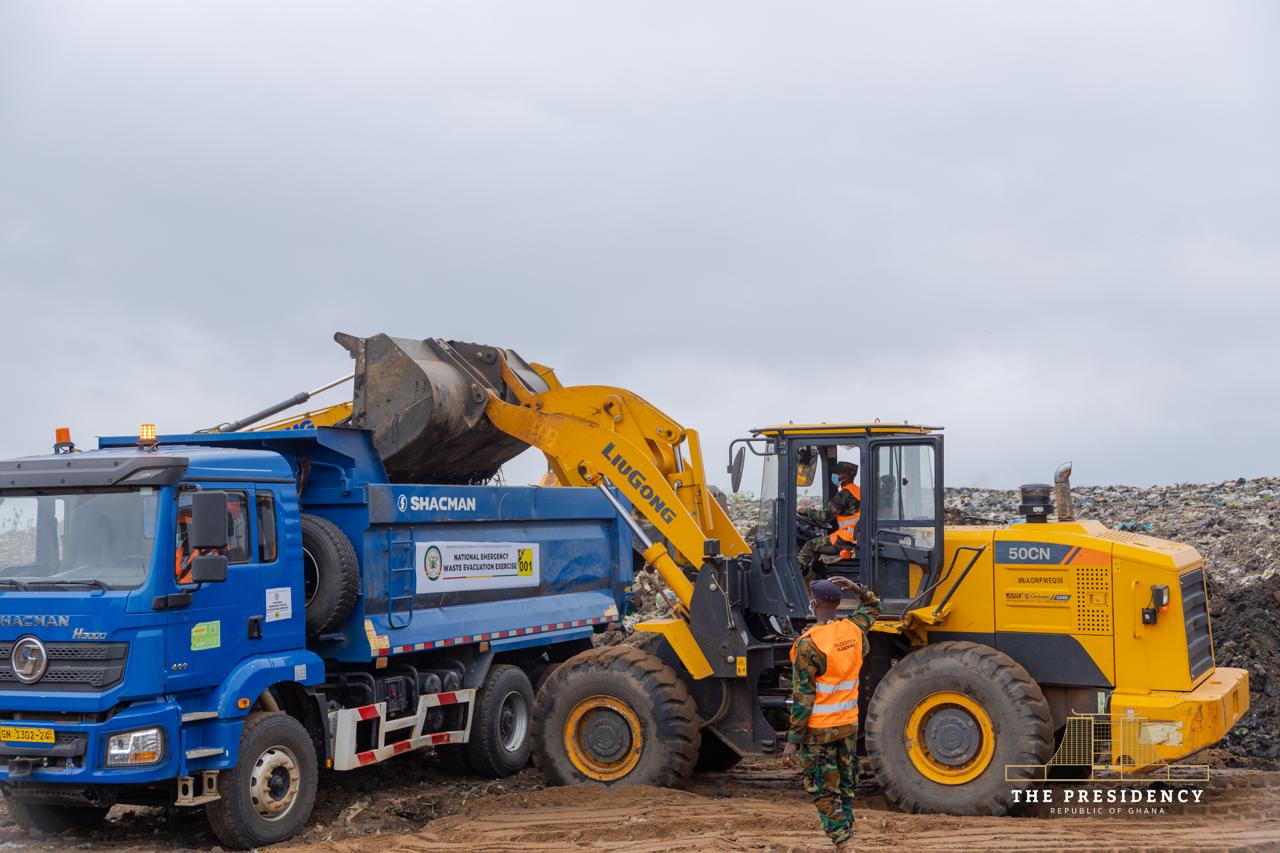
President John Dramani Mahama has commissioned the evacuation of waste heaps from Agbogbloshie in Accra to the Adepa Engineered Landfill Site near Nsawam in the Eastern Region.
The exercise, which is expected to remove an estimated one million tonnes of waste, is being undertaken by the Ministry of Local Government, Chieftaincy and Religious Affairs in collaboration with the Ghana Armed Forces and the District Road Improvement Project (DRIP).
The initiative is being funded by the Ministry of Finance, with additional support from the District Assemblies Common Fund.
According to a drone-based AI assessment of the waste, the volume accumulated at the site is estimated at about one million tonnes.
The entire evacuation operation is expected to be completed within 90 days.
Speaking at the commissioning ceremony on Friday, September 18, President Mahama said the exercise formed part of efforts to restore order, improve sanitation and reclaim the area for the people who live and work there.
He identified three key reasons why the exercise was significant, including the deployment of Ghana’s own capacity, inter-agency collaboration and the government’s broader plans to transform the area.
President Mahama said the government was deploying heavy equipment acquired under DRIP to tackle the longstanding sanitation challenge.
The equipment includes tipper trucks, excavators, bulldozers and wheel loaders, which will be used to excavate, load and transport the waste to the engineered landfill.
“We are putting our own capacity to work,” he said.
The President also highlighted the collaboration among government institutions in executing the project.
The Ministry of Local Government, Chieftaincy and Religious Affairs is leading the exercise, while the Ghana Armed Forces, particularly the 48 Engineers Regiment, is providing operational and engineering support.
President Mahama said the regiment’s previous work in clearing the Accra-Kumasi Expressway demonstrated its capacity to support major national operations.
“We are now mobilising them to clear Agbogbloshie; after that, I have a lot of work for them. They have more tasks. Soldiers are not only going to go to war. They are going to be used for emergency operations,” he stated.
President Mahama said the waste evacuation was also part of a broader plan to transform the Agbogbloshie area.
He said clearing the site would remove a longstanding public health hazard and create the conditions for the proposed Agbogbloshie Urban Renewal Project.
“When we have cleared this garbage, the land that will be reclaimed and recovered is going to be an Industrial Park. We intend to establish a major textile factory here so that they can provide employment to our young people,” he said.
The President said the exercise would bring an end to open dumping and burning in the area, which he said had endangered lives and affected the surrounding environment.
President Mahama said the evacuated waste would be transported to the Adepa Engineered Landfill for controlled disposal, compaction and covering under appropriate environmental safeguards.
He stressed that every stage of the operation—from excavation and loading to transportation and final disposal—must be handled responsibly.
“We must protect the waste, the residents, road users, and the communities along the haulage routes,” he said.
To minimise disruption and facilitate the movement of large volumes of waste, the President said major haulage operations would take place at night as part of the government’s 24-Hour Economy initiative.
“And that is why we are suggesting that the major haulage must take place at night in accordance with our 24-Hour Economy Initiative,” he said.
“In the daytime, there will be some evacuation of garbage, but on a smaller scale, and then at night we go to full capacity.”
President Mahama appealed to residents of Old Fadama and Agbogbloshie to cooperate with the military personnel, DRIP operators and assembly teams during the 90-day operation.
He said the exercise was ultimately intended to improve the health and dignity of residents while creating better conditions for future generations.