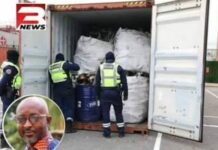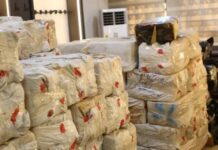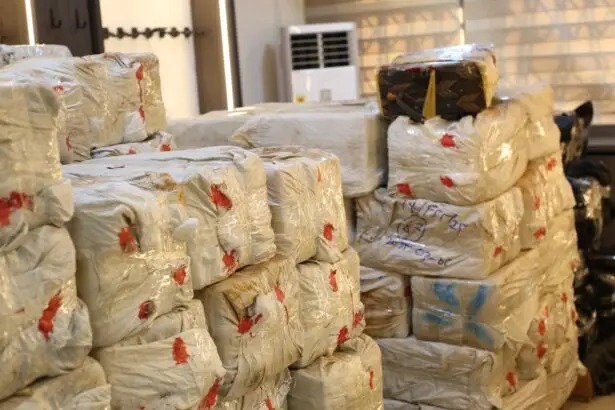

Nearly four tonnes of cocaine, worth an estimated €225 million, were found at the French port of Dunkirk in September 2026.
The drugs were hidden among plastic waste inside a container that had arrived from Ghana and was intended, at least in part, for Antwerp in Belgium.
French prosecutors say the criminal network suspected of being behind the shipment was already being targeted before customs officers found the cocaine.
For Ghana, this is once again very uncomfortable news. Nobody has proved that the cocaine was put into the container in Ghana. We don’t know that the Ghanaian exporter was involved either, and every container leaving our ports cannot simply be blamed on the authorities.
But we have been here before, often enough for this latest seizure not to become another spectacular European drug bust that makes the news for a few days and disappears.
Twenty years ago, Ghana went through one of the biggest cocaine scandals in its history. There were arrests, allegations involving senior police officers, court cases, a government-appointed committee and eventually lengthy prison sentences.
At the end of it all came a warning that should have stayed with us. It concerned a vessel whose name became familiar in almost every Ghanaian household at the time: the MV Benjamin. The story had actually begun before the MV Benjamin.
In November 2005, police raided a house at Mempeasem in East Legon and recovered 588 kilograms of cocaine. Two Venezuelans were arrested. That case subsequently formed part of the wider inquiry into a narcotics trade that was beginning to expose just how deeply Ghana had become entangled in international cocaine trafficking. And that’s when the MV Benjamin sailed along.
In April 2006, the vessel entered Ghanaian waters carrying what the subsequent government inquiry found to be 77 parcels or sacks of cocaine. By the time the authorities located the vessel, 76 sacks were gone. This was not a few kilograms hidden in somebody’s suitcase at Kotoka International Aiport.
An enormous consignment had reached Ghanaian waters and almost all of it had disappeared before the vessel was secured. The subsequent investigation reconstructed an extraordinary operation in which the cocaine was removed during the early hours, transported by canoe towards Kpone and taken away. When the MV Benjamin was eventually found, only one parcel remained.
The scandal became too large to contain. President John Agyekum Kufuor’s government established a fact-finding committee chaired by Justice Georgina Theodora Wood, then a Justice of the Court of Appeal and later Chief Justice.
Its work went considerably further than simply asking what had happened aboard one ship. The committee heard evidence about suspected traffickers, money, meetings, police officers and allegations of corruption. Many allegations were made during the hearings, but the committee did not accept all of them as proven. And the reason why that matters is because some have since been repeated as though the committee established them as fact.
For example, the committee did not find evidence that police personnel assisted with the original importation or discharge of the cocaine from the MV Benjamin. It did, however, make serious findings about what happened afterwards. Detective Sergeant Samuel Yaw Amoah was found by the committee to have received US$3,000 from Asem Darkei Sheriff and allowed him to escape.
The committee also dealt with allegations concerning senior police officers and made recommendations for prosecutions. Separately, in relation to the 588-kilogram East Legon case, it examined an allegation that two senior CID officers had received a US$200,000 bribe, but concluded that the allegation had not been proved.
Those distinctions are very important. But twenty years later, I have to question whether the committee ever got to the bottom of what was really happening. Its findings reflected the evidence before it, but what followed made some of its conclusions increasingly difficult to accept.
In 2007 came the extraordinary case of cocaine seized during a police operation that somehow ended up testing as kokonte, with police officers themselves subsequently being questioned. It was another warning that the problem Ghana was dealing with went far beyond a few traffickers and a ship called the MV Benjamin.
What the committee said about Ghana itself was perhaps more important than any individual name. It concluded that the drug trade in Ghana had “taken root” and warned that the country was gaining notoriety as a transit point for drug trafficking.
That was not written in 2026. It was written twenty years ago. There was another development around the same period which cannot simply be forgotten when looking back at Ghana’s cocaine years. In November 2005, Eric Amoateng, then the sitting NPP Member of Parliament for Nkoranza North, was arrested in the United States in a heroin trafficking case.
He eventually pleaded guilty and was sentenced to ten years in prison. So, when we talk today about politicians and the international narcotics trade, we should remember that at least one case went far beyond rumour and political accusation.
A sitting Member of Parliament belonging to the governing party was arrested abroad, prosecuted and convicted. Amoateng’s arrest did not happen in isolation.
The Kufuor years became increasingly overshadowed by cocaine controversies: the MV Benjamin, the extraordinary disappearance of 76 sacks of cocaine, a sitting NPP MP imprisoned in the United States for heroin trafficking and, in 2007, the almost unbelievable spectacle of a substance seized as cocaine during a police operation subsequently testing as kokonte.
None of that proves that the Kufuor government itself was involved in drug trafficking, and it would be irresponsible to say so. But it does explain why that period became so closely associated in the public mind with questions about narcotics, political influence and the integrity of the institutions supposed to stop the trade.
That history makes some of what is being circulated around the latest Dunkirk seizure particularly sensitive. Claims have appeared suggesting that two NPP figures are connected to the €225 million shipment, and one circulating news card has gone as far as naming New Juaben South MP Michael Okyere Baafi and claiming that he is on the run. Okyere Baafi has publicly dismissed the allegation as fake.
More importantly, there is presently no confirmation from the French, Dutch or Ghanaian authorities that he is wanted, has been arrested or has any connection whatsoever with the cocaine shipment.
That distinction has to be made. Amoateng was convicted. Okyere Baafi denies what is being circulated about him and, so far, I have found no official evidence connecting him to the Dunkirk shipment. But the speed with which the allegation became party political, tells us something else about how Ghana deals with these cases.
It would be tempting, looking back now, to say Ghana investigated, produced another report and nothing happened. That would not be true this time. People were prosecuted and people went to prison.
Joseph Kojo Dawson, owner of the MV Benjamin and Managing Director of Dashment Company Limited, was eventually convicted alongside Isaac Arhin, Phillip Bruce Arhin and Chinese crew members Cui Xian Li and Luo Yui Xing.
In July 2008 the Accra Fast Track High Court sentenced each of the five men to 25 years’ imprisonment with hard labour. Justice Anin Yeboah found that the prosecution had established the involvement of members of the crew in the voyage that brought the cocaine towards Ghana. Evidence before the court traced part of the operation to waters off Monrovia, where cocaine was taken aboard from another vessel before the MV Benjamin continued towards Ghana.
So, something was done, and that has to be acknowledged. There was an inquiry. There were investigations. There were even prosecutions and convictions. There were also cases that did not survive. Kwabena Amaning, better known as Tagor, and Alhaji Issah Abass became two of the best-known names to emerge from the wider cocaine scandal.
They were convicted and sentenced to lengthy prison terms, but their convictions were subsequently overturned by the Court of Appeal. That too belongs in the history. Otherwise I risk doing precisely what I have criticised others for doing: remembering only those parts of the story that suit the argument I want to make.
Six years after the MV Benjamin convictions, Ghana found itself confronting another cocaine scandal, this time not at sea but at Kotoka International Airport. On 10th November 2014, Nayele Ametefe, also known as Ruby Adu-Gyamfi, arrived at Heathrow Airport carrying 12.5 kilograms of cocaine.
She had flown from Accra the previous night. What made the case particularly disturbing in Ghana was not simply the cocaine she was carrying but how she had been able to begin that journey. Investigations centred on her use of the VVIP Lounge at Kotoka, away from the normal passenger route through the airport.
Three officials were arrested in Ghana, including an Assistant Director at the Ministry of Foreign Affairs responsible for the VVIP Lounge and an officer of the Research Department attached to it. The British High Commission later made clear that British authorities had no prior knowledge that Ametefe intended to carry drugs to the UK.
She pleaded guilty before the Isleworth Crown Court and in January 2015 was sentenced to eight years and eight months in prison.
Nayele Ametefe
The significance of the Nayele case goes beyond another Ghanaian being caught abroad with cocaine. The MV Benjamin had already shown what could happen through Ghana’s maritime space. Nayele showed that the vulnerabilities were not confined to the ports.
Here was a woman able to leave Ghana carrying 12.5 kilograms of cocaine after passing through the VVIP system at the country’s principal international airport. Once again, the drugs were ultimately intercepted outside Ghana. Once again, Ghana was left asking how they had got that far.
And once again Ghana was asking uncomfortable questions about access and security, and whether some people could pass through a system differently from everybody else. Not every allegation that followed the case was proved, and we should not repeat those that were not. But the central fact does not need embellishment: 12.5 kilograms of cocaine left Ghana in a passenger’s hand luggage and was discovered at Heathrow.
There is also an uncomfortable political lesson running through this history. Eric Amoateng was a sitting NPP Member of Parliament when he was arrested in the United States in 2005 and was eventually convicted in a heroin trafficking case.
Nayele Ametefe’s arrest came in 2014 while the NDC was in government and immediately became the subject of fierce political accusations because of her passage through the VVIP Lounge. Now, in 2026, allegations are again being thrown around about NPP figures in connection with the Dunkirk shipment, although those current allegations remain unverified and one of the people named, Michael Okyere Baafi, has publicly denied them.
We should therefore be careful about forcing Ghana’s cocaine history into an NPP or NDC box. The problem has outlived governments, political parties and promises that the system has been fixed.
WATCH OUT FOR PART II
By Nana Kwaku Agyemang