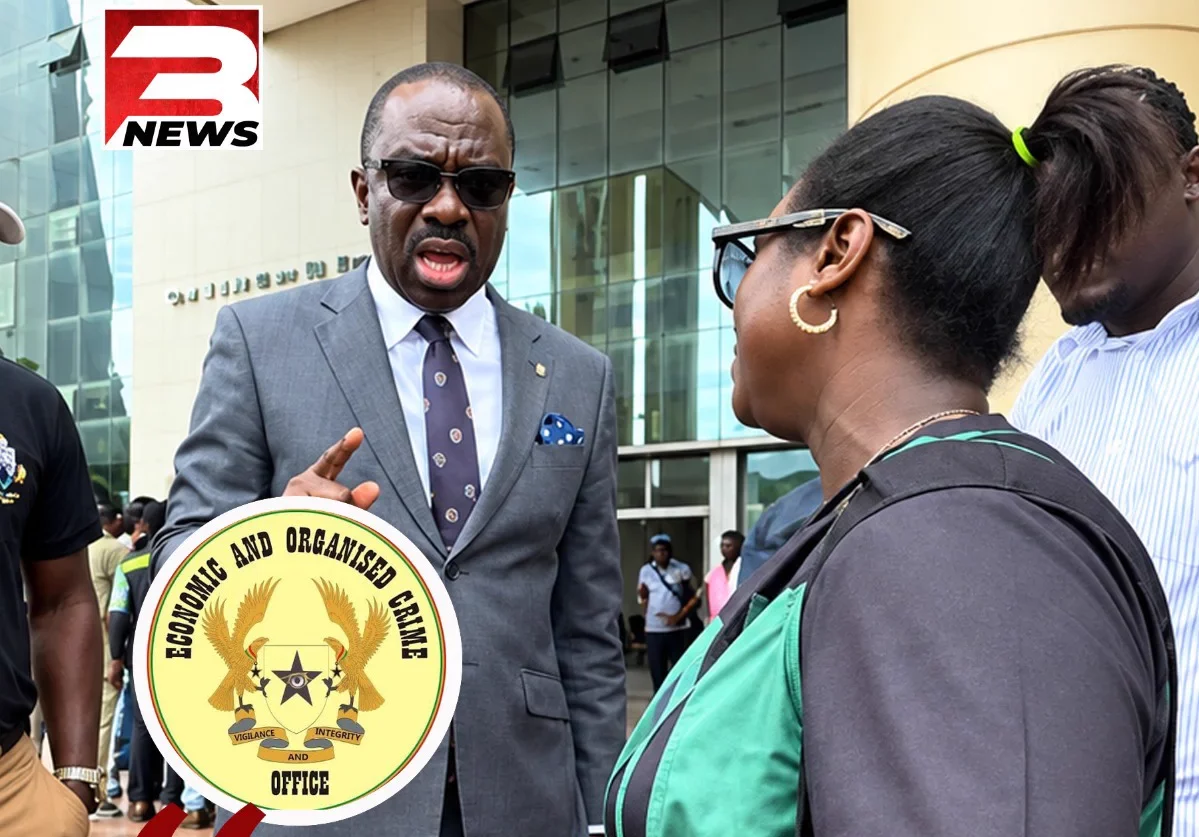

It’s a riveting video that has sparked heated debate across the length and breadth of the nation.
What was meant to be an arrest, later described as an attempted kidnapping.
It happened on Wednesday September 23, 2026, a woman in plain clothes walks up to Lawyer and Member of Parliament for Manhyia South Nana Agyei Baffour Awuah at the Accra High Court.
He had just finished representing a client.
She tells him he is needed at EOCO for questioning.
What happens next, will have the entire country talking?
So, what exactly brought us here.
The Economic and Organised Crime Office says this was not a random ambush.
In a statement released that night, EOCO explained, they had invited the MP twice in February this year to assist with an investigation, which he failed to honour.
Per the letters, the invitation on the 10th of February was addressed to the Senior Partner of his law firm, Sarkodie Baffour Awuah & Partners, to assist with investigations into a client of the firm, SIC Life Savings and Loans.
The MP says he replied on February 18, saying because he is now an MP, he had referred the letter to the Clerk of Parliament for advice.
The MP further claims, a partner in the firm, Theresa Terbi, went to EOCO three times; on March 4, March 18 and April 30, where she gave a full written statement.
Since then, he claims EOCO went quiet, until Wednesday.
Nana Agyei Baffour Awuah was in the High Court in his capacity as lawyer for Salomey Baffoe Awiti, who is being held for abetment in the case of the TikToker known as Ghana Jollof.
Is there a link between defending that nurse and the attempted arrest? EOCO says no.
Now, let us talk about the law.
First, is an MP untouchable? Article 117 of the Constitution says civil or criminal processes shall not be served on or executed in relation to the Speaker or a member or the Clerk to Parliament while he is on his way to, attending at, or returning from any proceedings of Parliament.
What that means is, you cannot arrest an MP when and ONLY! when he is going for, at or coming from parliamentary proceedings.
For now, we know Parliament is on recess.
So, was he on his way for parliamentary proceedings? He says he was going to Parliament for a committee meeting.
Was there a meeting? If there was, then Article 117 applies.
Second, do you need the Speaker’s permission to arrest an MP? Well, Speaker Bagbin himself clarified this saying; “It is not for the security agents to seek my permission before arresting or inviting a Member of Parliament for questioning. It’s not. It’s for them to inform me and include the circumstances or the allegations that have created the suspicion”.
Third, do you need a warrant to arrest? This is where Section 10 of the Criminal Procedure Act, Act 30, comes in. The law says you can arrest without a warrant if you have reasonable suspicion that a person has committed an offence.
Hence, if someone is seen committing a crime or there is credible evidence linking them to the crime, the police may have reasonable suspicion to make an arrest.
And so, whilst EOCO, under Section 18 of Act 804, has police powers, it clearly required a warrant for such an arrest.
But here is the catch. With or without a warrant, an arrest must be done lawfully.
Identify yourself, and give reasons for the arrest.
Was that done? No.
So, as the debate continues, it is no longer just about one MP and one EOCO officer.
It is about how we balance law enforcement with parliamentary privilege, and how we ensure that even when we enforce the law, we do it lawfully.
Now the onus lies on the courts to clarify.
By Judith Brown