The College of Agriculture and Natural Sciences of the University of Cape Coast (UCC) has launched the Africa Centre for Food Integrity (AFIC) to combat food fraud, adulteration, and counterfeiting through rapid, affordable, AI-enabled testing technologies.
The Centre was launched under the theme:”Advancing Food Integrity through Science, Innovation, Capacity Building and Partnerships.”
According to the School of Agriculture, AFIC will develop portable technologies that assess food authenticity, quality, safety, and origin closer to farms, markets, processors, and inspection points.
Meanwhile, at the Department, a fully equipped laboratory with specific scientific equipment has been set up.
The Centre is open to students, researchers, individuals, organizations, and other universities for studies.
The Founding Director of the Africa Centre for Food Integrity, Engr. Prof. Ernest Teye, speaking to Onua News explained that the Centre is developing what it calls the “Food Oracle,” a technology that mimics the five human senses to test food integrity.
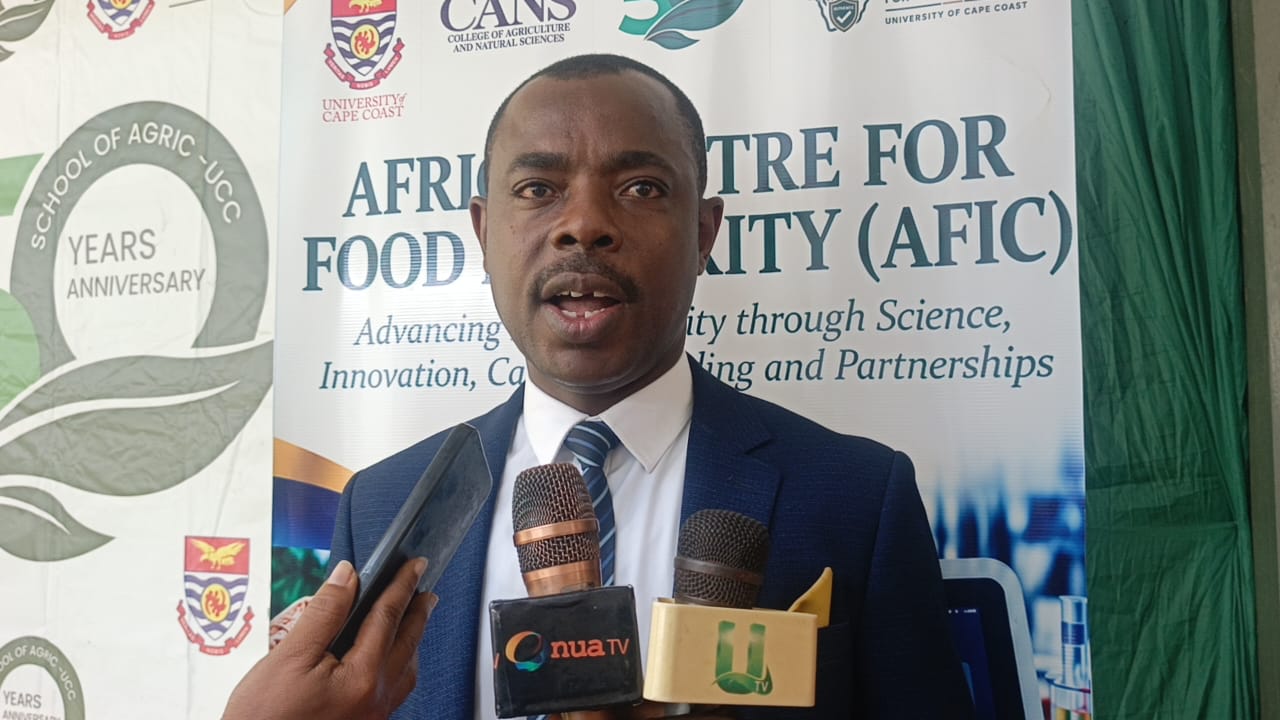
“The food oracle is actually using all your five senses. Your nose, so we have electronic nose, your tongue, we have electronic tongue, the ear, we have acoustic sound, the eye, we have computer vision and now we have near infrared spectroscopy, now we equate it to the touch. When you add all this we are developing what we call AI technologies that gives results non-destructively, below one minute you get your results.”
He explained that the Centre is researching technologies that can help evaluate the food system and will make these technologies available to the FDA and other stakeholders in the food value chain.
Prof. Teye disclosed that the Centre is on the verge of releasing what it calls the “Spice Check Technology,” which will allow consumers to check the authenticity of spices at the market, as well as a portable device for analyzing palm oil to determine whether it has been adulterated.
He said the devices will be used at the initial stage for screening to provide results in real time, while suspicious samples can be taken to sophisticated laboratories for further analysis.
He added that the Centre will develop affordable techniques, sensitize the public, and train human resources to fight food fraud, adulteration, and counterfeiting, which he described as a canker destroying the food system.
The Dean of the School of Agriculture at the University of Cape Coast, Prof. Julius Kofi Hagan, has described the launch of the Africa Centre for Food Integrity as a landmark achievement for the School as it marks its 50th anniversary.
Prof. Hagan however indicted that, food fraud, adulteration and contamination remain a major threat to public health and trade in Ghana and across Africa.
He said the establishment of the Centre under the College of Agriculture and Natural Sciences is timely and will provide scientific solutions to ensure that food sold on the Ghanaian market is safe, authentic and nutritious.
Prof. Hagan noted that the Centre will not only conduct research but will build capacity, train students and stakeholders, and partner with regulatory bodies like the FDA and GSA to bring its innovations from the laboratory to the market.
He commended the Founding Director, Engr. Prof. Ernest Teye and his team for pioneering the initiative and pledged the full support of the School of Agriculture to ensure the Centre becomes a continental hub for food integrity research.
“This Centre is very important to us, especially as we celebrate 50 years of the School of Agriculture. The issue of food fraud and adulteration is a big challenge. AFIC will provide the science, the innovation and the training needed to ensure food integrity in Ghana and Africa. We as a School are fully behind
this initiative.”
The Ambassador of the State of Israel to Ghana, Liberia and Sierra Leone, Roey Gilad, has lauded the University of Cape Coast for establishing the Africa Centre for Food Integrity, describing the project as one that will directly benefit Ghanaian farmers.
H.E. Gilad, who disclosed his own family background farming including avocado farming, Israel is proud to be associated with the project and is committed to supporting Ghana and the University of Cape Coast to strengthen food quality, food safety and food integrity.
He stressed that Israel, as a global leader in agricultural technology, sees agriculture and food systems as a key pillar of its cooperation with Ghana, and expressed optimism that AFIC will become a bridge between science and the farm.
The launch brought together university authorities, researchers, students and development partners.
UCC lecturer calls for review of EC commissioners appointment process
By Timothy Kwame Kakraba Gaison