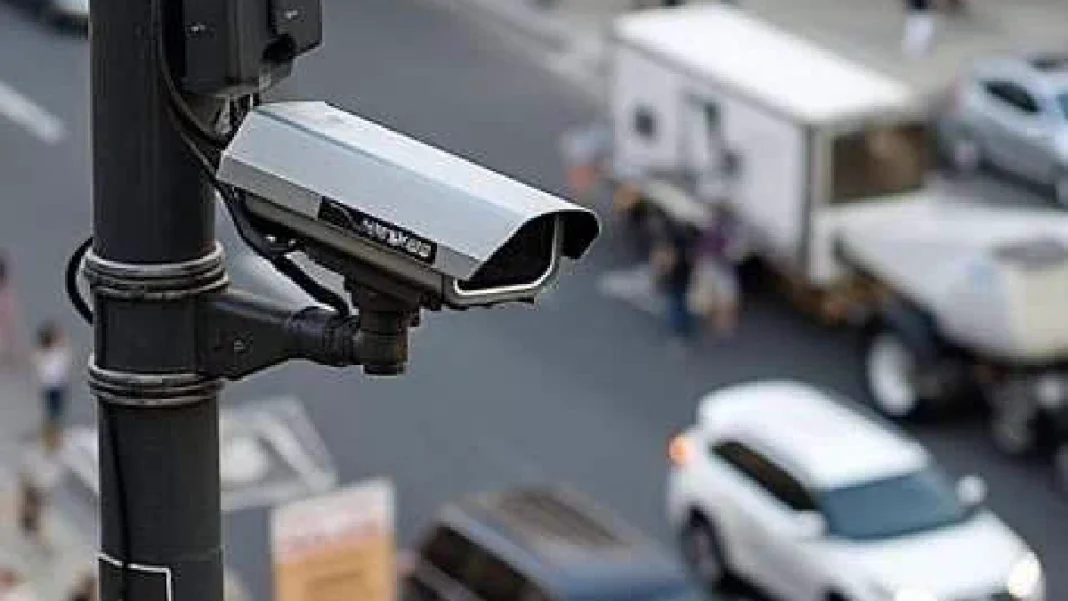

A member of the communications team of the New Patriotic Party (NPP), Kwasi Kwarteng, has said more premium must be placed on the lives that would be saved by the introduction of the TraffiTech-GH system than the cost involved.
According to him, needless lives have either been maimed or lost in the past due to over-speeding.
“If GH₵77 million can reduce road accidents by even one per cent, then the investment is worthwhile,” he said on TV3’s The KeyPoints on Saturday, November 7.
Mr Kwarteng made the comments amid ongoing public debate over the cost, fairness and revenue-sharing arrangement of the new automated traffic enforcement system, which went live on November 1, 2026.
He revealed that his grandmother who was hit by an over speeding car, has been subjected to the use of clutches for the past 24 years. Similarly, one of his closest friends has been crippled after being involved in a motor traffic accident.
Background: What is TraffiTech-GH?
TraffiTech-GH is Ghana’s new automated traffic law enforcement system, run by the Ghana Police Service through its Motor Traffic and Transport Department (MTTD).
It uses radar, high-resolution cameras, sensors and other digital tools to detect violations — initially speeding and later red-light jumping. Captured violations are reviewed by police personnel before an Electronic Notice of Violation is sent to the vehicle owner by SMS, with video evidence. Motorists have 14 days to pay or contest it.
Full enforcement was originally scheduled for October 1 but was moved to November 1 to allow for more public education.
On its first day, police said they recorded thousands of speeding offences, with some drivers clocked above 130km/h on 50km/h roads.
Why speeding is the focus
The police say speeding is the biggest killer on Ghana’s roads.
Speeding accounts for 60 to 62 per cent of serious injuries and deaths from road crashes, according to ACP Alexander Kwaku Obeng, Director of Education, Research and Training at the MTTD.
The National Road Safety Authority (NRSA) has also said speeding and inattentive driving together account for roughly 58 to 59 per cent of road fatalities nationwide.
The human cost is staggering. President John Dramani Mahama has cited 2,151 deaths in road accidents in 2025, including 474 pedestrians knocked down. Other official figures put 2025 deaths at 2,949, the highest in 35 years.
In the first four months of 2026 alone, 1,009 people died in road crashes, according to the NRSA.
The GH₵77 million question
According to the Ministry of Finance’s 2024 Annual Report on Public-Private Partnership Projects, the TraffiTech-GH project has an estimated investment cost of GH₵77.73 million over an 11-year contract period.
The deal was signed in December 2022 under an 11-year Design, Build, Finance, Operate, Maintain and Transfer (DBFOMT) agreement running until December 2033. The public side is the Ministry of the Interior and the Ghana Police Service, while the private partner is Nationwide Traffic Management and Enforcement Limited (NTMEL).
Under the arrangement, fine revenue is split 60 per cent to the Government of Ghana and 40 per cent to NTMEL.
That 60/40 split has drawn criticism. Policy analyst Bright Simons, has warned that making a private operator’s earnings dependent on traffic fines could create incentives that undermine fairness in enforcement.
Others have questioned where the government’s share will go, with calls for it to be channelled into the Ghana Road Fund to fix roads and black spots.
Early signs
Police say the pilot phase is already showing results.
In September 2026, after intensified education and the issuance of more than 200,000 caution notices, crashes fell by 9.4 per cent compared to September 2025, injuries fell by 15.02 per cent, and fatalities fell by 7.82 per cent.
For Mr Kwarteng, that is the point. Even a small percentage drop, he argues, means families spared the pain of losing loved ones to preventable speeding-related crashes.