
A fire outbreak in a student hostel, particularly in the middle of the night, can quickly turn into a tragedy when occupants do not know how to respond or where to escape.
With hundreds of students living in hostels around the Takoradi Technical University (TTU), the Sekondi-Takoradi Metropolitan Fire Command is stepping up efforts to prevent potential disasters through fire safety inspections and emergency simulation exercises.
The exercise is aimed at ensuring that hostel operators comply with fire safety regulations while equipping students with the knowledge and practical skills needed to respond to emergencies.
Under the Fire Precaution (Premises) Regulations, 2003, L.I. 1724, non-residential premises, including hostels, hotels, hospitals, schools, shops and workplaces, are required to meet prescribed fire safety standards and obtain valid Fire Safety Certificates from the Ghana National Fire Service.
Around the Takoradi Technical University enclave, fire officers are inspecting hostels to verify fire safety certificates, assess the availability of firefighting equipment and evaluate the preparedness of occupants.
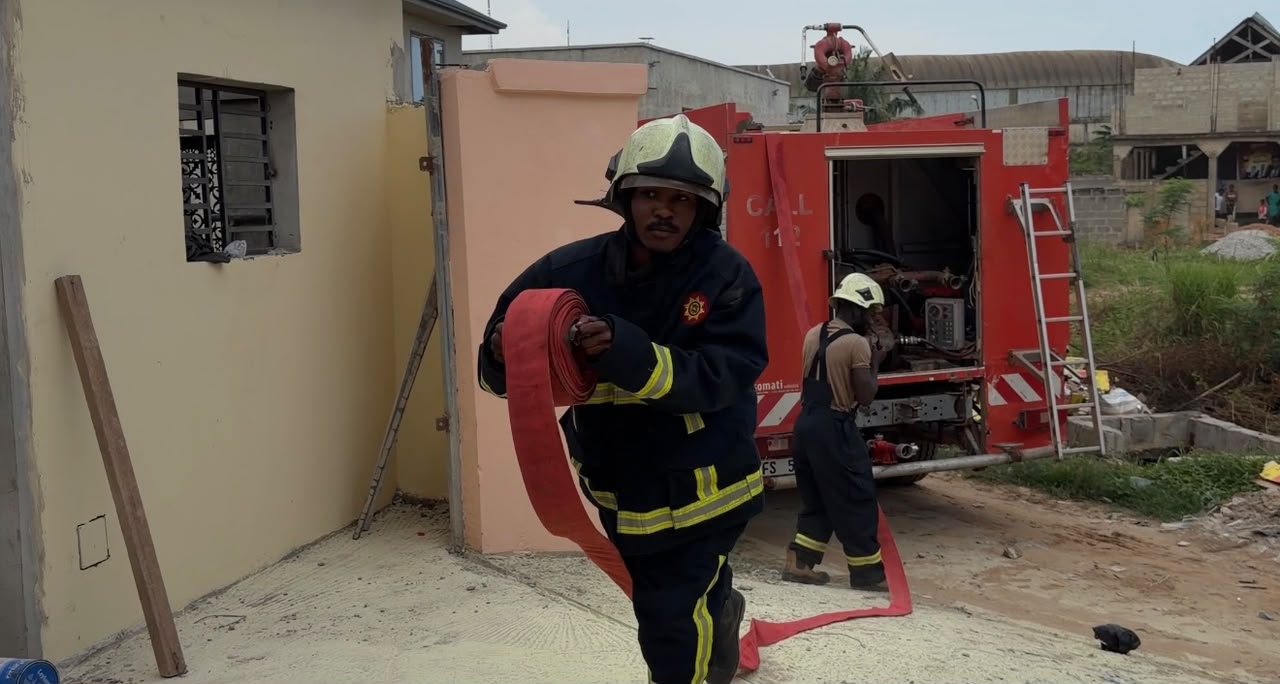
As part of the exercise, firefighters staged a simulated fire outbreak in a hostel kitchen, triggering an emergency response from students.
Occupants evacuated their rooms and assembled at designated safe points, while some helped direct firefighters to the location of the simulated fire.
Speaking after the exercise, Sekondi Fire Officer, ADOI Kenneth Agbevo, said the simulation was designed to test the building’s safety systems and familiarise firefighters with its structure to ensure an effective response during actual emergencies.
He commended the students for their response, particularly their ability to evacuate and direct emergency personnel to the simulated fire location.
“The reason behind this simulation is to test the safety system of the whole building and also familiarise ourselves with the structure. The students did very well. They assembled at the assembly point, and some gave us directions to where the fire was, which was the kitchen. As civilians, they did what they could,” he said.
An inspection of the facility also revealed the presence of fire extinguishers, hose reels, smoke detectors and alarm systems on the various floors.
However, Mr Agbevo cautioned that providing firefighting equipment alone was not enough, stressing that hostel operators must ensure the equipment is properly maintained and occupants are trained to use it to contain fires at their initial stages.
He urged hostel operators around the university community to comply with fire safety requirements, warning that the Fire Service would intensify inspections.
“We are urging all hostels around this facility to get their firefighting equipment. There’s a programme coming on board, so we’ll be coming around for inspections. If you don’t have this equipment, it’s going to be a problem,” he cautioned.
Meanwhile, Richard Atsu Golley, manager of one of the hostels, described the simulation as an important opportunity to prepare students for emergencies.
He said the exercise provided practical lessons on how to operate fire extinguishers, use hose reels and respond quickly when a fire breaks out.
Mr Golley recounted that some occupants initially mistook the exercise for a real fire outbreak and immediately mobilised firefighting equipment before realising it was a simulation.
“Fire is part of us. We need to prepare to fight fire anytime it happens. We need to train the students here. The Fire Service came to educate us. They taught us how to handle the extinguishers and the hose reels. When they came in, they thought it was a real fire, so they acted quickly,” he said.
He commended the Fire Service for the exercise, adding that the training had improved students’ understanding of how to handle firefighting equipment.
The exercise highlights the importance of moving beyond fire safety certification to practical preparedness, particularly in student accommodation facilities where a single outbreak could put many lives at risk.
For students living around the Takoradi Technical University, knowing the nearest emergency exit, identifying assembly points and understanding how to use firefighting equipment could make the difference between life and death.
The Fire Service is therefore urging hostel operators to prioritise fire prevention, obtain the required certificates, maintain firefighting equipment and organise regular emergency drills.
The message is simple: fire safety is not just about having a certificate on the wall; it is about ensuring that everyone knows what to do when the flames break out.
By Ebenezer Atiemo