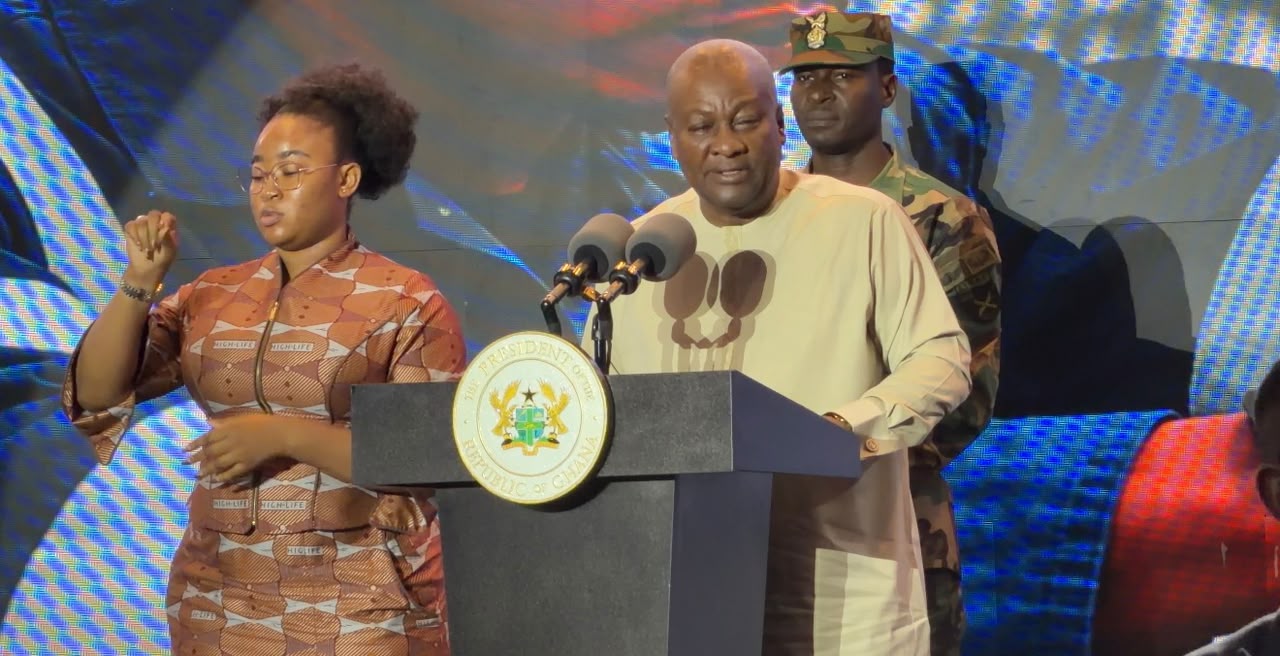

President John Dramani Mahama has announced a new offshore hydrocarbon discovery in Ghana’s Cape Three Points contract area, describing it as a major milestone in the country’s efforts to revive exploration and strengthen its upstream petroleum sector.
The discovery, made by Planet One Oil and Gas Limited in partnership with World Upstream Limited and the Ghana National Petroleum Corporation (GNPC), was announced at the 2026 Petroleum Commission Local Content Conference and Exhibition in Takoradi on Tuesday, November 10, 2026.
The conference was held under the theme: “Enriching Local Content for Sustainable Growth: Building a Resilient Upstream Sector Through Reforms and Partnership to Spur Competitiveness and Investment.”
President Mahama said the discovery at the Nya Gyidie (Have Faith) 9 1X Well in the deepwater Cape Three Points contract area was Ghana’s first successful test of a Cenomanian-Turonian carbonate play as a primary exploration target.
He explained that the well also targeted the Albian as a secondary objective, describing the discovery as evidence of renewed investor confidence in Ghana’s petroleum sector.
The President said the name Nya Gyidie (Have Faith) 9 1X Well, aptly reflected the government’s determination to restore confidence and accelerate responsible exploration.
He congratulated Planet One Oil and its partners, urging the Petroleum Commission to intensify efforts to ensure that operators fulfil their exploration and work programme commitments.
The President also disclosed that Ghana was beginning to record significant gains from renewed engagement with international oil and gas companies following a period of declining production and investor uncertainty.
He revealed that crude oil production had recovered to more than 120,000 barrels per day, following interventions by his administration to resolve outstanding disputes and restore confidence among upstream operators.
According to him, the Jubilee partners have committed $2 billion in new investments, while partners in the Offshore Cape Three Points project have pledged another $1.5 billion.
The investments will support new wells, subsea infrastructure and the expansion of production facilities.
President Mahama said the Jubilee investment was expected to sustain oil production and increase gas output, while a renegotiated gas price would reduce the cost of Jubilee gas by approximately 18%, generating estimated savings of $300 million for the country.
He further announced that under renegotiated gas sales agreements with ENI and Vitol, the average gas price was expected to decline by 23%, with projected savings of about $3.5 billion over the remaining life of the field.
Ghana currently produces approximately 400 million standard cubic feet of natural gas daily, a figure expected to approach 500 million standard cubic feet following the completion of upgrades to the Offshore Cape Three Points non-associated gas facilities.
The President also announced that government had fully restored the $500 million well-being guarantee and was up to date with gas payments to its partners.
President Mahama acknowledged that Ghana’s oil production had declined from a peak of approximately 195,000 barrels per day in 2019 to about 88,000 barrels per day, attributing the situation partly to the global energy transition.
However, he admitted that poor governance and regulatory inconsistencies had contributed significantly to the loss of investor confidence, forcing some major industry players to withdraw and redirect investments elsewhere.
He said his administration had prioritised resolving outstanding upstream disputes, improving regulatory consistency and creating a more predictable investment environment.
The President indicated that government was engaging companies including ENI, Vitol, Shell, Chevron and Petrobras over prospective petroleum acreages in Ghana’s western and eastern sedimentary basins.
He added that three memoranda of understanding had been signed on key terms for three blocks, while discussions on other petroleum agreements were ongoing.
He also disclosed that a major obstacle to the development of the Pecan field had recently been removed, paving the way for discussions on an accelerated development programme.
President Mahama assured international partners that government remained committed to resolving disputes and arbitration outcomes in a manner that protects the interests of all parties.
He cited the recent engagement between government and Tullow following their arbitration as an example of efforts to reach mutually acceptable solutions.
The President further announced that proposed amendments to the Petroleum Exploration and Production Act, 2016 (Act 919), had been signed by the Ministers of Energy and Finance and submitted to Cabinet for consideration.
He said the amendments were intended to introduce improved incentives to attract investments and position Ghana’s upstream petroleum sector to respond effectively to changing conditions in the global energy industry.
He also revealed that the GNPC, through its subsidiary Explorco, was preparing to drill its first exploration wells in the Voltaian Basin, with drilling expected to begin in the first quarter of 2027.
He tasked the Petroleum Commission to ensure that operators engage host communities, minimise environmental and social impacts, and create economic opportunities for residents in areas where they operate.
On local content, President Mahama said the country must measure the success of its petroleum industry not only by production volumes and investment commitments but also by the opportunities created for Ghanaian businesses and workers.
He recalled the opposition some international partners expressed in 2013 when government sought to pass the Local Content and Local Participation Regulations, 2013 (L.I. 2204).
He said he was pleased that some of those same partners were now actively promoting local content and acknowledging its contribution to the industry.
The President, who commended the Petroleum Commission for 15 years of service, stressed that local content must move beyond Ghanaian ownership of businesses to include skills development, technology transfer, employment and the ability of local companies to execute increasingly complex contracts.
He urged international operators to provide qualified Ghanaian suppliers with early information about upcoming contracts and incorporate training and technology transfer into their partnerships.
He also called on financial institutions to develop financing arrangements that would enable credible Ghanaian suppliers to compete for larger industry contracts.
Universities, technical institutions and professional bodies were equally encouraged to align their training programmes with the skills and expertise required by the petroleum industry.
President Mahama charged the Petroleum Commission to ensure strict compliance with safety, environmental protection and local participation standards as activities in the sector expand.
The President also highlighted government’s ambition to strengthen the link between upstream petroleum production and domestic refining, gas processing and petrochemical manufacturing.
He cited the $28 billion agreement between the Petroleum Hub Development Corporation and a consortium led by Global Spheres for the development of the second phase of the Petroleum Hub project as part of efforts to position Ghana as a regional centre for refined petroleum and petrochemical products.
He called on the Petroleum Commission to collaborate with the Petroleum Hub Development Corporation and upstream operators to secure reliable feedstock supplies for the proposed refineries and petrochemical plants.
President Mahama also pointed to the recommissioning of the Tema Oil Refinery’s crude distillation unit in August following critical maintenance works.
He said the Ministry of Energy and Green Transitions facilitated the delivery of Jubilee crude ahead of the refinery’s restart, after which the facility received 950,000 barrels of crude from GNPC.
He maintained that refining Ghanaian crude locally would enable the country to retain more value from its natural resources.
The President further disclosed that construction had commenced on the second gas processing facility, known as GPV-2, at Anochie in the Western Region.
The facility is expected to reduce reliance on imported liquid fuels for power generation and generate savings for the country.
President Mahama urged stakeholders to use the conference to identify practical opportunities for Ghanaian businesses, strengthen industry partnerships and attract new investments.
He said the ultimate objective was to translate the country’s petroleum resources into jobs, industrial growth and lasting improvements in the lives of Ghanaians.
He subsequently declared the 2026 Petroleum Commission Local Content Conference and Exhibition officially open and launched the accompanying exhibition.
By Ebenezer Atiemo