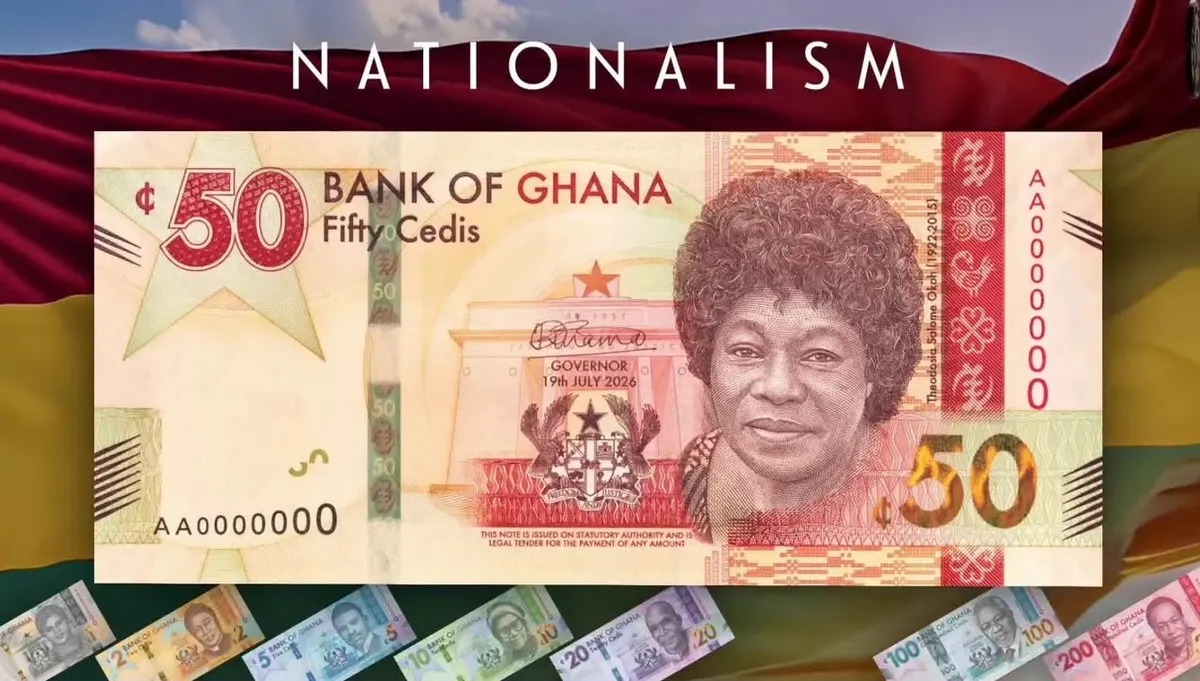

The Bank of Ghana has moved to end days of public debate over the new GH¢50 Heritage Series banknote, insisting that the portrait on the note is that of Mrs Theodosia Salome Okoh, designer of Ghana’s national flag, and not her younger sister, Dr Letitia Obeng.
In a press release issued on Friday, November 13, the central bank said the portrait was developed from different photographs of Mrs Okoh, and not from a photograph of Dr Obeng.
According to the Bank, the photographs were used to create an engraved artistic representation suitable for banknote printing.
“During this process, certain adjustments, including the replacement of Mrs Okoh’s familiar head-tie with a hairstyle common during that period, were made to meet the technical and security requirements of currency production,” the statement said.
The Bank admitted that those adaptations “unfortunately, contributed to the perceived differences in her appearance, and to the image bearing a close likeness to Dr Obeng.”
It thanked the family for its constructive engagement and the public for its interest in preserving Ghana’s national heritage, and reaffirmed that the portrait is intended to honour Mrs Okoh and her invaluable contribution to Ghana’s national identity.
“The Bank is committed to ensuring that the distinguished personalities featured on Ghana’s currency are represented with dignity and respect,” the statement added.
The Heritage Series banknotes will enter circulation on December 1, 2026.
Background
The controversy began hours after President John Dramani Mahama unveiled the Heritage Series at Bank Square in Accra on Thursday, November 12, 2026. The series, themed, “The Cedi, Our Future: Secure, Designed to Last,” is the first comprehensive overhaul of Ghana’s banknotes in nearly two decades.
It retains the eight existing denominations, from GH¢1 to GH¢200, with each note pairing a national icon on the front with a landmark and an Adinkra symbol on the reverse. The GH¢50 note, themed Nationalism, carries Mrs Okoh on the front, Jubilee House on the reverse, and the Fawohodie symbol, representing independence, freedom and emancipation.
Shortly after the unveiling, Prof. Eddie Obeng, a nephew of Mrs Okoh and son of Dr Obeng, wrote on LinkedIn that he had been delighted to hear his aunt had been honoured, only to realise the face on the note looked like his mother.
“Imagine my surprise when I took a look and realised that they have used a picture of my mother instead — she’s famous for being the country’s first lady PhD,” he wrote.
The claim quickly gained traction on social media and in the press, prompting an initial clarification on Facebook on November 12 by Bank of Ghana board member Beatrice Annan. She explained that the Bank had worked from three authentic photographs of Mrs Okoh — two from her younger years and one from later life — to produce a composite image of her as a mature woman, and that the hairstyle had been adjusted to produce a distinct outline suitable for engraving.
Friday’s press release is the Bank’s first formal, official statement on the matter, restating that position.
Who were the two sisters?
Theodosia Salome Okoh (1922–2015) was born Theodosia Salome Abena Kumea Asihene on June 13, 1922. A teacher, artist and sports administrator, she studied fine arts at Achimota School.
When the government invited designs for a national flag ahead of independence, her proposal was selected. It was adopted on March 6, 1957: red for the blood shed in the struggle for independence, gold for Ghana’s mineral wealth, green for its forests and agriculture, and the Black Star for African emancipation.
She also played a leading role in developing hockey in Ghana. She died on April 19, 2015, aged 92.
Dr Letitia Eva Takyibea Obeng (1925–2023) was her younger sister. Born at Anum in the Eastern Region on January 10, 1925, she became the first Ghanaian woman to earn a doctorate, and a pioneering zoologist and environmental scientist widely described as the “grandmother of female scientists in Ghana.”
She died on March 23, 2023, aged 98.
The sisters’ close family resemblance, and their shared maiden name Asihene, have been cited in public discussion as part of the reason for the confusion.
The Bank of Ghana says the existing banknotes will remain legal tender alongside the Heritage Series when it enters circulation on December 1.