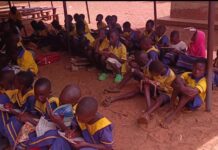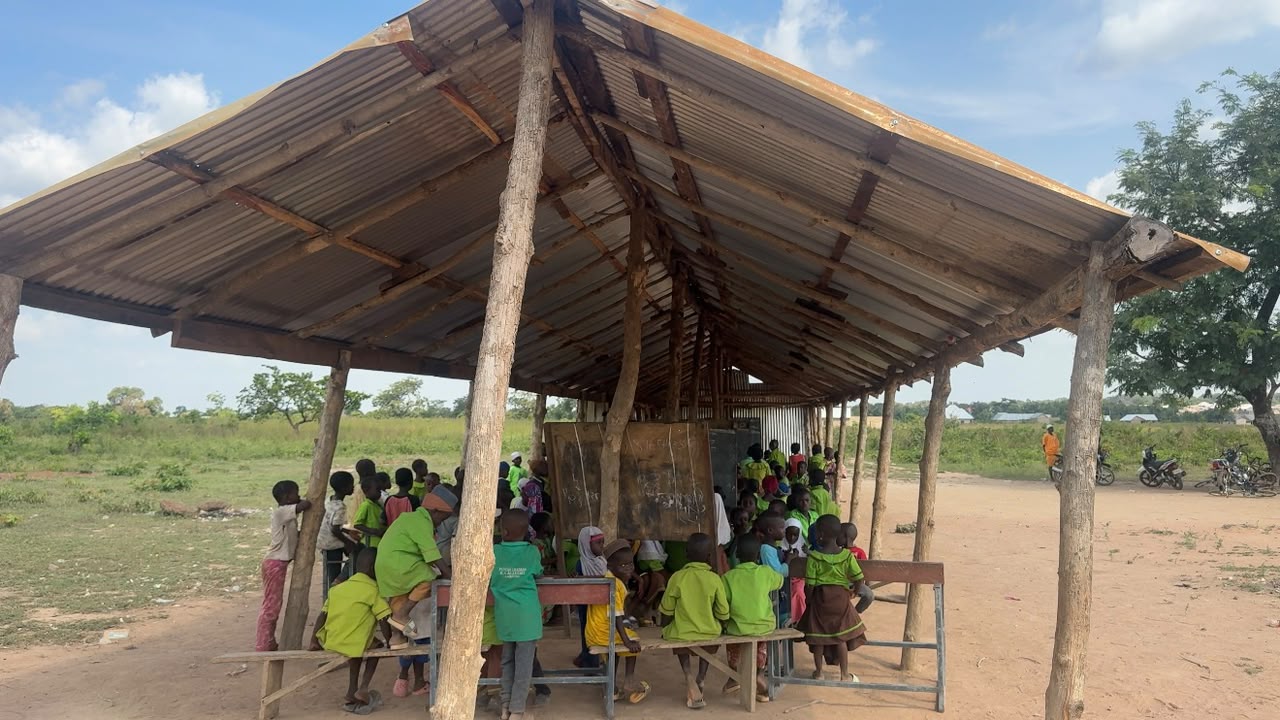

When dark clouds gather over Solaayagli DA Primary School in Zabzugu, teachers do not simply tell pupils to prepare for the next lesson. They begin moving children, benches and books from the open side of a parent-funded pavilion to the only covered section before the rain arrives.
For 244 pupils, from Kindergarten One to Primary Six, that daily scramble has become part of school life. The community’s makeshift shelter is all that stands between them and the rain, after years of appeals for a permanent classroom block went unanswered.
A School Without Classrooms
Headteacher Abukari Yakubu said the school began with 37 pupils in somebody’s house before moving to another resident’s home. When that landlord also needed the building, the school relocated to its own land but without classrooms.
“We went to the authorities, the GES, the district assembly, even our Member of Parliament,” Mr Yakubu said. “He came here about two years ago, surveyed the land and promised to build a school for us, but to no avail.”
The school wrote several letters and made repeated follow-ups, but no permanent structure followed. As the rainy season approached, pupils were sitting under trees, scattered across the compound and exposed to the elements.
Parents Step In
Rather than allow the children to continue learning in the open, the Parent-Teacher Association and parents met and agreed to contribute GH¢20 and two tubers of yam per child. The money was used to construct a pavilion.
“That is exactly what we did, and we were able to raise the pavilion,” Mr Yakubu said.
The structure was divided into about seven or eight classroom spaces, allowing the school to run classes from KG1 to Primary Six. But it remains incomplete. Whenever rain threatens, teachers move pupils and furniture into the covered area, then return outdoors when the weather clears.
Fear Beyond the Rain
Teacher Adam Suale said snakes had previously been killed around the school, frightening some children and affecting attendance.
“Sometimes, when it is about to rain, children say they cannot come to school because of the rain,” he said.
Besides the rain and scorching sun, snakes were also another problem that chased most of our students away. “Sometimes in a day we can kill about two or three snakes here,” Mr Suale said.
The open pavilion also affects concentration. With no separate classrooms, pupils can see and hear activities in other sections, making it difficult for teachers to keep their attention.
“They don’t have single classes,” Mr Suale said. “So we face a lot of challenges, and we are pleading with the authorities to look at our situation so that teaching and learning can improve.”
Authorities Respond
The District Chief Executive (DCE) for the area, George Lakoba Tanie, has assured the community that steps are being taken to address the school’s infrastructure needs.
He noted that the Member of Parliament has visited the allocated school land and made some promises.
“The MP is promising that they will do whatever it takes,” the DCE said, adding that the assembly and the MP are considering the use of the District Assembly Common Fund and parliamentary support to construct a permanent classroom block.
The DCE, who described Solaayagli as his home community, said the issue was a major concern to him. He indicated that, if all goes well, a permanent structure could be provided from 2028 onwards.
“We are working on it,” the DCE said. “We are not sleeping over that school.”
GES Responds
The Zabzugu District Director of the Ghana Education Service (GES), Ernest K. Ayaba, said the service was aware of the infrastructure challenges facing Solaayagli DA Primary School and that plans were underway to address them.
The Director said the situation at Solaayagli was raised with the Member of Parliament, Hon. Umar Alhassan.
“Honourable Umar Alhassan reasoned with us and said, instead of putting a second block for Nuria, he is going to move it to Solaayagli DA Primary School to address that infrastructural challenge,” the Director said.
According to the Director, plans to address the Solaayagli situation are “far advanced.” The Director also noted that his office would write to the Member of Parliament and the District Chief Executive to ensure that the government’s policy of constructing one kindergarten, one primary school and one junior high school each fiscal year could help resolve infrastructure challenges in the district.
“My office will be writing to the Member of Parliament and to the District Chief Executive so that in 2027 and 2028, one KG, one Primary, one JHS could resolve these problems in town,” the Director said.
A Temporary Relief, Not a Solution
While the DCE and GES responses offer hope, teachers and parents say the incomplete pavilion remains only a temporary measure. Pupils continue to face rain, heat, dust, snakes and distractions because the school has no enclosed classrooms.
For now, the community welcomes the promises of a permanent structure, but pupils, parents and teachers are still waiting for the day the school will have real classrooms.
By Nadra Mohammed