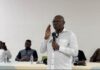




A National Vice Chairman aspirant of the National Democratic Congress (NDC), Samuel Addo Otoo, has pledged to expand access to education and skills development for party members as part of efforts to improve their welfare and strengthen the party.
He says, if elected, he will facilitate scholarship opportunities and introduce programmes to enable party members, particularly those without formal educational qualifications, to pursue certificate, diploma and other higher education programmes.
Mr Otoo made the pledge when he addressed party members at Daboase, the Wassa East District capital in the Western Region, as part of his campaign ahead of the NDC’s upcoming national executive elections.
He is number 10 on the ballot paper in the contest for National Vice Chairman.
Mr Otoo, who has been a member of the NDC since 1995, said his decision to contest the position was driven by the need to prioritise the welfare and empowerment of party members, whom he believes are often neglected after the party assumes political power.
He argued that while members contribute financially, intellectually and physically to the party’s electoral successes, adequate attention is not given to their personal development and economic well-being when the party is in government.
Drawing on his professional background in banking, law, economics and business, Mr Otoo said he intends to use his experience to create opportunities for party members to improve their livelihoods.
He disclosed that he had engaged vice-chancellors of various universities, who had indicated their readiness to offer certificate and diploma programmes for mature students, including individuals who had never had the opportunity to attend formal school.
According to him, the initiative is expected to begin in February 2027, with opportunities available to people in different occupations, including dressmakers, farmers and artisans, who wish to upgrade their skills or pursue further education.
He said the initiative would be supported through existing scholarship opportunities from the Scholarship Secretariat, the Ghana National Petroleum Corporation (GNPC) and other institutions, alongside additional fundraising efforts to make the programmes accessible at no cost to beneficiaries.
Mr Otoo also pledged to advocate the training of at least two party members in every constituency to become lawyers, equipping them to provide legal representation and support to members.
He said his experience handling legal cases involving party members across the country had exposed the need to develop more legal professionals within the party to address their challenges.
Beyond education, the aspirant pledged to mobilise resources to construct decent constituency and regional party offices, arguing that many existing facilities are in poor condition and do not provide a conducive working environment for party executives.
He further proposed the establishment of an insurance scheme to provide financial and medical support to party members who suffer injuries while undertaking party activities, particularly during elections.
Mr Otoo cited cases of party supporters who sustained serious injuries during the last general election, including some who lost their teeth, saying the party must establish a system to support members in times of need.
He said his ambition was to assist the National Chairman and other executives to build a party that not only wins political power but also invests in the people whose commitment and sacrifices make electoral victories possible.
Mr Otoo, who currently chairs the NDC Ashanti Regional Finance Committee, said his fundraising experience includes mobilising more than GH¢12 million to support the party during the last general election, in addition to logistics.
He maintained that his background in finance, law and policy analysis would be valuable in advancing institutional reforms and improving the welfare of party members.
He urged delegates to support his candidature, insisting that the NDC must move beyond relying on members during election campaigns to deliberately investing in their education, skills development and economic empowerment.
By Ebenezer Atiemo