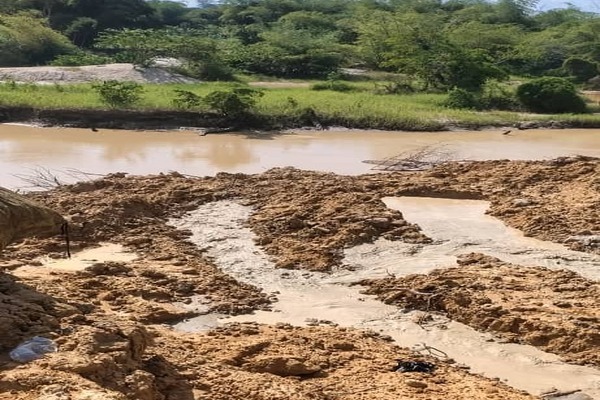

Praho, a farming community in the Akyemansa District in the Eastern Region has been completely taken over by illegal mining.
This has left natives in despair as their main source of livelihood — farming — is in ruins, with vast tracts of land and even the community’s main source of water, River Pra, mined out.
Already, about 560 acres of land in the small community have been consumed by the illegal miners, some of whom are foreigners who carry out their large-scale activities with bulldozers and excavators.
The situation has resulted in an increase in the cost of food items in the community.
The environment has been ravaged, water bodies polluted, and farms and forests destroyed.
Indeed, cassava, which could sell for GH¢10 in Koforidua, the regional capital, is being sold at between GH¢15 and GH¢20 at Praho.
Residents trek for almost two kilometres daily to get water for domestic chores.
Most of the residents now depend on rainwater for their domestic chores and farming activities.
Our reporter gathered this last Friday, November 20, 2026, when he visited the Praho community to see for himself how the town was fast deteriorating as a result of these illegal mining activities.
Accompanied by some opinion leaders, some youth of the community and security personnel, the team came face to face with environmental degradation, a devastation being inflicted on the community in broad daylight.
With heavy machinery at work, light-skinned foreigners directing affairs, some youth dug away the life of the soil and the future of agriculture and unborn generations with careless abandon.
The team arrived in the town around 11 a.m., and after about two hours of trekking and manoeuvring the narrow, bushy and muddy route, reached the site of the relentless illegal mining.
Three opinion leaders whose boots gave way during the virtual jungle walk through the pitted path, ended their journey midway.
The illegal miners bolted upon hearing of the arrival of the team, leaving their mining equipment behind.
While the key figures, the foreigners, ran into the forest, some of the youth kept on mining.
On one side stood some youngsters, who looked like teenagers, who had brought food, drinks and bottled water to sell to the miners.
They included a lactating mother and her baby.
As has come to be associated with galamsey activities, the illegal activity must have fetched the illegal miners and their sponsors thousands in foreign currencies, but the town’s infrastructure does not portray a community with such volume of wealth mined from its belly.
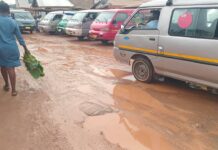
The roads in the community are in a sorry state so passengers sometimes had to alight and push their vehicles anytime they got stuck on the muddy roads.
Wastewater from the mining activities ends up on sections of the road, making [movement difficult for] the neighbouring communities — Abu, Paawudu, Foase and others.
They raised concerns over persistent poor telecommunication network services in their area, calling for urgent intervention from authorities.
Some residents who spoke to our reporter said what even beat their imagination was that Pra River — where their spiritual god dwelt and where natives performed rituals to seek clearance in order to enter the wild forest reserve in the community — had all been raided by the illegal mining activities.
Opanin Yaw Osei, for instance, expressed concern that the traditional authorities had not been able to tackle the issue head-on.
“Our people can’t get to the site,” he said.
Galamsey is in full swing and appears to be getting worse by the day at Praho in the Eastern Region.
A stream used by farmers in the community has been completely polluted, raising serious concerns about the impact of illegal mining on water sources and livelihoods.
Residents are increasingly concerned as the activities continue, while authorities appear silent, including the Eastern Regional Security Council.
The situation raises questions about what is being done to stop the destruction and protect the community’s water sources.
The residents have been left with brownish, milky-looking water sources.
Water-borne diseases are rife in the community as residents are forced to use the polluted water.
Residents depend on the Pra River for their livelihood as they use water from the stream for household chores, including bathing, irrigating crops and fishing activities.
By Benjamin Aidoo