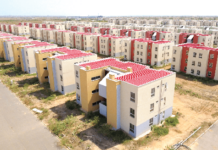

The Group Chief Operating Officer (GCOO) of Media General, Mr Nuamah Eshun Famiyeh, has said that providing affordable housing is not just about putting up structures that cannot be afforded by ordinary Ghanaians.
He says it is about aligning affordability with accessibility, and ensuring that dignity, safety, and opportunity are not compromised by the very solutions meant to improve lives.
Mr Famiyeh made this point during a thought leadership forum on the theme ” Blueprint to Brick: Making Affordable Housing Work” organised by Media General on Tuesday, September 23.
He said, “And here is another paradox. Built communities often begin with better infrastructure, stronger social bonding, and a sense of pride. But to keep them in the pristine condition of their early years requires service charges. Unfortunately, try collecting service charges from the average Ghanaian pensioner, and you quickly realize why so many of these communities fall into decline. By the time the proud homeowner retires from active service, their capacity to contribute dwindles, and the entire estate begins to deteriorate. What started as a solution, again, becomes part of the problem.”
According to him, “These realities remind us that affordable housing is not simply about constructing units. It is about creating sustainable communities, backed by sound governance, enforceable management systems, and financing models that work across a resident’s entire life cycle. It is about aligning affordability with accessibility, and ensuring that dignity, safety, and opportunity are not compromised by the very solutions meant to improve lives.
He therefore tasked participants “to move beyond identifying the paradoxes, and to explore the pathways that will make affordable housing not just a promise, but a lived reality for ordinary Ghanaians.”
During the event, the CEO of National Homeownership Fund, Prosper Hoetu, appealed to financial institutions to help grow the mortgage market.
He made the point that a buoyant mortgage market will ensure more products are promoted for more workers to access.
He said, financing is the main issue facing the housing sector.
“Help us grow the mortgage market. to promote competition so that different kinds of products can be promoted for Ghanaian workers to access,” Mr Hoetu said.
He noted that developers are looking for cheap resources to enable them to develop affordable housing.
To address the housing challenge, he said, there is a need for a statutory fund that will go into housing.
“Addressing the demand and supply requires financing, that is the bottom, the developer needs resources to invest in housing.”
“There must be some dedicated funds for that. We have failed significantly in doing that, providing social housing programmes targeting the vulnerable, we must deliberately, as a state, provide funding,” he added.
Below is Mr Nuamah Eshun Famiyeh’s full speech:
THOUGHT LEADERSHIP SEPTEMBER SERIES – From Blueprint to Brick: Making Affordable Housing Work
Date: 23rd September 2025
Opening Remarks By the GCOO
It is my honor to welcome you to this Thought Leadership Event on “Making Affordable Housing Work.”
Housing, as we all know, sits at the heart of national development. Yet, it is also one of the areas where the paradoxes of our society are most visible. For instance, the lower-income families who require more rooms often because they have larger households are those who can least afford them. On the other hand, smaller households, with fewer dependents, are often better able to afford more suitable accommodation.
We also see this paradox in the geography of our cities. Rent appears cheaper on the outskirts, but the financial and human cost of transportation time lost in traffic, higher commuting expenses, reduced productivity erodes whatever savings are made on rent. What looks affordable on paper often becomes unaffordable in practice.
I speak also from personal experience. Over the years, I have lived in four separate government-built estates Sekondi, Kanda, the Italian Flats in Tema, and Kumasi. These were initially well-planned communities, designed with vision and foresight. Yet, over time, many fell into decline. Uncontrolled extensions, poor maintenance, and weak estate management systems turned what were once model neighborhoods into cautionary tales.
And here is another paradox. Built communities often begin with better infrastructure, stronger social bonding, and a sense of pride. But to keep them in the pristine condition of their early years requires service charges. Unfortunately, try collecting service charges from the average Ghanaian pensioner, and you quickly realize why so many of these communities fall into decline. By the time the proud homeowner retires from active service, their capacity to contribute dwindles, and the entire estate begins to deteriorate. What started as a solution, again, becomes part of the problem.
These realities remind us that affordable housing is not simply about constructing units. It is about creating sustainable communities, backed by sound governance, enforceable management systems, and financing models that work across a resident’s entire life cycle. It is about aligning affordability with accessibility, and ensuring that dignity, safety, and opportunity are not compromised by the very solutions meant to improve lives.
Our task here today is therefore clear: to move beyond identifying the paradoxes, and to explore the pathways that will make affordable housing not just a promise, but a lived reality for ordinary Ghanaians.
Thank you, and once again, welcome.