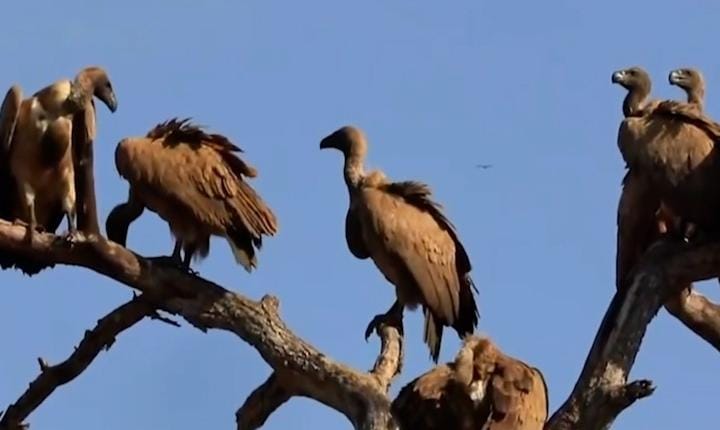

The former Agbogbloshie dumpsite, where vultures once gathered in large numbers, is noticeably quieter today.
Following a visit to the Kpone Landfill Site too, it was apparent that although some vultures can still be seen, their numbers appear far fewer than in years past.
Usman Muslim has worked as a waste collector for decades. He recalls a time when vultures were a common sight around waste sites.
“Here, there are no vultures like before. There used to be a time when their numbers were many; today it’s only the white birds that we see mostly.”
Professor Francis Gbogbo says the decline of vultures is no longer hearsay. Research across Ghana and West Africa points to shrinking populations.
“Vultures numbers are so low that the IUCN classify them as critically endangered. Now society is getting more advanced, and there are more advanced ways of managing waste. With that, you know the vultures are scavengers, and they find it more difficult to get food. This is one of the main reasons for the decline. Besides that, you see the Pied Crows; they are very strong competitors, and it appears that they are outcompeting the vultures.”
He further explains that there are strong persecutions as well.
“There are people who kill the vultures. They kill them for food, some for traditional medicine. In fact, there is high demand for vultures by the traditional practitioners. They use them for all kinds of things. So people kill them, they wrap them nicely in cement, brown papers, and then they export them.”
Nab Kwasi Borke, is a subsea engineer by profession and wildlife enthusiast by passion. He says the disappearance of vultures should concern everyone.
“People always ask, why are you keeping vultures? I think it’s because of the mysticism around vultures. People think they are witches or wizards, and indeed they use them for a lot of spiritual things. I don’t believe in them anyway. So, when they see me with a vulture, they would always ask, what are you keeping vultures for?“
Away from the wild, Nab has taken on an unusual mission to care for and breed vultures, with the hope of one day releasing them back into their natural habitat.
“They are all raptors and scavengers, and so they will eat meat. Their scavenging nature makes it easier. No matter how bad the meat is, they are still able to consume it. And that is one of the importance of having vultures around.”
According to experts, the role of vultures becomes even more important during the rainy season.
As floods wash waste through communities and stagnant water heightens public health risks, vultures help nature clear away dirt and decay before it becomes a threat to life.
Their stomach acids destroy deadly bacteria and viruses, preventing diseases like anthrax, botulism, and cholera found in rotting meat from spreading to humans, wildlife, and livestock as they feed on carcasses.
Yet at a time when their services may be needed most, these silent custodians of the ecosystem are themselves struggling to survive.
Obed Segbefia is Assistant Project Officer at the Ghana Wildlife Society. He says among the threats vultures are facing is the falling of big trees.
“Some threats, such as habitat loss is one of the greatest problems that vultures are facing because without tall trees, they are not going to be able to find nesting places and then nest and reproduce. So, cutting down these big trees that are still left in the cities, we should kind of consider that these birds are going to be using those places as very important breeding grounds.”
What is now left is how to conserve the little population left behind.
Professor Gbogbo says a lot more must be done.
“Vultures are seen as unclean animals. That is just generally how it is. And people don’t like them. They don’t see them as important. But if you look at the role they play in the environment, you see that they are very, very, very important. And if they go extinct, it is not too good for society.”
For him, captive breeding could be another means of conserving the little population left behind.
“Captive breeding is important. We use it when a species is getting out of the nest. But then you always have to exercise caution because when you breed animals and release them to the wild, you should do it in such a way that the animal can survive in the wild.”
On society, he adds that proper waste management should continue to be a priority.
“As for society, we cannot say that we will not manage our waste. We have to certainly manage our waste because that is also important for us. But the most important thing is that the killings, the unwanted killings, should be stopped and we need to educate people on that.”
For a species that has spent generations quietly cleaning the environment and helping keep ecosystems healthy, the challenge now is to ensure they remain part of Ghana’s skies for generations to come.
By Samuel Yeboah Adams