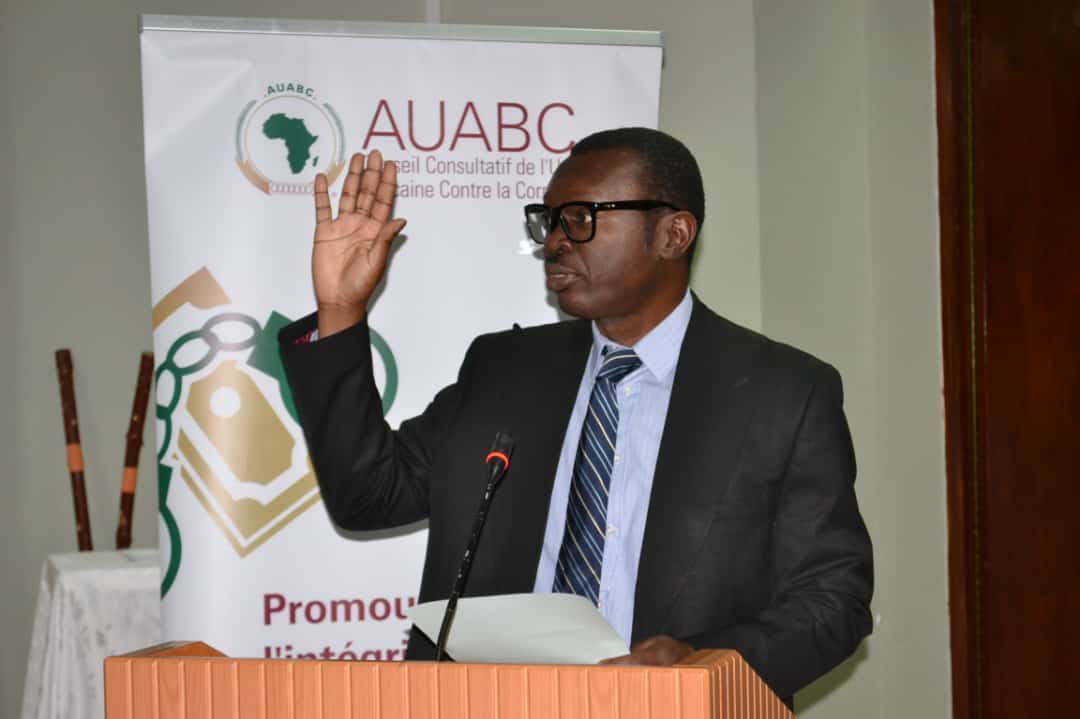

Chairperson of the African Union Advisory Board Against Corruption (AUABC), Kwami Edem Senanu, has proposed a new chain-of-results framework to measure the African Union’s performance on corruption and accountability.
He has warned that the “paper compliance” which has been the status quo over the years looks good on paper but fails citizens in reality.
Speaking at the 12th Students and Young Professionals African Liberty Academy (SYPALA) at UPSA on Tuesday, August 25, 2026, Mr. Senanu said the AU should be assessed through outcomes, not by counting treaties or meetings.
SYPALA 2026, organised by IMANI Centre for Policy and Education and UPSA under the theme “Africa’s Ascent: Forging Resilient Economies & Inclusive Governance,” hosted 100 selected young Africans under 35 from over 16 countries.
The Academy, which started at Ashesi University in 2007, seeks to expose young people to critical policy debates and equip them with practical skills.
Presenting on the topic “The Accountability Deficit: Corruption, Transparency and Public Trust. How is the African Union Measuring up?”, the AUABC Chair argued that while the AU deserves credit for Africanising the governance agenda, it lacks in creating peer learning spaces, improving internal financial disclosure, and linking corruption to development.
He identified four persistent weaknesses with the Union; the implementation gap as the central weakness, peer review constrained by voluntarism and diplomacy, poor continental outcomes, and transparency that is not yet citizen-facing.
According to him, five questions need to be answered to fix what he argued as a credible measurement framework.
“Commitment: Have states ratified and domesticated the relevant instruments? Capacity: Are oversight bodies independent, adequately funded and professionally staffed? Practice: Are budgets, contracts, beneficial ownership data, asset declarations and audit findings disclosed in usable form?
“Consequences: Are violations investigated impartially, assets recovered and recommendations implemented? Public value: Do citizens experience fair services, reduced bribery and greater trust?” he outlined.
Mr. Senanu explained that the chain prevents “paper compliance” where states ratify conventions but fail to implement them, noting that corruption continues to cost Africa an estimated $125 billion annually, equivalent to half of domestic tax revenue.
Mr. Senanu, who was re-elected in 2024 as the first Ghanaian to serve two terms as AUABC Chair, emphasised that unless budgets, contracts, beneficial ownership data and audit findings are disclosed in usable form and violations have consequences, public trust will continue to erode.