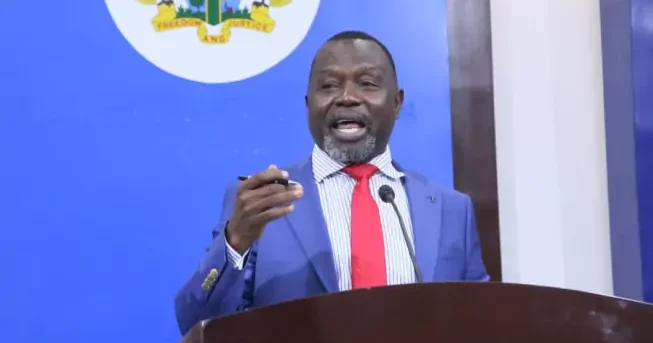

Attorney-General Dr Dominic presenting has criticised the Ghana Bar Association (GBA) for selectively speaking out on the removal of the Chief Justice, Gertrude Torkornoo.
He called on the GBA to uphold the rule of law and constitutionalism and not align with politics.
Speaking in reference to the removal of the former Chief Justice Gertrude Torkornoo, as head of the judiciary, at the opening of the Annual General Conference of the GBA on Monday, September 15, 2025, he said, “In 2015, an Article 146 petition was received by the Chief Justice in relation to the removal of CHRAJ boss, Madam Lauretta Lamptey. The bar failed to speak out in the process. In the run-up to the 2016 elections, the then-opposition NPP engaged the EC in court battles over the voter identification system. This gave rise to the Abu Ramadan line of cases.
“Immediately upon assuming office in 2017, an Article 146 petition was filed for the removal of the EC chairperson, , and her deputies from office. The Bar saw no basis to speak up about the compliance with due process.
“But in recent times, the bar found its voice when a petition based on the same constitutionally defined procedures was brought in respect of the removal from office of the former Chief Justice, Gertrude Torkornoo. The honest question we have to ask ourselves is what changed?
“The three petitions mentioned touch on three constitutional bodies critical to the sustenance of our democracy. Their independence has been guaranteed by the Constitution. The three occupants were all women of significant repute and members of our noble profession,” he said.
The Chief Justice Gertrude Torkornoo was from office by President John Dramani Mahama on Monday, September 1.
A statement issued by the Minister of Government Communications, Felix Kwakye Ofosu said that “President John Dramani Mahama has, in accordance with Article 146(9) of the 1992 Constitution, removed the Chief Justice, Her Ladyship Justice Gertrude Araba Esaaba Sackey Torkonoo, from office with immediate effect. This follows receipt of the report of the Committee constituted under Article 146(6) to inquire into a petition submitted by a Ghanaian citizen, Mr Daniel Ofori. After considering the petition and the evidence, the Committee found that the grounds of stated misbehaviour under Article 146(1) had been established and recommended her removal from office. Under Article 146(9), the President is required to act in accordance with the committee’s recommendation,” the statement said.
This came after President John Dramani Mahama received the report of the Article 146 Committee of Inquiry set up to investigate petitions calling for the removal of Gertrude Sackey Torkornoo, following the determination of a prima facie case in three separate petitions that sought the removal of the Chief Justice from office. In line with constitutional requirements, President Mahama constituted a five-member committee to conduct the inquiry.
The committee was chaired by Justice Gabriel Scott Pwamang of the Supreme Court. Other members included Mr. Daniel Yaw Domelevo, former Auditor-General; Major Flora Bazaanura Dalugo of the Ghana Armed Forces (GAF); and Professor James Sefah Dzisah, Associate Professor at the University of Ghana.
The President is expected to study the committee’s findings and communicate his decision in accordance with the provisions of the 1992 Constitution.
Justice Torkornoo was suspended on April 22, 2025, following the establishment of a prima facie case against her after the receipt of three separate petitions.
Her suspension, carried out in line with Article 146(6) of Ghana’s 1992 Constitution, was done in consultation with the Council of State.
Subsequently, a five-member committee chaired by Supreme Court Justice Gabriel Scott Pwamang was appointed by the President to investigate the allegations.
Justice Gabriel Scott Pwamang, said after presenting the report to the pressident that “To the committee, our mandate and remit as set out under Article 146 Clauses (7) and (8) of the Constitution is clear and it is to inquire into the petitions in camera, hear the person against whom the petitions have been brought in her defence by herself or by a lawyer or other expert of her choice and then to make a recommendation to the President.”