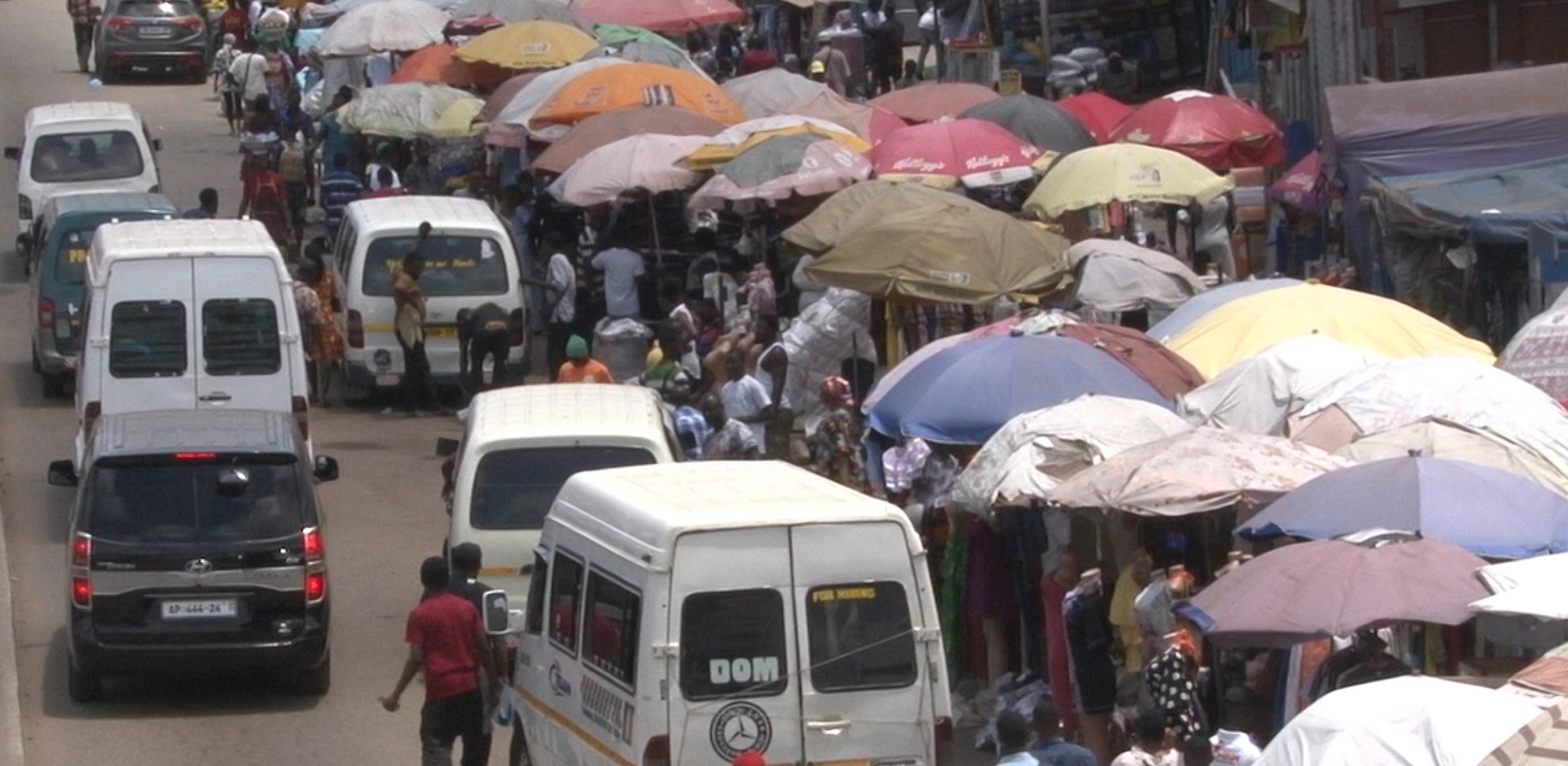

Traders at Lapaz, a community known for its busy night market activities in the Greater Accra Region, have appealed to city authorities to open a space close to the footbridge for trading activities.
Although they are ready to comply with a directive to stop selling on the edges of the road and along pavements, they are against any attempt to evict them completely from the area.
“Do not chase us off the streets entirely. Just let us sell under the footbridge,” Samuel Ofosu Bamfo, Chairman of the Lapaz traders, told TV3 in an interview on May 11.
The appeal comes after the Greater Accra Regional Minister, Linda Ocloo, visited the area on Thursday, May 8, 2026 and delivered a stern ultimatum that the traders vacate the streets by Monday, May 11, or face the full force of a new bylaw that bans highway selling and restricts pavement trading to Saturdays and Sundays only.
In what they describe as a show of cooperation, the traders on Monday did not show defiance, but rather moved backwards in a fashion that creates a clear passage for drivers and pedestrians.
A visit in the morning of Monday, May 11, showed an improved sight.
“We have accepted not to sell on the pavement; the road is free. The pavement is clear. We have done our part,” Bamfo said.
But even as they made space for the public, the traders made one thing clear – they are not going home; they simply shifted their position.
“This place is not a market place. We are here because of hardship. We have spoken to the people to allow traders on the pavement to move under the footbridge. Being under the footbridge is safer than the pavement. The pavement and roads won’t be choked anymore.”
The traders argue they were asked to vacate the premises for the construction of the footbridge, which affected their sales.
Upon the completion of the footbridge, they expected the Roads Ministry to open a barricaded space around the footbridge so they could use for trading but that has not happened.
That appears to be the only space they could manage now in the face of the new decongestion drive.
“My children are in the university and SHS. I am suffering; we take loans to run the business” – among the crowd, one trader’s story cut through the noise like a knife.
Gladys, a mother and long-time vendor, broke down as she described the cruel irony of their situation.
“During construction of the footbridge, we were asked to move from where we were to the pavement. Now that it has been completed, we have been asked to go home,” she said, with her voice trembling.
She looked at the metal barricades that now seal off the space under the footbridge, a space that could be their salvation.
“Many of the traders have been forced to go home due to lack of available space to sell,” she said.
Constant efforts to decongest the capital appear to yield little long-term success because traders continue to return to pavements and roadsides shortly after enforcement exercises.
Concerns remain over lack of sustained monitoring and continuous enforcement as the problem persists, especially in Lapaz where traders say they have not been given any better alternative to sell.
The situation in Lapaz reflects a difficult balance between enforcing city order and protecting livelihoods of hundreds of informal traders who depend on these busy commercial spaces for survival.
By Kuzagbe Efua Bernice, with files from Christian Yalley.