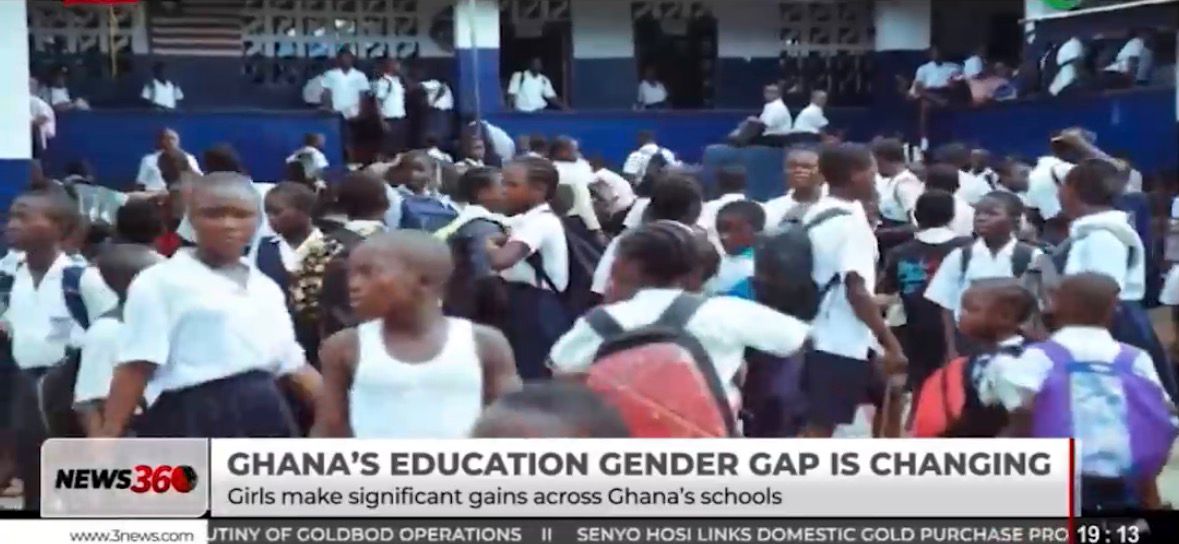

Ghana has spent decades trying to close the education gap between boys and girls.
Today, girls have made significant gains and, in some schools, are increasingly taking the top academic honours.
But does that mean the girl child is now outperforming the boy child?
And as attention turns to that progress, is there something about the boys we may be missing?
There was a time when Ghana had to sing this song.
For many girls, getting into school and staying there was not guaranteed.
Where resources were limited, the boy could come first.
The girl could be needed at home.
Early marriage or pregnancy could interrupt her education.
And beneath it all were old assumptions about how far a girl really needed to go.
So the response was deliberate.
Education reforms, Girl-child campaigns, Affirmative interventions, More support from families.
“I always say that when I came into the university in 2000, I could count the number of professors that were females in the department, but today, the narrative is changing gradually. We realize that now we go for graduations in many of our basic schools and the number of girls who take awards are high.
In my daughter’s school, all the 7 awards were taken by girls and I am told it is happening in different places as well so it shows therefore that there seems to be this change in terms of the number of girls having access to education.”
And the numbers show how far that journey has come.
In 1990, girls were significantly underrepresented, particularly at junior secondary level.
Today, primary enrolment has reached parity.
And at JHS, the balance now tilts slightly towards girls.
Research examining Ghana’s education reforms over 25 years similarly concludes that the gender gap at basic-school level has closed, even though inequalities remain beyond basic education.
And at some schools, that change is now visible on the prize giving stage.
At Christ the King International School, Headmistress Portia Felice Mensah says she has noticed a pattern in the classroom too.
“The consistency in completing assignments, notetaking, preparation towards class assessment and even seeking clarity when it comes to concepts that they do not understand, you see the girls emerging. The girl child is outspoken and they develop 6 months earlier than the boys so you get the boys delaying in that aspect. The boy child feels that he should conceal his academic difficulty. Because of ego, they wouldn’t want to ask so many questions in class.” Says headmistress of Christ the King International School, Mrs. Portia Felice Mensah.
But what we see at a few schools is only part of the story.
The bigger test is what happens when we look across thousands of classrooms nationwide.
A 2024 study examining Ghana’s 2021 Primary Four National Standardised Test found statistically significant differences favouring girls overall in both English and Mathematics.
Girls were ahead in both subjects in six regions, and in English in another six.
Boys recorded a significant Mathematics advantage in only Oti Region.
But the research and gender lead at the Africa Education Watch, Sahadatu Ali says the national picture still needs much better gender disaggregated data.
“We don’t have data especially disaggregated by gender when it comes to learning outcomes, completion, we have for transition, you need to look at JHS to SHS transitions. In Ghana recently, we don’t disaggregate performance by gender and it has been one of our advocacy messages so we know who is doing well and how to target interventions.”
For years, the question was how to give the girl child the same chance as the boy.
The evidence suggests Ghana has made considerable progress doing that.
But there is an important distinction.
A girl doing well does not necessarily mean a boy is doing badly.
So perhaps the question is no longer whether girls have caught up.
Perhaps it is whether, while celebrating that progress, we are paying enough attention to what boys themselves may be going through.
For Dr Samson Obed Appiah, Senior Lecturer at the Department of Sociology in the University of Ghana, part of that changing story may be the expectations society places on boys.
“Because of the cultural norm that the boy must become bold and must take care of the family, many of them begin to see economic independence, so even if the person goes to school, at some level, they would want to find something to do to support the family.
This is how the narrative must look at, that we shouldn’t look at it as a competition because their education is being affected so you’ll see why a lot of the girls will move ahead of them. Can we begin to identify the areas that boys are being left out and encourage them, so that they will also see to need that they don’t have to drop out and just enter into trade to support the family so as we are also doing to support the girl to go to school,” she said,
In farming, fishing and mining communities, those expectations can begin early.
And for Ethel Adjorlolo Marfo, Founder of Junior Shapers Africa, her interest in the boy child began with something she noticed firsthand.
“An idea came to me to start a salon for girls and whiles I was there, parents used to drop off their sons with me as well. I realized the character deficit between the girls and boys, I noticed girls will pick up a book from my shelf of books and be reading but the boys will never do that but rather, they will be climbing from one point to the other. I asked myself how can I engage these boys productively and that is where the idea came to me to have an intentional mentorship program where I bring men on board,” she stated.
Father absence, Limited male mentorship, Emotional struggles.
And sometimes, too much freedom wrapped in the assumption that boys will somehow work things out for themselves.
Even though boys may be facing challenges of their own that require attention, the barriers facing girls have not disappeared, especially among poorer and marginalised communities.
“When we are looking at these issues, yes the national picture may look very nice, but going beyond the national picture, let’s look at district specific data. I mentioned gender parity for instance, at the national level, it looks good but when you go to most deprived districts, you have issues there especially districst in the northern part of ghana, they have gender parity as low as 0.75 which means for every 1 boy, you don’t even have up to 1 girl.”
For the headmistress at Christ the King International, even with girls taking many of the prizes, the picture in her own school is not one sided.
“We are not saying that we don’t have the girl child struggling academically. We do have and when the boys make it, they make it big time but what I have seen is that even when the boy leads, those who follow are girls, so you get the girls taking most of the awards but we still have some girls who are struggling. My argument will be that, let’s support the individual child because they all have potentials.”
So recognizing boys’ needs cannot mean dismantling what helped girls get this far.
“I think that that affirmative action should still remain. We shouldn’t also do deny the boys per say but the truth is that if we remove it and say we should all go to school there are cultural barriers that are affecting the girl child at the basic level, the menstrual thing, issues about teenage pregnancy they are still there and even though GES has a policy that girls who are still pregnant can still go to school. The truth is that, stigma is still affecting most of them.” Dr Samson Obed Appiah ended with this.
Years ago, Ghana looked at its classrooms, saw that too many girls were being left behind and decided to do something about it.
Today, those girls are showing us what can happen when opportunity meets deliberate support.
Their success should not become a problem to solve.
It should become a lesson to learn from.
Because if some boys are now struggling, academically, socially or emotionally, the answer is not to ask the girls to slow down.
It is to ask what those boys need to keep moving too.
Perhaps equality was never about ensuring that boys and girls finish in exactly the same place.
It was about making sure neither is denied the chance to become everything they can be.
By Sarfoa Boahene