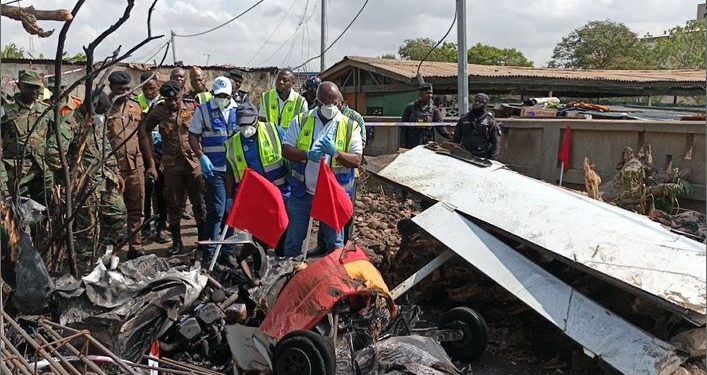

The Aircraft Accident and Incident Investigation and Prevention Bureau (AIB Ghana) has attributed the March 17 light aircraft crash in Tema to engine failure due to overheating.
Presenting its findings on Wednesday, May 27, the lead investigator, Captain Paul Forjoe (rtd) said investigations also pointed to the pilot’s personal texting activities on his cell phone, as well as limited access to flight instruments and switches due to his seating position, as contributing factors to the accident.
“The investigation believes that the aircraft most likely had an engine failure due to overheating,” AIB Ghana noted.
According to the report, investigators considered the pilot’s failure to properly respond to signs of engine overheating as a major concern.
The investigation further revealed that the pilot breached aviation regulations by carrying his brother on board during the flight.
According to Aircraft Accident and Incident Investigation and Prevention Bureau, the action violated condition number four of the permits issued to the pilot, which prohibited the carriage of cargo or persons other than crew members necessary for the purpose of the flight.
The microlight aircraft, registered 9G-ADV, crashed on March 16, 2026, within the premises of the TMA Day Care Centre near the Oninku Drive Basic School in Tema Community One.
Findings by the Investigation Bureau
All the three flights conducted from Ho Airport on March 16, 2026, the pilot occupied the rear seat while his friend and brother occupied the front pilot seat. This was not in compliance with conditions of the flight permit and restricted access of the pilot in the rear seat to some critical instruments like warning lights and switches.
All three flights conducted from Ho Airport on March 16, 2026 were unauthorized as they did not have flying permit to operate.
ATC was not aware of the details of the flight permit issued to the aircraft.
Accra airport and Ho airport management were not aware of the details of the flight permit issued to the aircraft.
The aircraft did not have any nominated maintenance facility or personnel responsible for providing medical service for the aircraft.
Following the white snow and engine overheating, the required maintenance actions were not performed.
There are no records available of any maintenance action on the aircraft between January 14, 2026 and the last flight of March 16, 2026 during which 15 flights were executed.
The aircraft most likely had an engine failure due to engine overheating.
The aircraft did not make a distress call or declare an emergency prior to the accident.
Contrary to the ACT, Air Traffic Control (ATC) did not notify AIB Ghana of the accident.
Causes
The investigation believes that the aircraft most likely had an engine failure due to overheating.
Also, that the aircraft at which the engine failed was too low to enable the pilot find a suitable safe landing area.
Contributory factors
The failure to address the engine malfunction, identified at home which required maintenance assistance to diagnose the root causes, the results of the undiagnosed malfunction most likely worsened the malfunctions en route.
Pilot seated in the rear seat with limited access to the aircraft engaging instruments and switches needed during the critical stages of the flight.
Destructions due to persistent communications on his cell phone.