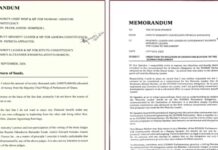

An intercepted memorandum purported to have emanated from the office of the Deputy Minority Leader in Parliament and MP for Asokwa, Patricia Appiagyei is making the rounds and the headlines.
Some persons have tagged it as fake, but for what it is worth it has generated varied public conversations.
The “return of funds” memorandum seems to have blown the lid off what looks like a well-oiled attempt to buy the conscience of the Minority. The bitter truth is, the memorandum reads good on paper but in reality it stinks. It is not just a refund memo, it is a full confession.
I dare say that, that memorandum would not have been written and, the funds would not have been returned if the Minority had participated in the vetting per the logic espoused in the document.
The said funds amounting to Seventy Thousand Ghana Cedis (GHS70,000.00), was given to the Deputy Minority Leader allegedly, as ‘advance money’, for the purposes of granting ministerial and supreme court nominees ‘safe passage’ at their vetting.
I beg to ask oo, is vetting no longer about competence these days? Is it no longer about integrity? It is not about protecting the public purse? Have all those hours of efforts, time, airtime and emotions been a money exchange platform all this while?
The budget, purse, wallet, pocket, coffers of kitty from which these funds were drawn, remains unknown. The Deputy Minority Leader herself confirms in paragraph two of the memo that, primarily and as a matter of fact, she doesn’t know the source of the money given to her. Yet, she banked it for a few days anyway.
For the records, Madam didn’t know the source of the money in paragraph two of her momo. However, in the very next paragraphs she goes ahead to mention the names connected to the money.
Question: How can one not know the source of money and still know who the money was meant to help vet? Isn’t it interesting and shocking at the same time? Any Gen Z will be looking at Madam with a bombastic side eye.
The occupants of the front bench in Parliament are not called leaders for nothing. They are central to everything that happens in Parliament —before, during and after. So, if a Deputy Minority Leader does not know the source of money being pushed to her by the Majority Chief Whip, through his opposite number, the Minority Chief Whip, then what is it? A gift? A bribe? A trap? A familiar tradition?
Mind you, Patricia Appiagyei is not new to the vetting table, nor is she new to the front bench. She definitely knows so much that we don’t know.
It gets even more damning when the Deputy Minority Leader says she “…. does not want to enjoy any financial benefit to vet her own colleagues in leadership from the other side — Hon. Mahama Ayariga and Hon. Zanetor Agyeman Rawlings.”
What does this mean? Madam dey wan talk say like Ayariga and Zanetor no be leaders, she go collect the thing kulerm? Does it mean the Majority had so much money at their disposal that had to be shared, regardless, to the Minority to perform their constitutional mandate (for which they are paid) to vet nominees? What kind of vetting is that when the vetter is paid by the vettees’ side ahead of the vetting?
The memo also cites the Minority’s protest and non-participation in the vetting of three Judges — Justice Sophia Rosetta Odukuwa Bernasko Essah, Justice Edward Amoako Asante and Justice Anthony Forson Jnr.
Per principle, Madam says it is “totally unthinkable” that she should enjoy any gift presented by any of the above Judges. Chillingly she adds: “It is also not my intention to extort any money from any of the above judges.”
Two key words were introduced there: Extort and Gift. The former, has recently been hung around the neck of the Minority Leader Osahen Afenyo Markin by Goldbod CEO Sammy Gyamfi. The latter is also very popular in the Ghanaian setting to the point where some people think of gifts as inalienable rights.
Again, on the question of extortion, if one is not extorting, why mention extortion? People only mention what they know exists and the circumstances under which they exist.
I am wondering how this extortion thing works.
Let me hazard a guess: a nominee’s name is sent to Parliament, a committee is constituted, money is assembled from somewhere, MPs take the cash and ask soft or irrelevant questions, they commend and endorse and that’s it, “rubber stamp” duties done nice and easy?
A basic question is, were the Supreme Court nominees expected to or supposed to pay members of Parliament to be vetted? Was that money really being channeled through the Majority Chief Whip as an “advance”? When was this advance actually received? Did it mean that there was more to come? Does that make Parliament a cash-and-carry vetting center?
Does it point towards judicial capture via parliamentary gift-giving, extortion or bribery? By the way, is this advanced money, gift or bribe taxable?
A section of the public has heaped praises on Madam Patricia Appiagyei. Does she deserve the praise? Yes, but definitely not a clean bill of health.
First and foremost, she deserves praise because she returned the cash in full and left a paper trail, in a Parliament where many may have collected money and kept quiet.
She deserves praise because she fully supported her Leader by following his example to return her share; which is also her caucus’ position.
The praise must however be paused to examine some contradictions in the memorandum. This will be hinged on the question of morality and conditional morality. One, she returned the funds because her leader did. It was not her own initiative. She had to fall in line. Question: would she have kept it if her leader had?
Two, she first received the money possibly ahead of the vetting or on the day of vetting. Then she kept it while the boycott was on.
She only returned it later to be in sync with a caucus position. Question: why take it in the first place if the principle was unshakeable? See, you don’t collect money you don’t know the source of, keep it, and then remember your principles days later after a caucus meeting to return it.
Now, let’s examine motives. Was the true motive of returning the cash a form of damage control? Bluntly speaking, boycotting vetting and still taking vetting money is indefensible. If the public gets to know that a side boycotted on principle in the morning and collected GHS70,000 each for the same vetting in the afternoon, wouldn’t the rubber stamp tag become a bribery tag?
Was it a question of clean conscience or caucus management? For example, If the Leader returns his share and the Deputy keeps hers, the Minority will appear divided. That will not send a good signal, especially in these times of opposition when unity is key.
Do you also get the sense that the word “extort” was for self-protection? An alibi and self-defense of a sort? Because really, nobody had accused her of extortion so what made her think that somebody would, eventually? The unpleasant rumor is that many Ghanaians think vetting money comes from nominees.
In the view of the right-thinking society, this would not qualify as an advance money. It will be seen as a textbook definition of a bribery machinery that has been operated overtime in a certain manner. If it is bribery, both the giver and the receiver are guilty.
Furthermore, in the memorandum, the Minority Leader, Osahen Alexander Kwamena Afenyo-Markin, is said to have returned his share of the money first. Which means this was not an isolated mistake. It was coordinated sharing. An organized distribution with a sharing formula.
In simple terms, “obiaraa be didi pekyeeer”. But wait oo, if this is not corruption, then what is? I mean, how else do you explain the memo and its contents to the ordinary man or woman?
Some Ghanaians have also suggested that Madam Appiagyei must be commended. Well, her actions may attract commendation, but what she has exposed also attracts condemnation. Have bullion vans been parked behind Job 600 all this while when we were hailing Parliament as the house of democracy?
At this moment, the Majority Chief Whip and MP for South Dayi, Nelson Dafeamakpor must come clean. He ought to tell us if the Deputy Minority Leader’s claim is true or false? He ought to reveal the source of the funds? He ought to say what the GHS 70,000 was for? He ought to tell us whether he has taken custody of the refund and what purpose that money will be put to? He ought to tell us who else took money and has kept quiet?
Is this the normal practise in our Parliament? Doesn’t this reinforce the long-standing rubber stamp tag on Parliament and the quality of nominees they endorse to serve us and the consequences thereof?
Is this the long-awaited scandal of President John Mahama’s second coming? Aside the Minority Leader and his Deputy, who else received anything and has kept quiet?
Will those beneficiaries also return their share in principle?
Would the money have been returned if the Minority had participated in the vetting and not staged a walk-out, according to Madam?
How many of such ‘gifts’ have been received in the past for participating and how much does it amount to?
Will those previous funds too be returned in principle?
If vetting 5 people can prick one’s conscience not to ‘extort’ GHS 70,000 then what would have been the benefit of vetting 60, 100 or even 120 ministers — money presented in bullion vans?
Should we be looking at Parliamentarians on sensitive committees like the Vetting, Governance Assurance, Public Accounts, Adhoc Bi-partisan, etc with microscopic lenses?
The masses are murmuring. Soon they will start screaming. They are reading between the lines and wondering why no nominee ever fails at vetting. They are wondering why no one is ever disqualified no matter how terrible their CV or performance is. Alas, ’tis only commonsensical not to fail the person who had paid you before the vetting?
It is not the case that holding on to the money was wrong, it made no political sense boycotting a process and receiving financial gains from same. The money may have been received as usual business and returned as unusual politics. Caucus has beaten conscience.
From what I see, the memo didn’t just expose a refund. It exposed the ‘business model’ the citizenry have suspected all along. Nominees pay, whips share, members receive, vet and endorse.
Until proven, these are but mere allegations. However, you view it, allegations fuel perception and perception damages image. Parliament, as an important part of our democracy, must quickly purge itself of this disturbing choreography and charade and regain its fearsome glory.
And, by all means, may this one too not be called fake, swept under the carpet or caged forever in a bi-partisan investigative adhoc committee report that will never see the light of day.
By Johnnie Hughes