
There’s growing concern following a chilling pattern of deaths recorded in the country.
Some persons reported missing were later discovered dead.
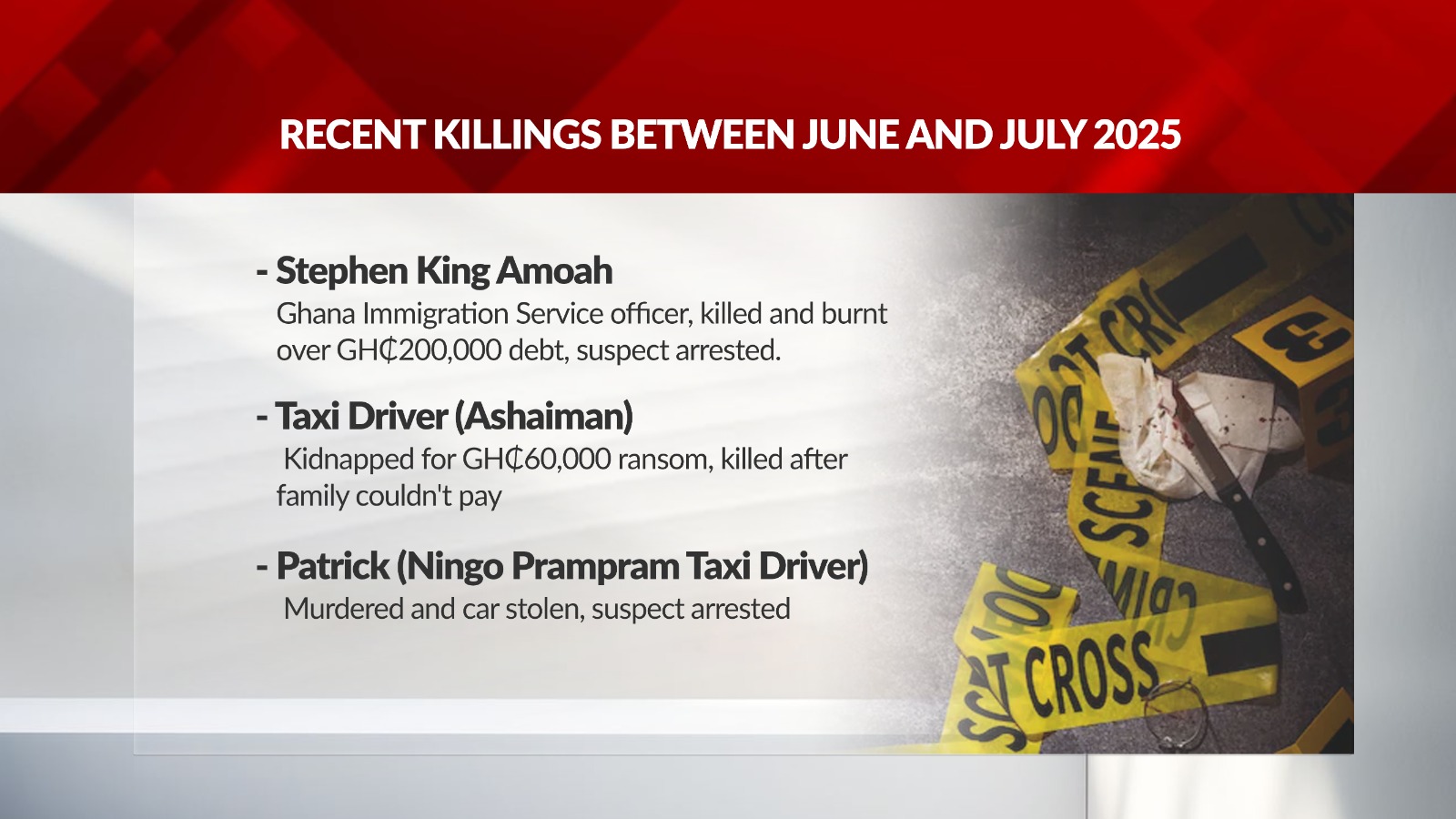
It started with the killing of Stephen King Amoah, a 38-year-old officer with the Ghana Immigration Service. On July 3, Amoah left his home in Ashongman Estate to collect a GH₵200,000 debt, but he never returned.
His body was discovered five days later; burned and stabbed, dumped in a gutter opposite Comet Estate in Accra. The key suspect, Bright Aweh, reportedly lured Amoah with WhatsApp images of large cash sum, has since been arrested.
In Ashaiman, another taxi driver allegedly met a tragic fate, after he was kidnapped for GH₵60,000 ransom demand. He was later killed after his family was unable to provide the ransom.
Another taxi driver in Ningo-Prampram picked up three passengers who requested a trip to Aflao, according to eyewitness accounts and police sources.

The journey which seemed routine turned tragic near Dodze, where Patrick was murdered, and his car stolen. One of the suspects driving the stolen car was however stopped and arrested by police personnel.
In a separate, still-developing case, a young taxi driver was found dead after CCTV cameras captured unidentified men dumping his body. So far, investigators are reviewing footage to identify the perpetrators and establish a motive. The victim’s name has not been publicly released, pending family notification.
And finally, we turn to Mampong, where the campus community is mourning the death of Emmanuel Agyei Baffour, also known online as Atom De Morale Spirit.
A second-year Visual Arts student and TikTok performer, his disappearance prompted days of online searching. His body was later found in a bush near Jachie Pramso. The cause of death remains under investigation, but the loss of this rising digital creator has triggered grief and calls for justice across social platforms.
These five cases, each marked by sudden disappearance and violent ends, suggest more than coincidence. They reflect a deeper crisis in public safety and community trust.
For Criminologist Dr Jones Opoku Oware, the recent surge speaks to the weakness of our justice systems.
“It speaks to the weakness of our judicial, criminal and security systems. We should strengthen our investigation systems and send a strong signal to Ghanaians that no matter who you are, if you come and commit a crime in our jurisdiction, the police will come after you.”
He however rules out ritual murders, and he’s calling on individuals to report missing cases early enough to help with early tracing.
“If you look at the patterns of the murders as we find them, one, I’m ruling out ritual murders because as we’ve indicated, none of these bodies as they’ve been discovered had any parts, I mean, dismembered, right? So typically, if you look at how ritual murders are carried out, you normally will find some part of the body missing.”
“But if you have consistent patterns of people just being killed on the streets or maybe placed in some places, like we are seeing now, then it tells me that this is a serial pattern of some people who want to, you know, as it were, exert or exert maybe reprisal on some people. They might have some kind of, you know, issue with or some kind of dealing with.”
“So, it becomes very difficult for the police to, you know, as it were, police those kinds of crimes because people normally use subtle deception and all that to get people into their location and the area where they think there’s no guardianship and then exert that kind of brutality on them. It is very important that the police deploy, you know, their resources much earlier. Much also, I expect also family members, to swiftly report missing person cases.” He said.
Evidently, authorities now face a growing burden to respond swiftly and fully to such cases to prevent more killings.