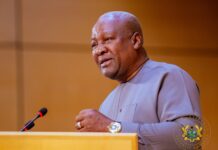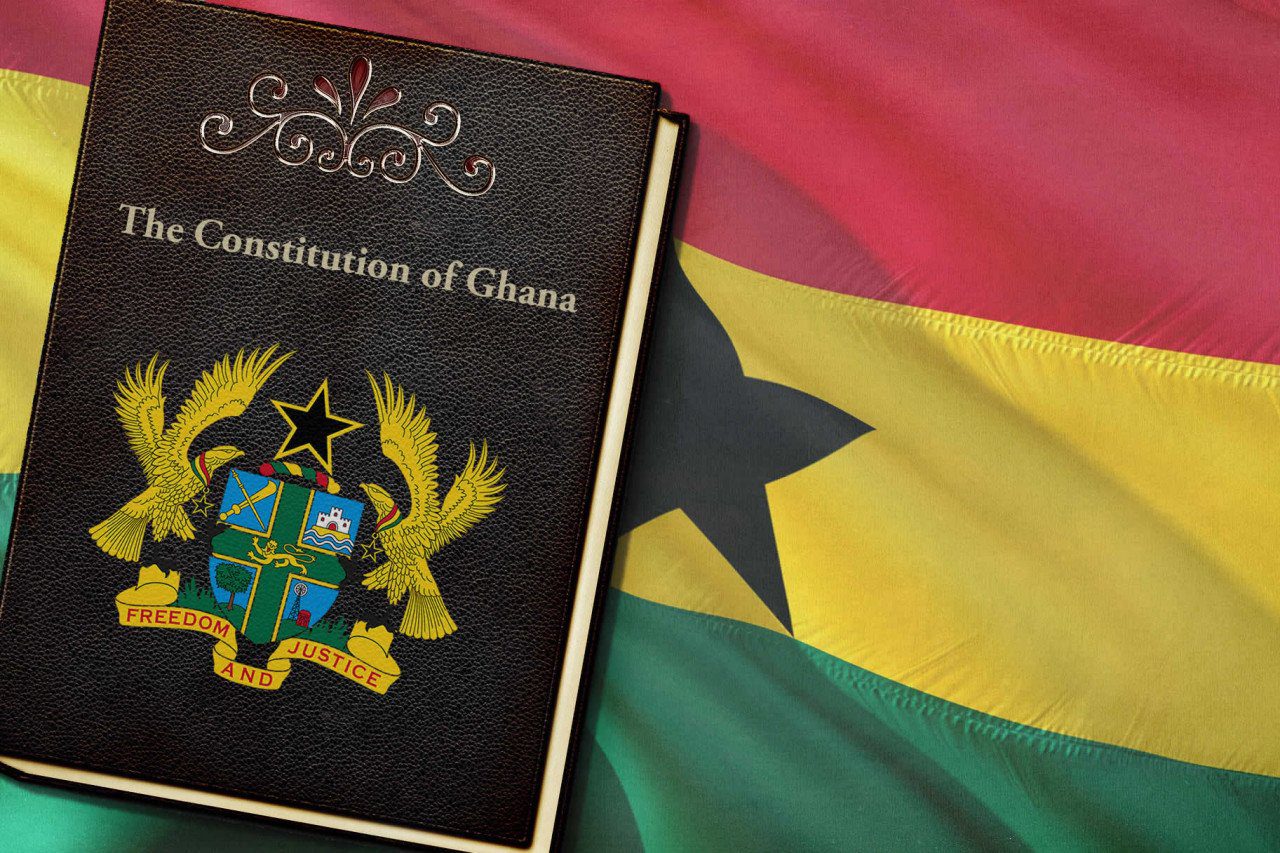

The Attorney-General and Minister of Justice, Dr Dominic Ayine has presented the position of Government on the recommendations made by the Constitution Review Committee.
He presented this during the Government Accountability Series on July 30 at the Jubilee House.
Please read full statement below:
PRESS BRIEFING BY THE ATTORNEY GENERAL & MINISTER FOR JUSTICE, DR DOMINIC AKURITINGA AYINE ON THE POSITION OF GOVERNMENT ON THE FINAL RECOMMENDATIONS OF THE CONSTITUTION REVIEW COMMITTEE ACCRA JULY 30, 2026
Ladies and Gentlemen of the Media, My Fellow countrymen and women,
1. I am here this afternoon to speak to the sovereign people of Ghana on the position of the Government of His Excellency John Dramani Mahama on the final recommendations of the Constitution Review Committee. The recommendations of the CRC were carefully considered by Cabinet on three occasions, including the dedication of an entire weekend retreat presided over by the President of the Republic.
2. You would recall that on January 19, 2025, His Excellency the President appointed an eight-member committee chaired by Professor H. Kwasi Prempeh to undertake a comprehensive review of the 1992 Constitution. The Committee was inaugurated on January 30, 2025, and thereafter went straight to work on the task assigned to it.
3. Over the course of nearly one year, the Committee- a. Organized ten (10) thematic stakeholder engagements involving over 500 experts and practitioners in law and governance; b. Held engagements with identifiable groups, reaching over 21, 500 people; c. Consulted 11 eminent persons, including former Presidents of the Republic, who were closely involved in constitutional developments in the country; and d. Received and reviewed 785 written submissions from members of the public.
4. On December 22, 2025, the Committee presented a summary of its recommendations to the President of the Republic. Subsequently, on February 10, 2026, the Committee submitted its full report containing the final recommendations. The Report is titled “Transforming Ghana- From Electoral Democracy to Developmental Democracy”.
The Report is very comprehensive, well-researched and reflects the consultative approach adopted by the Committee in accordance with its terms of reference. It contains 147 proposals for amendment of the Constitution and about 59 proposals which are entirely new provisions, bringing the total of proposed amendments to 206.
5. On behalf of the Government of H. E. John Dramani Mahama, I wish to thank Professor H. Kwasi Prempeh and the eminent members of his committee as well as the Secretariat of the Committee for the excellent work done for our dear country and its citizens.
Their names will forever be etched with indelible ink in the annals of Ghanaian history.
Ladies and Gentlemen of the Media, My Fellow countrymen and women,
6. I wish to make it clear from the outset that this is not a Government White Paper. The reason is that the work of the Committee was not technically the work of a commission of inquiry pursuant to Chapter 23 of the Constitution.
If that were the case, Government would have had a constitutional obligation to either publish the report of the commission of inquiry together with a White Paper or give reasons why it would not publish the report.
7. The position of Government in respect of the recommendations of the Committee is formulated in three ways- acceptance, acceptance in principle subject to modification or non-acceptance of the recommendation.
Where Government accepts the recommendation of the Committee in principle subject to modification, we provide reasons for why we seek to modify the recommendation.
Reasons are also accorded where Government does not accept the recommendation of the Committee.
8. In formulating its position on the final recommendations of the Committee, Government examined each recommendation against the relevant provisions of the Constitution to assess the nature, scope and implications of the proposed amendment.
Each recommendation was then subjected to rigorous constitutional and legal analysis, including whether it touched on entrenched or non-entrenched provisions of the Constitution and whether its underlying objective could be achieved through other legislative or administrative means.
We also examined the recommendations in light of the work of prior constitutional reform commissions or committees, such as the Report of the 2010 Constitution Review Commission, in order to ensure continuity and consistency in the reform process.
9. As I have noted earlier, when I submitted the draft position paper to Cabinet, extensive deliberations were held and each recommendation was interrogated, weighed against the practical experiences of our country and refined before Cabinet granted approval to the position paper.
I have underscored the importance of this process in order to highlight the fact that the Position Paper being published today is not the product of one Ministry or Department of Government or a group of technocrats working in a corner.
On the contrary, it is the product of the considered thoughts of the men and women who have been given the honour to run the affairs of our country within the executive arm of Government.
10. Before I turn to the highlights of the recommendations accepted or not accepted by Government, indulge me a little to turn to the principles that guided the formulation of Government’s position on the final report of the Committee.
First, Government took the view that with the Constitution being the supreme law of the land, any attempt to amend it must be done with caution. Therefore, recommendations that were considered insignificant for their normative value were not accepted for constitutional amendment.
The Constitution is the statement of our foundational values and structure and not an operations manual designed to troubleshoot every problem in our society.
11. Secondly, and this flows from the first consideration, only changes that definitely required constitutional amendment were accepted. Where 3 the objective of a proposed amendment is best achieved through ordinary legislative or administrative action, Government chose the alternative route. This approach was also animated by the fact that an ordinary statute can be amended by Parliament as circumstances change. Not so with the Constitution. My Fellow countrymen and women:
12. Permit me now to turn to some of the key highlights of the government’s position on the various recommendations.
President
13. The Government has accepted the recommendation to extend the term of office of the President from four years to five years, with the term of Parliament extended to correspond with this. Our thinking is practical.
Under the current four-year cycle, the early months of every administration are consumed by transition, and the final year is largely consumed by elections. That leaves precious little time for actual governance. A five-year term provides a more realistic timeframe for the formulati on, implementation, and assessment of policy.
For the avoidance of doubt, this recommendation, if carried through, will be in respect of future Presidents, not the current one.
14. Still on the Presidency, the Committee recommended that the minimum age of eligibility for election as President be reduced from forty years to thirty years. The Government has accepted this recommendation in principle, subject to one modification: the minimum age will be thirty-five years, not thirty.
The current threshold of forty excludes qualified citizens from seeking the highest office on the basis of an arbitrary age line. Thirty-five is consistent with the trend in modern democratic constitutions towards greater inclusivity, while ensuring that a candidate for the highest office has attained a measure of maturity and experience.
15. We have also accepted that the Presidential election be held on a day in the first week of November, as the Electoral Commission may specify by constitutional instrument. A fixed period gives certainty to the electoral 4 calendar. It allows the Commission, the parties and observers to plan, and it ensures an adequate interval between the election and the inauguration of the incoming President on January 7.
16. On Presidential election petitions, the Government has accepted that a petition must be filed within fourteen days of the declaration of results and determined by the Supreme Court within thirty days, with the Electoral Commission obliged to disclose all relevant election data to the court and the parties.
We take this position because the timely resolution of election disputes inures well to the stability of our democratic transitions and to the general political stability of our country.
17. The Government has accepted the principle that the President should not enjoy tax exemptions by virtue of office alone. The President will pay tax on salary and allowances, as well as the applicable indirect taxes on goods and services. The Government has not, however, accepted the proposal to tax the President’s retirement gratuity and pension, and the details of the President’s tax liability will be worked out in the tax laws, where such details belong.
Parliament
18. The Government has accepted that the size of Parliament be capped, and we propose a ceiling of 300 members. Of these, 276 will be elected directly in constituency elections like we already have. The remaining 24 will be elected through proportional representation among women, persons with disabilities, and the youth.
An independent study will be commissioned into the design of the proportional representation element. Capping Parliament saves cost, and the reserved element opens the door of our legislature wider to those our politics has historically kept on the outside.
19. The Government has also accepted the recommendation on dual citizenship. A citizen of Ghana by birth who holds the citizenship of another country will no longer be barred from contesting for election to Parliament, only on account of his/her dual citizenship and will not be required to renounce the other citizenship.
The current disqualification sits uneasily with our engagement with our diaspora and with the realities of modern citizenship.
The Judiciary
20. Regarding the Judiciary, two positions deserve mention. First, the Government supports a fixed tenure for the Chief Justice: a single, nonrenewable term of ten years, or until the retirement age, whichever occurs first.
This ensures predictable transitions at the head of the Judiciary and removes the risk of prolonged or indefinite occupancy of that high office.
21. Second, the Government supports capping the Supreme Court’s membership. The Committee recommended a cap of fifteen Justices. The Government proposes nineteen, that is, the Chief Justice and eighteen others.
A cap promotes efficiency and manages public expenditure, while a bench of nineteen remains sufficiently robust to discharge the Court’s constitutional mandate.
Political Parties
22. The Committee recommended an amendment to Article 55 to require every registered political party to afford its members in good standing equal voting rights in the selection of its Parliamentary and Presidential candidates.
The Government has accepted this recommendation. Just yesterday, the Supreme Court, in the case of Prof. Frimpong Boateng and Others v NPP, NDC and Others, held that all registered members of political parties should be allowed to take part in their internal elections. And therefore, on this question, the Committee, the Government, and the Supreme Court now speak with one voice.
Political parties are the vehicles through which we choose those who govern us. They cannot themselves be governed by the few.
23. Relatedly, the Committee recommended an independent body to register and regulate political parties, in place of the Electoral Commission’s current role. The Government accepts this in principle. We prefer, however, the designation Political Parties Regulatory Commission to the nomenclature of a “Registrar and Regulator”.
The Commission will be established through legislation, and matters such as campaign financing and the proposed Democracy Fund will be addressed in that legislation, providing the flexibility a rapidly evolving field demand. Local Government 24. On the election of District Chief Executives, the Government has gone further than the Committee.
The Committee recommended a phased approach, under which the right to elect a DCE would be tied to a district’s fiscal capacity, so that some districts would vote and others would not. The Government takes the position that all District Chief Executives should be elected. Creating a distinction between voting and non-voting districts carries significant political costs and may be perceived as discriminatory against citizens.
25. Under the Government’s proposal, the President will nominate five persons, two of whom shall be women. Out of the five, three will be shortlisted, one of whom shall be a woman, after vetting by a committee drawn from the Ministry of Local Government, the Public Services Commission and the Local Government Service. Those three will then be the candidates for election as District Chief Executive. Article 71 Officeholders and Public Financial Management
26. To deal with the question of the emoluments of article 71 office holders, the Government has also accepted the establishment of an Independent Public Emoluments Commission to determine the salaries, allowances, facilities and privileges of public officers generally, including the President and other Article 71 officeholders. The current arrangement, under which a committee appointed by the President determines the emoluments of officeholders including the President, creates a structural conflict of interest and has been a persistent source of public dissatisfaction. An independent commission will bring transparency and equity to this matter once and for all.
27. On public financial management, the Committee made far-reaching proposals: the classification and annual reporting of tax exemptions as tax expenditures, safeguards on the Contingency Fund, a medium-term economic framework laid before Parliament, debt anchors and fiscal sustainability rules, and an Independent Fiscal Council. The Government shares the concerns underlying every one of these proposals. Our position, however, is that they belong in the Public Financial Management Act, 2016 (Act 921), and not in the Constitution. Fiscal rules must be adaptable as economic conditions change.
The Constitution should state principles; the statute should carry the procedures. The Government will accordingly bring amendments to the Public Financial Management Act to give effect to these recommendations. Fundamental Human Rights
28. On the issue of fundamental human rights, the Government has accepted the recommendation to abolish the death penalty. The relevant provisions of Articles 3, 13, 19 and 72 will be amended accordingly, and offences that previously attracted the death penalty will attract life imprisonment.
The death penalty is inconsistent with the constitutional right to life and with Ghana’s international human rights obligations.
29. Now, let me spend a moment on what I consider a key pillar of the Position Paper: the proposed Human Rights Act.
The Committee made numerous proposals to expand the rights protected in Chapter Five of the Constitution: economic, social and cultural rights, the rights of women, children, persons with disabilities, older persons and the youth, the right to healthcare, the right to housing, the right to a clean and healthy environment, the right to food in custody, and more.
The Government accepts the spirit of virtually all of these proposals. But here is the difficulty. Chapter Five is entrenched. Every amendment to it requires a national referendum. Subjecting each of these new rights to a referendum would impose a procedural burden disproportionate to the gain.
30. The Constitution itself shows us the way out. Article 33(5) provides that the rights expressly mentioned in Chapter Five are not to be regarded as excluding others which are inherent in a democracy and intended to 8 secure the freedom and dignity of man. Pursuant to that provision, the Government will enact a comprehensive Human Rights Act.
The Act will elaborate on the rights already guaranteed, extend protection to the new categories of rights identified by the Committee, incorporate Ghana’s obligations under the international human rights treaties to which we are party, and provide detailed enforcement mechanisms. It will be justiciable and enforceable. And because it is a statute, it can be improved as standards evolve and as our institutional capacity develops. Most of the Committee’s recommendations on fundamental rights are going into this Act.
31. In the same spirit, the Government has accepted the recommendation of a constitutional right of abode for persons of African descent in the diaspora, subject to conditions set by Parliament, with a heritage-based pathway to citizenship. Ghana has a proud tradition of welcoming the African diaspora, and this provides a principled framework for the Year of Return and Beyond the Return. Parliament will legislate the criteria and safeguards, and measures will be put in place to ensure the right is not abused. Corruption and Accountability
32. From rights, let me turn to accountability. The Committee recommended the establishment of an Independent Anti-Corruption and Ethics Commission with the power to investigate and prosecute corruption, and to assume the functions of the Office of the Special Prosecutor.
The Government accepts the proposal in principle, but the objective does not require a constitutional amendment. The Government will through the Conduct of Public Officers Bill which is currently before Parliament, establish a Public Ethics Commission with the power to investigate and prosecute acts of corruption and conflict of interest involving public officers and their collaborators in the private sector. Its mandate would be similar to that of the Corrupt Practices Investigation Bureau of Singapore, but, unlike that Bureau, it will be independent of Executive control.
33. Ladies and Gentlemen, this briefing would be incomplete without me telling you about the changes affecting my own Ministry. It is not every 9 day that a Minister stands before the press to announce the splitting of his own office.
34. The Committee recommended removing the Attorney General’s authority to prosecute corruption offences, and recommended requiring leave of the court before a prosecution may be discontinued. The Government has not accepted those proposals, for reasons set out fully in the Paper.
But the Government has squarely addressed the concern that lies beneath them, namely, that an Attorney General who sits in Cabinet cannot comfortably prosecute members of the government of which he is part.
35. The Government proposes that Article 88(1) be amended to remove the requirement that the Attorney General be a Minister of State. A separate portfolio of the Minister of Justice will be established to oversee the justice sector.
The Attorney General will remain the principal legal adviser of the Republic and the repository of the prosecutorial authority of the State, but will cease to be a Minister of State. And to guarantee the prosecutorial independence of the office, a new clause will be inserted in Article 88 to give the Attorney General the same terms and conditions of service as a Justice of the Supreme Court.
This is a significant restructuring of the legal architecture of the Executive, and I believe history will judge it kindly. Constitutional Amendment and Roadmap
36. Government has accepted the introduction of a citizen-initiative mechanism for constitutional amendment. Citizens will be able to propose amendments to the Constitution upon securing the support of registered voters, subject to minimum regional representation and gender-balance requirements.
The Government proposes that the threshold be ten percent of registered voters, rather than the five percent recommended, so that the mechanism is invoked only where a proposal commands substantial national support. The initiative will be triggered through the Council of State. The Constitution belongs to the people, and the people should be able to knock on its door directly.
37. The roadmap is set out in the Paper, and it is deliberate and time bound. Following today’s publication, the President will swear in the 10 Constitution Review Implementation Committee (CRIC). The CRIC will prepare two Constitution Amendment Bills simultaneously.
38. The first Bill will cover the amendments to the non-entrenched provisions of the Constitution. It will follow the procedure in Article 291: publication in the Gazette, laying in Parliament, referral to the Council of State for advice, and passage by a two-thirds majority of all Members of Parliament, followed by Presidential assent.
39. The second Bill will cover the amendments to the entrenched provisions. That Bill must travel the road prescribed by Article 290. It will be referred to the Council of State for advice, published in the Gazette for six months, laid in Parliament and then submitted to the people of Ghana at a national referendum. For the referendum to carry, at least forty percent of eligible registered voters must turn out, and at least seventy-five percent of the votes cast must be in favour.
40. The two draft Bills should be ready by October 2026. And here I should mention one practical reality- a national referendum is an expensive undertaking. To avoid the enormous cost of organizing a standalone referendum, the Government intends that the referendum on the second Bill be held alongside the District Assembly elections in 2027. We will work closely with the Electoral Commission on the calendar.
41. Alongside the two Bills, the Government will bring the complementary legislative reforms I have spoken of, including amendments to existing laws such as the Public Financial Management Act and the enactment of new legislation such as the Human Rights Act, to give effect to the recommendations that do not require constitutional changes.
Conclusion
42. Ladies and Gentlemen, permit me to close with thanks. I thank His Excellency the President for his leadership of this process and for his unwavering commitment to constitutional reform. I thank my colleagues in Cabinet for their extensive input and helpful deliberations on the Position Paper.
The document being published today is far richer for the scrutiny it received around the Cabinet table. And I thank, once again, the Constitution Review Committee, whose diligent work made this moment possible.
43. I wish to thank my able and indefatigable Deputy, the Honourable Dr. Justice Srem-Sai. Justice held the fort in the courts of law, from the Supreme Court to the High Court, on a daily basis so I can devote time and effort to the constitutional reform project and to the management of the affairs of the Department.
That is true partnership at work and the kind of division of labor that produces results. I cannot end without thanking the junior lawyers in our secretariat, especially Saeed Moomin, for their tireless assistance in this project and especially in the preparation of this Position Paper.
44. The Position Paper and the Final Report of the Committee will be published immediately after this press conference. I encourage every Ghanaian to read them. Constitutional reform is not a single event but a continuing process, and the Constitution must remain a living document that responds to the needs and aspirations of each generation of Ghanaians.
The next phase of that process begins today. Thank you for your attention.