
Illegal mining in Ghana has evolved beyond environmental destruction into a complex political, economic and security ecosystem that increasingly shapes control over land, labour and community authority, the Commandant of the Kofi Annan International Peacekeeping Training Centre (KAIPTC) has warned.
Speaking at the Ashanti Regional Validation and Dialogue Workshop on the Safety and Security Ecosystem of Illegal Mining in Ghana, Air Vice Marshall David Anetey Akrong said the menace has become deeply embedded in local governance and community dynamics.
He explained that recent field engagements in communities across the Ashanti Region show that the problem now extends far beyond environmental degradation or licensing violations.

“The growing influence of illegal mining activities is shaping how resources are distributed, how authority is exercised and how safety is experienced within mining communities. In some districts, the persistence of illegal mining activities has contributed to the emergence of informal power structures that operate alongside and sometimes in competition with formal state institutions,” he noted.
Air Vice Marshall Akrong cautioned that such developments risk weakening public confidence in regulation and enforcement while complicating the work of institutions responsible for maintaining order and protecting communities.
He added that the situation is further complicated by economic pressures, particularly youth unemployment, which makes illegal mining attractive in many rural communities.
“Many communities are navigating a difficult balance between immediate economic survival and the long-term environmental and social wellbeing of their lands and water bodies,” he said.
The KAIPTC Commandant also raised concerns about emerging security threats linked to illegal mining, including the circulation of improvised or illegal weapons in remote mining areas.
“Some mining sites are increasingly witnessing heightened security postures where the threat or use of force is employed to protect financial interests, secure access to land or deter rival groups and state intervention. This development increases risks for community members and frontline security personnel and links local mining challenges to broader patterns of organised crime and illicit financial flows,” he warned.
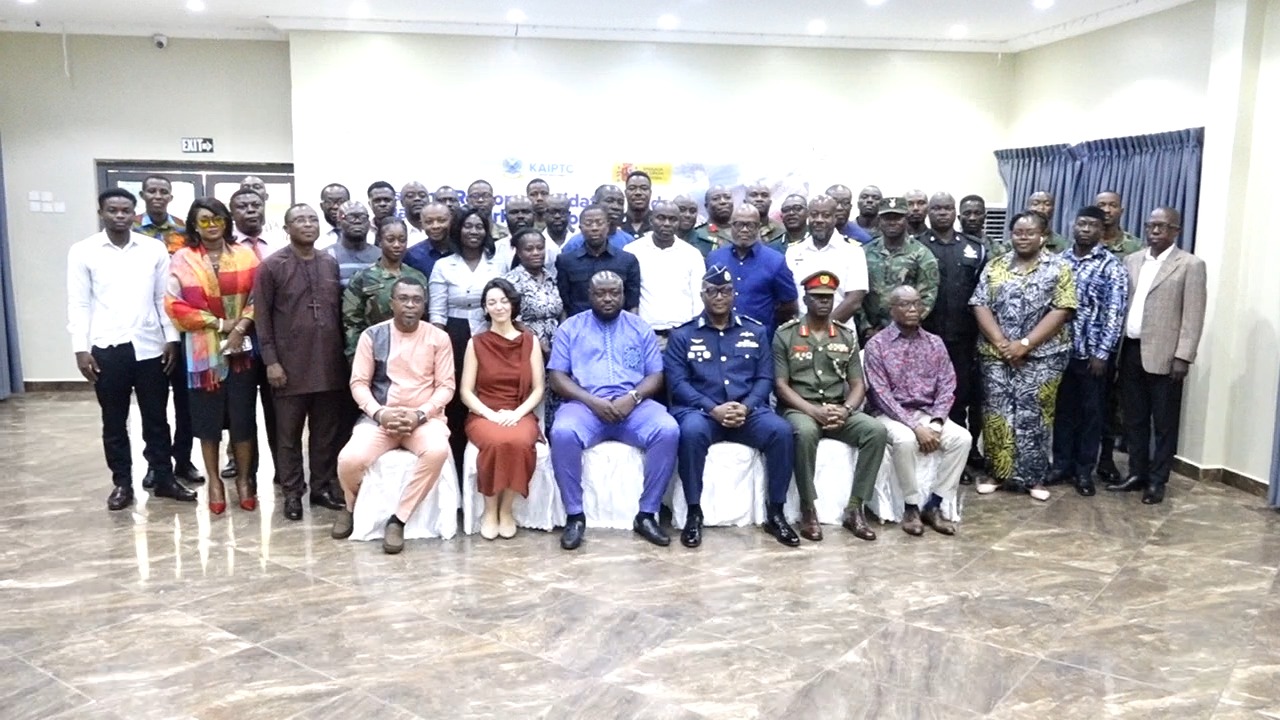
The workshop, organised by KAIPTC with support from the Embassy of Spain in Accra, is designed to validate research findings on the safety and security implications of illegal mining while gathering perspectives from stakeholders.
Participants included traditional leaders, security agencies, regulators, civil society organisations, media and community representatives from mining areas across the Ashanti Region.
Deputy Ambassador of Spain to Ghana, Isabel Escarlata Ibarra Serrano de Haro, observed that illegal mining has become intertwined with wider criminal activities including human trafficking, forced labour, arms proliferation and illicit financial flows.

She stressed that the issue must be viewed not only as an environmental challenge but also as a governance, security and human rights concern.
“These are not isolated incidents but part of a wider criminal economy affecting several mining communities,” she noted, adding that women and girls are often the most vulnerable to exploitation within such environments.
Representing the Ashanti Regional Minister, Asokwa Municipal Chief Executive, Amoh Kamel, also described illegal mining as a national security threat that continues to destroy fertile lands and pollute major water bodies.

He emphasised that assemblies must play a central role in addressing the crisis because of their proximity to affected communities.
“The fight against illegal mining cannot be won through enforcement alone. It requires evidence-based policies, strong institutions and active community engagement,” he said.
The outcomes of the Kumasi dialogue will feed into a National Policy Dialogue Forum scheduled to take place in Accra in the coming weeks, where stakeholders are expected to develop strategies to strengthen governance, security coordination and sustainable resource management in Ghana’s mining sector.
By Ibrahim Abubakar