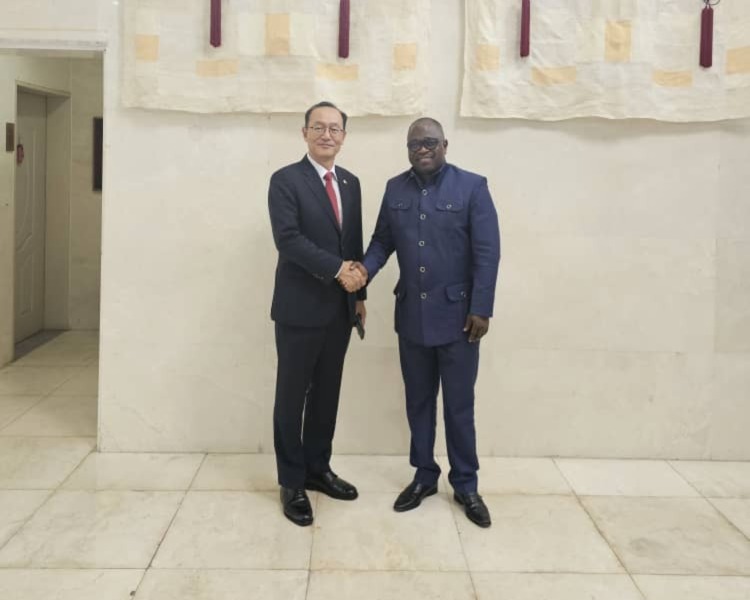

In a significant diplomatic engagement that signals deepening ties and shared ambition on climate action, the Minister of State for Climate Change and Sustainability, Seidu Issifu, has had a luncheon with Park Kyongsig, Ambassador of the Republic of Korea to Ghana.
The meeting, held at the Korean Embassy in Accra on July 7, served to formally introduce the newly established Ministerial Office and explore enhanced bilateral collaboration in the areas of climate change, sustainability, and green development.
This high-level interaction reaffirmed Ghana’s unwavering commitment to global climate diplomacy and multilateral cooperation. It also marked a critical step in strengthening bilateral relations with Korea, particularly around climate finance, green industrialisation, and access to international mechanisms such as the Green Climate Fund.
The Minister expressed gratitude for Korea’s continued support to Ghana, especially through the Korea International Cooperation Agency (KOICA) and related development initiatives.
Minister Seidu Issifu outlined the strategic rationale for the creation of his Office by President John Mahama — “a cross-sectoral mandate to coordinate national climate efforts and promote a green, inclusive economy powered by public-private partnerships,” he stated.

The Minister’s presentation spotlighted several priority interventions: The establishment of a National Technical Working Committee drawing membership from all ministries to harmonise climate actions and ensure inter-agency policy coherence.
Energy Transition measures, including an ambitious rollout of solar rooftop systems in public facilities to reduce national energy liabilities.
Plans to create a Climate and Sustainability Hub — a national centre for innovation, research, financing, and climate data. The vision to establish Climate and Sustainability Units across all Ministries, Departments, Agencies, and MMDAs, strengthening local climate governance.
Korea’s Support and Shared Commitment
Ambassador Park Kyongsig reiterated Korea’s commitment to support Ghana’s climate agenda, drawing on Korea’s own journey toward decarbonisation — from renewable energy expansion and electric mobility to reforestation programs. He emphasized Korea’s readiness to:
- Assist Ghana in expanding its carbon credit systems for international markets.
- Partner on clean cooking campaigns to benefit rural communities.
- Offer technical assistance and training opportunities, including scholarships, study tours, and short-term programs for the Minister’s Office and relevant institutions.
- Support joint economic forums and promote climate-resilient investments by Korean businesses in Ghana.
He also referenced a Korean foundation dedicated to catalyzing private sector investment into emerging markets like Ghana, particularly in sustainability-focused ventures.
The dialogue culminated in a shared resolve to deepen climate collaboration. Key proposals included:
- Launching a Ghana-Korea Climate Business Forum, to convene stakeholders and private sector actors from both countries to explore investment in green infrastructure, circular economy, and renewable energy.
- Pursuing joint pilot projects in afforestation, solar energy, and climate-smart agriculture.
- Providing technical and financial support from the Korean Embassy to enhance the operational capacity of the Minister’s Office in fulfilling both domestic and international climate mandates.
The Minister also reflected on the role of religion and moral values in Ghana’s public governance, emphasizing the importance of engaging religious leaders and communities in the climate agenda.
He affirmed collaboration with the Attorney-General’s Department to ensure all national climate proposals are legally sound and policy-compliant.