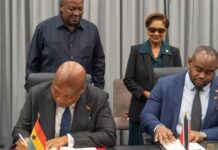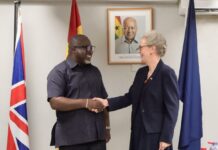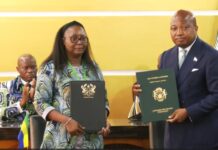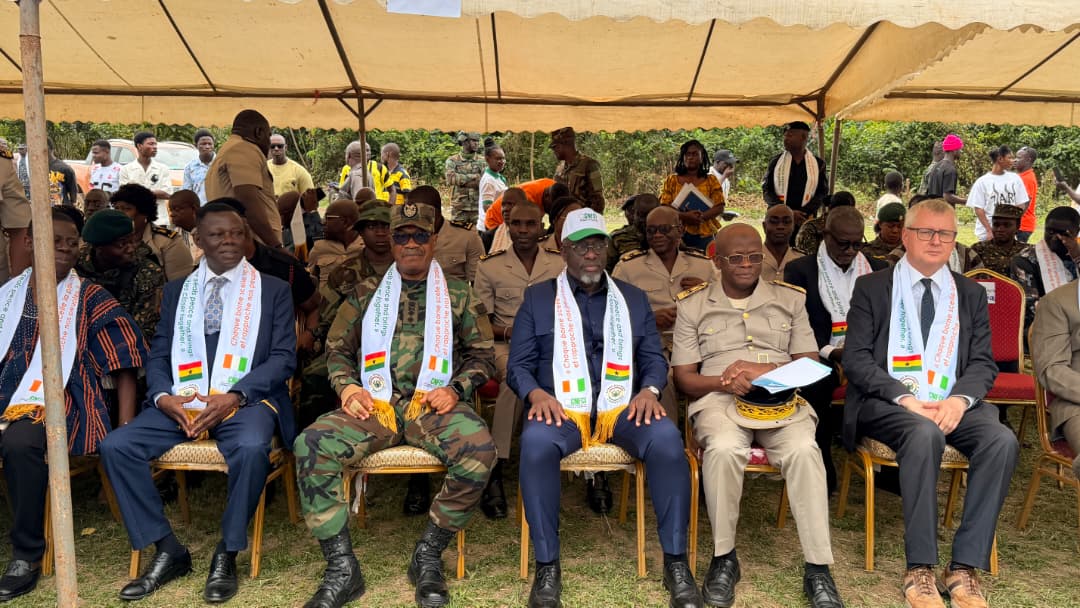

Ghana and Côte d’Ivoire have jointly commissioned 37 newly constructed International Boundary Pillars (IBPs) as part of efforts to reaffirm and strengthen the land boundary between the two countries.
The commissioning ceremonies, held at New Town in Ghana and Diby in Côte d’Ivoire, marked the successful completion of Phase One of the Joint Ghana–Côte d’Ivoire Land Boundary Reaffirmation Exercise.
The first ceremony was held on Tuesday, September 22 at New Town in the Jomoro Municipality of the Western Region, while the second took place on Thursday, September 24 at Diby, an Ivorian border community adjacent to Yaakase in the Enchi area of the Western North Region.
The exercise, supervised by the Ghana Boundary Commission (GhBC), covered a total distance of 150 kilometres.
The 37 newly constructed pillars were fully funded by the German development agency, GIZ and the African Union Border Programme (AUBP), with the 48 Engineer Regiment of the Ghana Armed Forces serving as the project contractor.
The pillars comprise one Terminus Pillar, 12 Main Pillars, 20 Intermediate Pillars and four Border Crossing Pillars.
At the ceremony in New Town, the Terminus Pillar was commissioned as the International Boundary Pillar marking the end of the Ghana–Côte d’Ivoire International Land Boundary and the beginning of the International Maritime Boundary between the two countries.
The Terminus Pillar is therefore a significant marker in defining the transition between the two countries’ land and maritime boundaries.
The second ceremony at Diby saw the commissioning of IBP48, which serves both as a Main Pillar and a Border Crossing Pillar.
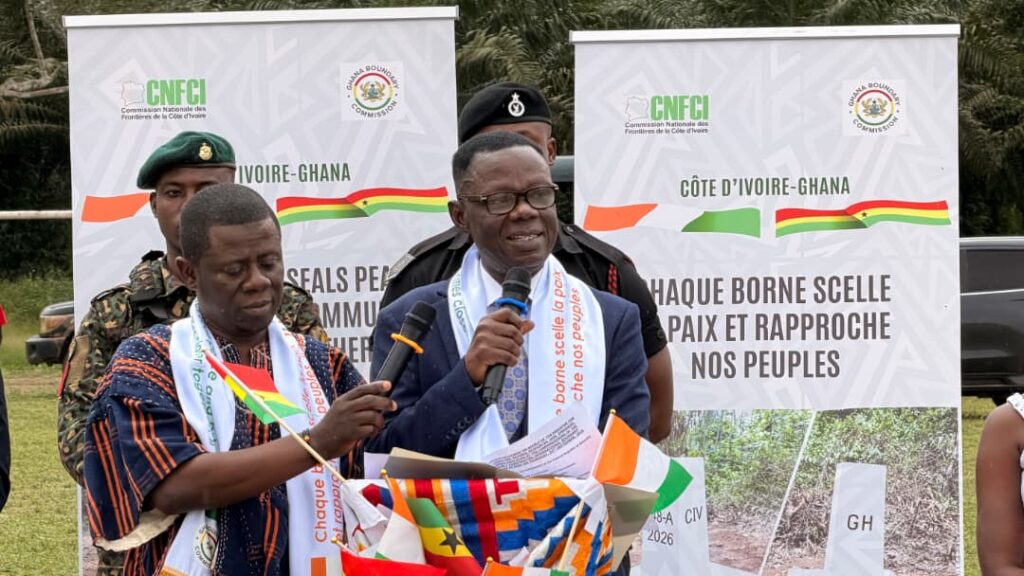
Speaking at the ceremonies, the Commissioner-General of the Ghana Boundary Commission, Major General Anthony Ntem, said the newly constructed pillars reinforce the African Union’s vision of a borderless Africa.
He explained that the concept of a borderless Africa does not mean eliminating clearly defined national boundaries, but rather ensuring that boundaries between countries are clearly established, mutually respected and managed in a manner that promotes cooperation.
“A Borderless Africa does not mean an Africa without clearly defined boundaries. Rather, it is an Africa in which clearly defined and mutually respected boundaries facilitate the free movement of people, goods and services, encourage legitimate trade and interaction, and create the certainty necessary for deeper regional integration.”
Major General Ntem said clearly defined boundaries should serve as points of connection rather than division between neighbouring countries.
He added that clarity over territorial jurisdiction provides a foundation for cooperation, from communities living along the boundary to the highest levels of government.
According to him, the strength of a united and integrated Africa depends on certainty, trust and cooperation among sovereign states.
He noted that clearly defined and mutually respected boundaries, established through processes including delimitation, demarcation and reaffirmation, are important to achieving that objective.
Major General Ntem urged all stakeholders to regard the newly constructed pillars as markers of certainty, cooperation and peaceful coexistence.
He said they provide a firm foundation for the historic ties between Ghana and Côte d’Ivoire to continue to grow.
The Executive Secretary of the National Boundary Commission of Côte d’Ivoire, Dr Diakalidia Konate, said the reaffirmation exercise is intended to make the international boundary line between the two countries more visible.
He expressed appreciation to members of the Joint Land Boundary Technical and Sub-Technical Committees for their work during the first phase of the exercise.
Dr Konate encouraged the technical teams to maintain the same level of commitment and dedication as the process moves into its next phase.
Phase Two of the reaffirmation exercise is expected to commence later this year.
The German Ambassador to Côte d’Ivoire, Matthias Veltin, reaffirmed the German government’s commitment to initiatives aimed at promoting African integration and cooperation.
He explained that Germany’s partnership with the African Union Border Programme, through its implementing agency GIZ, is intended to support African countries in the demarcation, reaffirmation and management of their common boundaries.
Mr Veltin said GIZ’s support is also aimed at preventing conflicts along international borders.
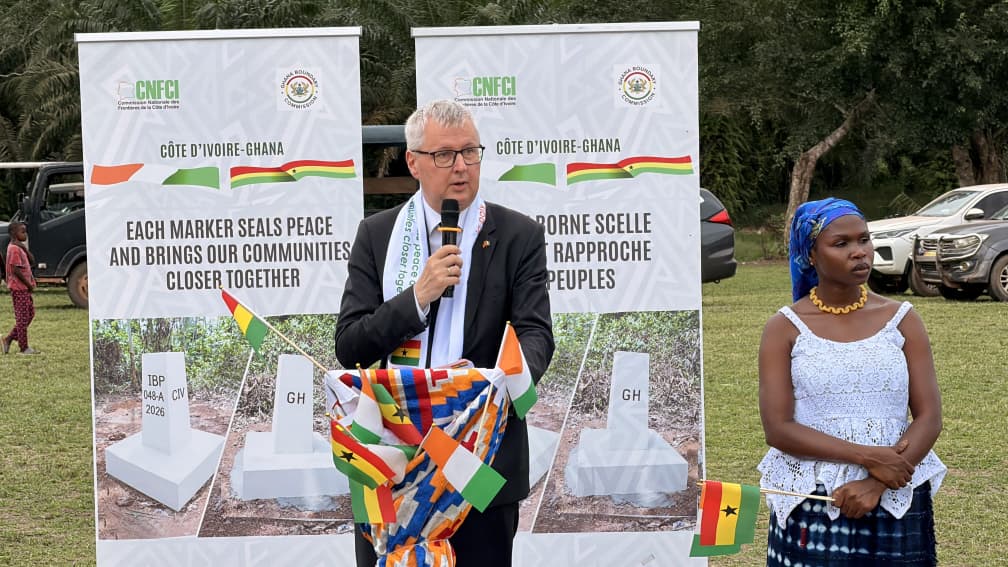
He stressed that African boundaries should not serve to separate people but should instead become points of union, cooperation and collaboration.
The Regional Minister for the Western North Region, Wilbert Petty Brentum, who spoke on behalf of the Minister for Lands and Natural Resources, Emmanuel Armah-Kofi Buah, said the newly constructed pillars symbolise the joint efforts of Ghana and Côte d’Ivoire to fulfil a commitment made by both countries and other African states in 1964.
He noted that at the time, many African countries agreed to maintain the boundaries inherited from the colonial period.
According to Mr Brentum, Ghana places significant importance on the reaffirmation and management of its international boundaries because clearly defined boundaries provide government with certainty to plan, administer and govern responsibly and inclusively.
He called on all stakeholders involved in the exercise, particularly traditional authorities and residents in border communities, to protect the newly constructed boundary pillars.
He also urged border communities to serve as ambassadors of peace, cooperation and good neighbourliness between Ghana and Côte d’Ivoire.
The successful completion of Phase One of the Ghana–Côte d’Ivoire International Land Boundary Reaffirmation Exercise paves the way for Phase Two of the project.
The second phase is expected to cover approximately 400 kilometres and will be supervised by the National Boundary Commission of Côte d’Ivoire.
The reaffirmation exercise is expected to further strengthen the clarity and visibility of the international boundary while supporting peaceful coexistence, legitimate cross-border movement, trade and cooperation between Ghana and Côte d’Ivoire.
The project also forms part of broader continental efforts to improve the management of Africa’s borders and support regional integration.