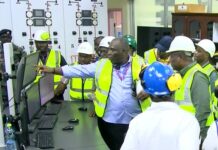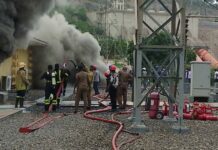

The recent fire at the Akosombo substation, with its potential to remove nearly 1,000 megawatts (MW) from Ghana’s national electricity supply, should not be treated as an isolated technical fault.
It is a systemic warning one that exposes a deeper structural weakness in how we generate, transmit, and secure power.
Ghana does not have an energy generation problem. Ghana has a resilience architecture problem.
For decades, the country’s energy strategy has leaned heavily on centralized infrastructure- large hydropower assets, thermal plants, and critical transmission nodes.
This model has delivered capacity, yes. But it has also created fragility. When one node fails, the consequences are not local, they are national.
When One Failure Becomes a National Crisis
A potential loss of 1,000MW is not a minor fluctuation it is a systemic shock. Ghana’s peak electricity demand typically hovers around 3,500–3,800MW. This means such a disruption could wipe out over 25% of national supply capacity at once.
In practical terms, 1,000MW is enough to power approximately 800,000 to 1 million homes, depending on consumption patterns. If such a deficit persists even for a few days, the consequences are immediate and compounding:
Manufacturing lines stall
Small and medium enterprises lose revenue.
Hospitals are forced onto expensive backup systems.
Digital and financial services face instability.
The productivity losses from even 72 hours of sustained disruption can run into millions of dollars, with ripple effects across supply chains and investor confidence.
This is the cost of centralization.
Renewable Energy: Not an Alternative; A Strategic Necessity
The conversation around renewable energy in Ghana has been too narrow for too long. It is often framed as an environmental obligation a pathway to reduce emissions and meet climate commitments.
That framing is incomplete.
Renewable energy, particularly when deployed in a distributed and decentralized manner, is fundamentally about energy security.
Solar installations on rooftops, mini-grids in communities, embedded generation for industries, and battery storage systems for critical services all do one thing:
They break the chain of vulnerability.
When power generation is dispersed, failure in one location does not paralyze the entire system. Hospitals can continue operating. Businesses remain productive. Communities are not plunged into darkness because of a single point of failure.
This is how resilient energy systems are being built globally and it is the direction Ghana must now take with urgency.
The Economics Have Changed. A Policy Has Not Kept Pace
A decade ago, the argument against renewables in Ghana was cost. Today, that argument no longer holds.
Solar photovoltaic (PV) costs have fallen by more than 80% globally over the past decade, making it one of the most cost-competitive sources of electricity. When combined with declining battery storage costs, renewable systems are no longer just viable they are economically strategic.
Yet Ghana’s transition remains slow and fragmented.
This is no longer a technology problem.
It is a prioritization and execution problem.
Despite existing renewable energy policies, implementation has lacked urgency. Distributed solar adoption remains limited. Grid integration strategies are underdeveloped. Energy storage is still treated as optional rather than essential.
This gap between policy ambition and delivery is where Ghana is losing both time and resilience.
What Must Change now.
The way forward is not incremental adjustment. It is strategic recalibration.
First, decentralization must become national policy.
Rooftop solar and embedded generation should be scaled across households, businesses, and public institutions. Critical facilities; hospitals, universities, and government agencies must be equipped with solar-plus-storage systems as a baseline.
Second, energy storage must be prioritized.
Battery Energy Storage Systems (BESS) are no longer emerging technologies they are central to reliable power systems. Without storage, resilience remains incomplete.
Third, the grid must become smarter.
Digital monitoring, predictive maintenance, and real-time response systems can reduce failures and improve recovery time.
Fourth, investment frameworks must be unlocked.
Clear regulations, risk guarantees, and investor-friendly policies are essential to attract private capital into renewable energy.
Finally, leadership must be decisive.
Ghana’s slow pace in deploying distributed renewables is no longer a capacity issue it is a prioritization issue. Reform must move from intention to execution.
A Defining Moment for Ghana’s Energy Future
The Akosombo substation fire should not be remembered as just another disruption. It should mark a turning point where Ghana moves decisively from vulnerability to resilience.
Because the real question is not whether disruptions will happen again.
They will.
The real question is whether the next disruption will expose our weaknesses or demonstrate that we have built a system strong enough to withstand them.
Conclusion: From Reaction to Resilience
Ghana stands at an inflection point.
One path leads to continued dependence on centralized infrastructure, where each failure carries national consequences. The other leads to a diversified, decentralized, and resilient energy system powered by renewables.
This is no longer just an energy conversation.
It is an economic, developmental, and national security imperative.
The future will not be secured by how much power Ghana can produce.
It will be secured by how well Ghana can protect, distribute, and sustain it.
Resilience is not built in moments of crisis it is revealed by them. Ghana now has the opportunity to build before the next test comes.
By Christabel Baaba Mills
MSc Energy and Sustainability Management