
Ghana’s railway system has been on a long and transformative journey — from the roaring steam engines of the colonial era to the sleek modern trains promised in the government’s current development plans.
Once the lifeline of trade and industry, the nation’s rail network now sits at a crossroads: a choice between revival and redundancy.
While major projects like the Tema–Mpakadan Railway Line signal hope, persistent challenges in funding, maintenance, and infrastructure modernization continue to derail progress.
With billions of cedis invested and more needed to complete ongoing works, many are asking- Is Ghana’s railway system truly on track for the future, or heading toward another missed opportunity?
A Colonial Legacy
The history of Ghana’s railways dates back to 1898, when the British colonial administration launched the first line under the Gold Coast Government Railway. Its mission was strategic, to move cocoa, timber, and minerals from the rich hinterlands to coastal ports for export.
The Sekondi–Tarkwa line, completed in 1901, was the first step, later extending to Kumasi in 1903. By the 1920s, railways had become the engine of Ghana’s economic and urban growth, linking rural producers to emerging cities like Accra and Takoradi.
After independence in 1957, Ghana’s rail network expanded to about 947 kilometres, covering three major lines that is the Western Line (Takoradi–Kumasi), Eastern Line (Accra–Kumasi), and Central Line (Huni Valley–Kotoku). Under President Kwame Nkrumah, railways were more than transport, they were a symbol of modernization and unity.
But the golden age of rail did not last long.
Years of Decline
By the 1980s, the once-proud Ghana Railway Corporation (GRC) was in decline. Decades of neglect, poor maintenance, and underinvestment crippled the system. Passenger trains became unreliable, freight operations collapsed, and key lines were abandoned.
Communities that once thrived along the rail routes from Tarkwa to Nsawam, faced economic decline as transport and trade shifted to the roads.
In the absence of an efficient rail system, Ghana’s roads became overburdened, carrying heavy cargo trucks and daily commuters, leading to worsening congestion, frequent accidents, and rapid road deterioration.
A Push for Revival
Renewed efforts to revive the sector began in the early 2000s. In 2008, the government established the Ghana Railway Development Authority (GRDA) to separate regulatory and operational roles, setting the foundation for reform.
The Ghana Railway Master Plan (2013) laid out a bold vision — a 4,007-kilometre standard-gauge network linking all major cities and even extending into Burkina Faso.
Under the current administration, several key projects have been initiated:
- Tema–Mpakadan Railway Line (97 km): Funded by India’s EXIM Bank, this forms part of the Ghana–Burkina Faso Interconnectivity Project, aimed at linking Tema Port to Ouagadougou.
- Western Line Rehabilitation: Connecting Takoradi–Tarkwa–Dunkwa–Kumasi, crucial for mineral and timber transport.
- Accra–Nsawam and Accra–Tema commuter lines: Revived to ease urban congestion and provide affordable city transport.
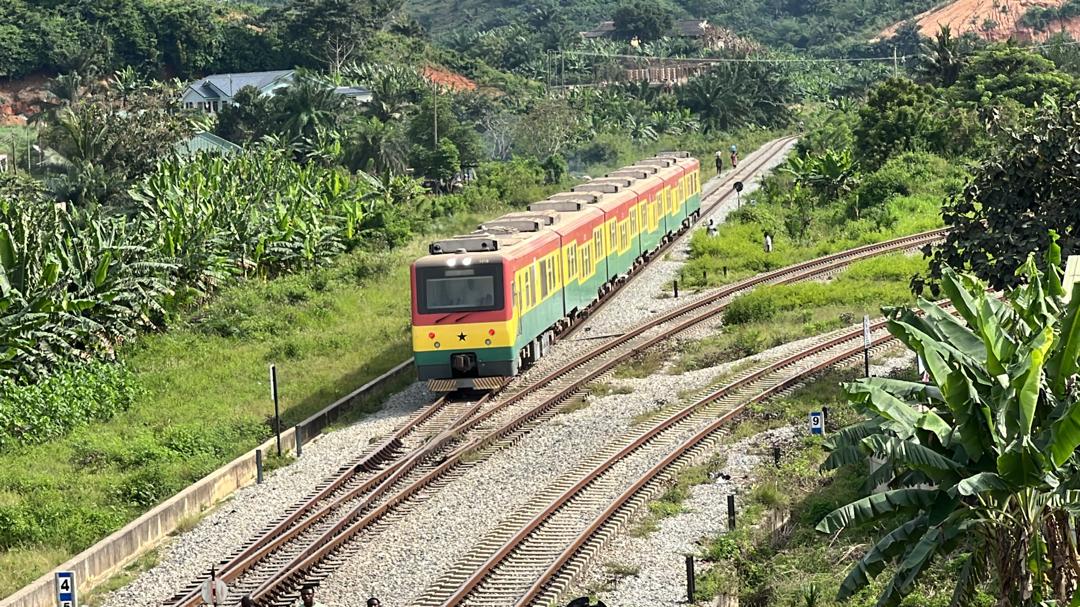
- Modern Diesel Multiple Units (DMUs): Introduced for test runs, marking the return of passenger trains after decades of dormancy.
Transport Minister Bukari Nikpe stated that Ghana is prioritizing rail development, including the upcoming full operation of the Tema-Mpakadan Railway.
He has also condemned the encroachment on and destruction of railway lands by illegal mining and construction, announcing a joint operation with security agencies to reclaim these areas.
The government is also exploring solutions for long-standing issues like infrastructure deterioration and unpaid salaries for railway workers, and aims to improve overall rail efficiency and capacity through projects like the Tema-Mpakadan line.
The Budget Reality: Billions Invested, Challenges Persist
According to the Medium-Term Expenditure Framework (2023–2026) from the Ministry of Railways Development, government spending on the railway sector has been substantial:
- 2020:
- Allocated: GH¢435.1 million
- Spent: GH¢697.4 million
- The overspend of GH¢262 million was largely due to an additional GH¢266.8 million released by Exim Bank for the Tema–Mpakadan project.
- 2021:
- Allocated: GH¢512.6 million
-
- Spent: GH¢528.8 million
- Again, expenditure exceeded budget due to another Exim Bank release of GH¢36.5 million, representing 109.9% of the approved budget.
- 2022:
- Revised Allocation: GH¢530.5 million
- Spent (as of Sept 2022): GH¢419.9 million
While these investments reflect renewed commitment, analysts say much of the budget still goes into project-specific funding rather than long-term maintenance and capacity building, a key reason for Ghana’s cycle of decline in infrastructure performance.
Challenges on the Track
Despite the progress, Ghana’s railway revival faces numerous obstacles.
Inadequate Funding. The reliance on foreign loans limits local ownership and slows timelines.
Outdated Infrastructure; Colonial-era tracks are incompatible with modern high-speed systems.
Encroachment. The informal settlements along rail corridors complicate expansion.
Limited Technical Expertise. Heavy reliance on foreign engineers slows local skill development.
Institutional overlaps with multiple agencies often duplicate functions, creating inefficiencies.
Road Competition. Trucks remain the dominant freight carriers, despite higher costs and environmental impact.
Easing Pressure on Ghana’s Roads
Experts argue that a functional rail system could dramatically reduce the load on Ghana’s congested road networks.
Here’s how:
- Complete key corridors like Accra–Tema–Nsawam and Kumasi–Takoradi to move bulk cargo off highways.
- Build multimodal transport hubs linking trains, buses, and ports.
- Encourage private sector investment through transparent public-private partnerships (PPPs).
- Develop urban light rail systems in Accra and Kumasi to cut travel time.
- Offer tax incentives to businesses using rail for freight.
- Ensure policy continuity beyond electoral cycles.
- If properly implemented, these strategies could not only revive the railways but also transform Ghana’s entire transport ecosystem.
The Future of Rail in Ghana
The revival of the railway sector is more than a transport policy; it’s an economic imperative. Efficient rail systems can power industrial growth, promote regional trade, create jobs, and drastically reduce road accidents and pollution.
However, achieving this requires consistent funding, strong governance, and political will. As Ghana moves forward, the question remains — will the railway system become a driver of transformation or another case of missed potential?
For now, the whistle has sounded — and the next few years will determine whether Ghana’s rail dream finally gets back on track.