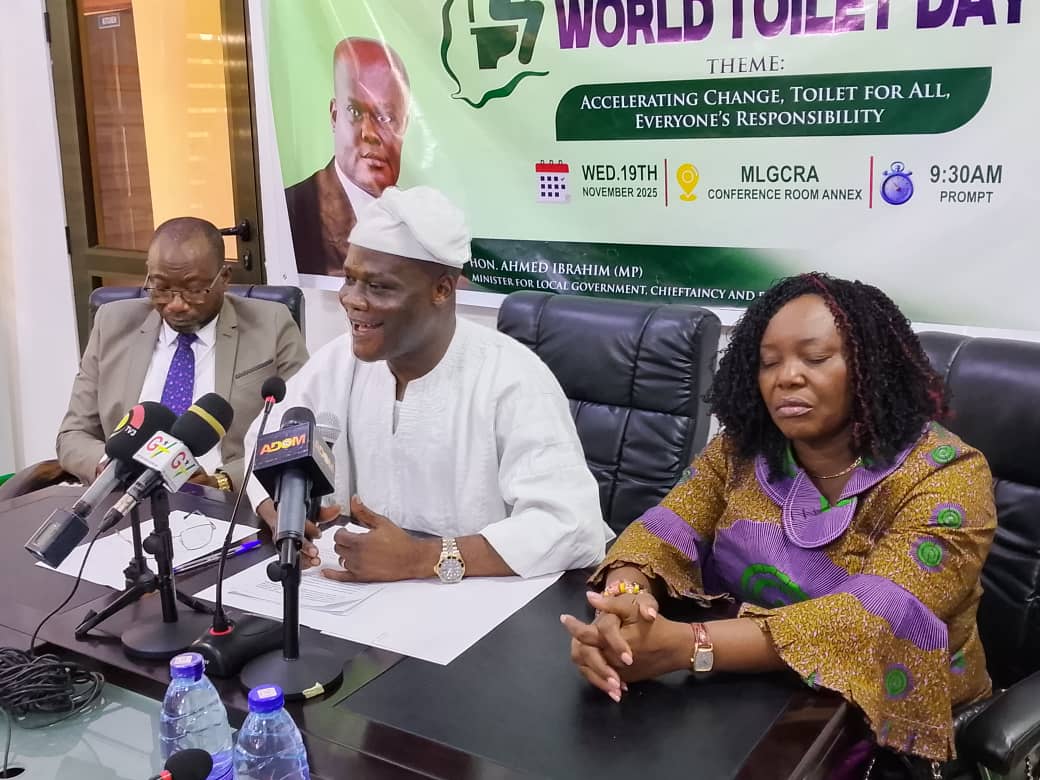

Minister for Local Government, Chieftaincy and Religious Affairs, Ahmed Ibrahim, has emphasized the need for collective action to address the country’s sanitation challenges.
Speaking at the commemoration of the 2025 World Toilet Day, the Minister highlighted that despite progress, Ghana still lags behind in achieving universal access to safe sanitation.
The State of Sanitation in Ghana
According to the 2023 Ghana Statistical Service Demographic and Health Survey, only 25% of households have access to basic sanitation, meaning three out of every four Ghanaian households still use shared, unimproved, or no toilets at all.
Additionally, 18% of Ghanaians practice open defecation, with rates significantly higher in some regions, including Upper East (49%), North East (40%), and Savannah (38%).
Challenges and Opportunities
The Minister identified several challenges hindering sanitation progress, including:
– Slow Household Investment in Toilets: Many households perceive toilets as optional rather than essential, with 23% citing lack of money and 17% saying toilets are not a priority.
– Infrastructure Bias Toward Water Over Sanitation: Almost 85% of public WASH investment goes into water supply, leaving sanitation chronically underfunded.
– Urbanization Outpacing Infrastructure: Rapid urban growth has outpaced sanitation infrastructure development, with over 75% of urban households relying on on-site sanitation.
– Weak Enforcement of Sanitation Bye-laws: Local government structures lack adequate resources and capacity to enforce regulations.
– Fragmented Sector Collaboration: Lack of integrated planning and shared monitoring leads to duplication of efforts and missed synergies.
A Way Forward
The Minister emphasized that Ghana already knows what works in the sanitation sector, citing successes with Community-led total sanitation approaches, toilet revolving financing schemes, and private-sector participation. What is needed now is scale, speed, and sustained commitment.
Key Stakeholders’ Roles
- Households: Invest in and maintain toilets
- Traditional Authorities: Enforce communal norms
- Faith-based Organizations: Drive behavior change
- Private Sector: Expand low-cost toilet options
- Media: Sustain public education
- MMDAs: Enforce regulations
- Development Partners: Provide technical and financial support
The Economic Case for Sanitation
Poor sanitation costs Ghana an estimated $500 million annually, including healthcare costs, productivity losses, and pollution clean-up costs.
The Minister stressed that investing in sanitation is crucial for the country’s economic transformation and human dignity.
As Ghana commemorates World Toilet Day, the call to action is clear: collective responsibility, accelerated action, and unwavering political support are needed to make “Toilet for All” a reality.