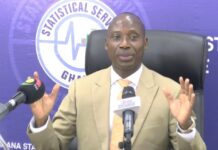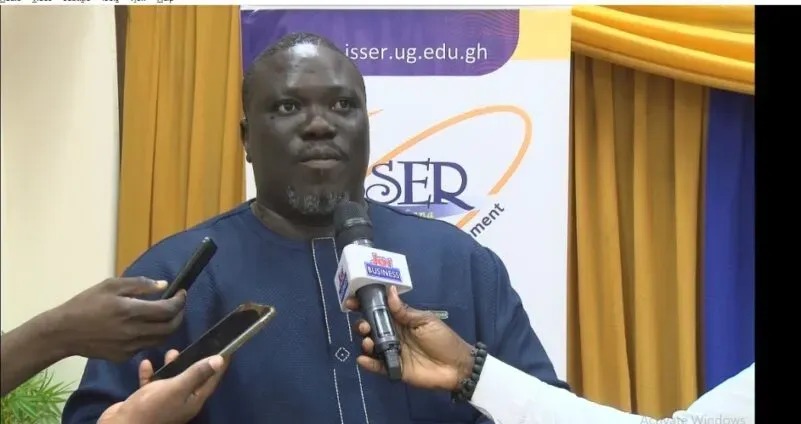

A member of the Monetary Policy Committee (MPC) of the Bank of Ghana, Professor Ebo Turkson, has pointed out the effect of high inflation rate on the economy.
He makes the point that high inflation distorts the economy.
“When inflation is high it disturbs everything in the economy, it doesn’t make the economy stable,” he said on the Key Points on TV3 Saturday, April 25.
He commended the current leadership of the BoG for taming inflation.
“We should always have a discussion relative to the benefits and the cost, every economic policy comes with a cost. Price stability comes at a cost,” the Associate Professor of Economics at the University of Ghana, added.
“Inflation has gone down as a result of the central bank’s intervention to take liquidity out of the market,” he said.
Meanwhile, the Governor of the Bank of Ghana (BoG) Dr Johnson Pandit Asiama, has said that the Bank’s 2025 financial results will reflect accounting costs that are the direct counterpart of the stabilisation achieved.
During a meeting with the Council of State members in Accra on Thursday, April 23, he stated that the debt restructuring under the Domestic Debt Exchange Programme (DDEP) reduced the income the Bank earns from its government securities portfolio, a loss of revenue that persists into 2025.
He also said the open market operations to bring down inflation carry an interest cost.
In addition, he said the gold programme carried a structural cost that has now been significantly reduced.
The exchange rate gap between the gold market rate at which gold is bought and the interbank rate at which it is recorded on BoG’s books, played a role in creating accounting costs.
Cedi appreciation produces a valuation effect on foreign currency assets. None of these affects the Bank’s ability to fulfil its mandate, he said.
• The outlook for 2026.
Dr Asiama said that the global environment has become more uncertain, with oil above US$100 per barrel. Ghana enters this period with stronger buffers than at any point in recent history.
The Bank’s focus in 2026 is on credit quality, banking governance, export finance, and sustaining the gains of stabilisation.
He also stated that Ghana entered 2025 with inflation above 23 percent, a weakened cedi, and reserves covering four months of imports.
The policy response
He said the Bank tightened monetary policy aggressively, absorbed excess liquidity through open market operations, rebuilt external reserves through the gold programme and FX reforms, and strengthened the banking sector.
The results
Inflation has fallen to 3.2 percent as of March 2026, the fifteenth consecutive monthly decline, he said. Reserves have reached a historic high of US$14.5 billion. The cedi appreciated by approximately 41 percent in 2025. GDP grew by 6.0 percent. The banking sector is stronger, better capitalised, and extending more credit.
Members of the Council of State were complimentary of the presentation and engaged with considerable interest.
The discussion that followed covered a range of forward-looking questions and observations.
These are Public education and youth engagement. Council members strongly encouraged the Bank to engage directly with young Ghanaians, to explain the economy in plain terms and to hear their concerns. The view shared was that the data is positive and the public deserves to hear it clearly.
• Exchange rate policy. Members were curious about the choice between fixed and managed exchange rate frameworks, and what approach best serves Ghana’s economic circumstances.
• Virtual assets and digital finance. The Council expressed interest in how the Bank intends to manage the growth of virtual assets and digital currencies, and what the regulatory posture will be.
• Import prices. Members shared concerns about the continued high cost of imported goods and the impact on households, acknowledging this as a key transmission point between macro stability and lived experience.
The Council encouraged the Bank of Ghana to take the story of Ghana’s economic recovery directly to the public, to educate Ghanaians on the financials in accessible terms, and to create space for the youth to ask questions and be heard.