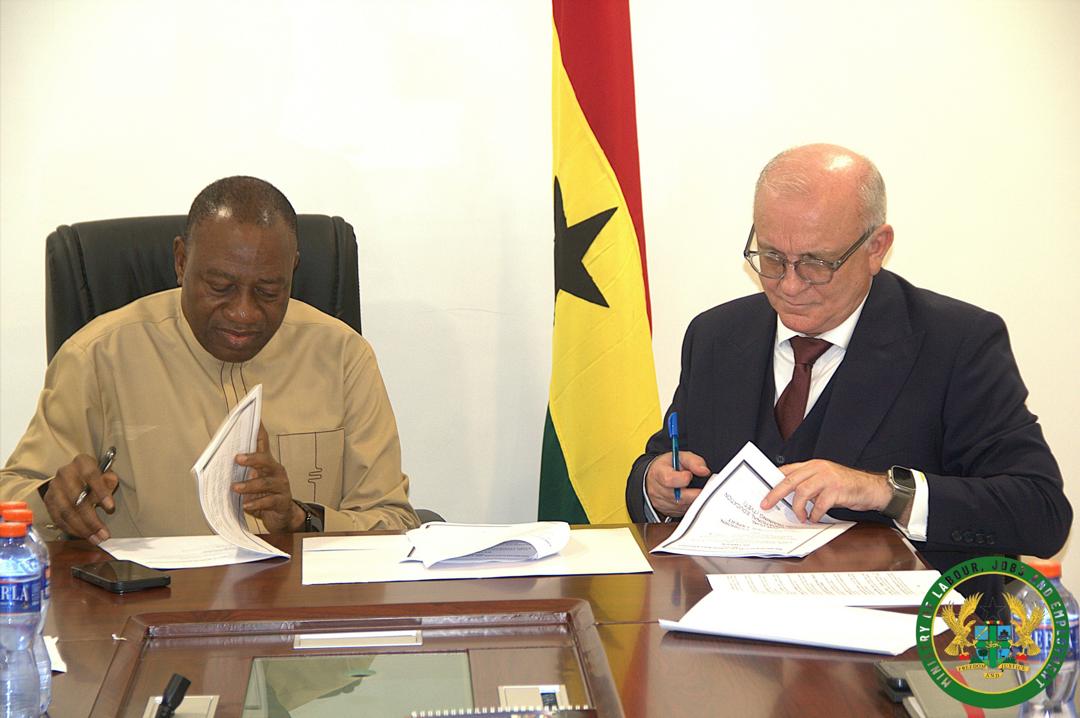

The Ministry of Labour, Jobs and Employment has signed a Memorandum of Understanding (MoU) with Dual Vocational Education Consulting FZCO of Dubai to strengthen Ghana’s technical and vocational education and training (TVET) system through closer industry involvement and the integration of emerging technologies.
The agreement was formalised after talks between the Minister for Labour, Jobs and Employment, Hon. Dr. Abdul-Rashid Hassan Pelpuo, and Prof. Dr. Rolf J. Eichhorn, Founder of Dual Vocational Education Consulting FZCO.
Dr. Pelpuo said the partnership is a strategic step toward closing Ghana’s skills gap, which he described as a major driver of youth unemployment and a constraint on economic transformation.

“Our challenge is the transition from learning to work,” the Minister said. “If we continue to train young people without strong links to industry, we risk producing skills that are not relevant to the labour market. This partnership is about ensuring that skills development leads directly to decent jobs.”
He noted that with hundreds of thousands of young people entering the labour market each year, education and training systems must be aligned with the real and evolving needs of industry. According to the Minister, government alone cannot determine the competencies required in fast-changing sectors.

“Industry must be at the centre of curriculum design, workplace learning and assessment,” Dr. Pelpuo added. “The private sector knows best the skills it needs today and those it will need tomorrow.”
Prof. Dr. Eichhorn, drawing on his experience with Germany’s dual vocational education system and similar reforms in the United Arab Emirates, said successful skills systems are driven by employers themselves. He cited global firms such as BMW as examples of companies that actively define their skills requirements, forcing education systems to continuously update their curricula.
“Education has to be proactive, not reactive,” he said, noting that industries worldwide are rapidly shifting toward electric mobility, automation and digitalisation.
Both sides agreed that while international best practices provide useful lessons, vocational education models must be adapted to local realities. Under the MoU, Ghanaian industries will be directly engaged to co-develop curricula that reflect local industrial conditions while meeting internationally recognised quality standards.
The partnership is expected to support the development of a more responsive, industry-led TVET system capable of equipping Ghanaian youth with skills relevant to current and future labour market demands.