
The Ministry of Lands and Natural Resources says it is making progress in addressing long standing challenges within Ghana’s land administration system through the introduction of the Land Bank and Digitalisation Project.
The Land Bank and Digitalisation Project is a government initiative under the Ministry and the Lands Commission aimed at modernising the management of land data in Ghana. It combines two main objectives: establishing a Land Bank, a centralised system for managing land information, and digitising land records and processes to improve transparency, efficiency and access to land services.
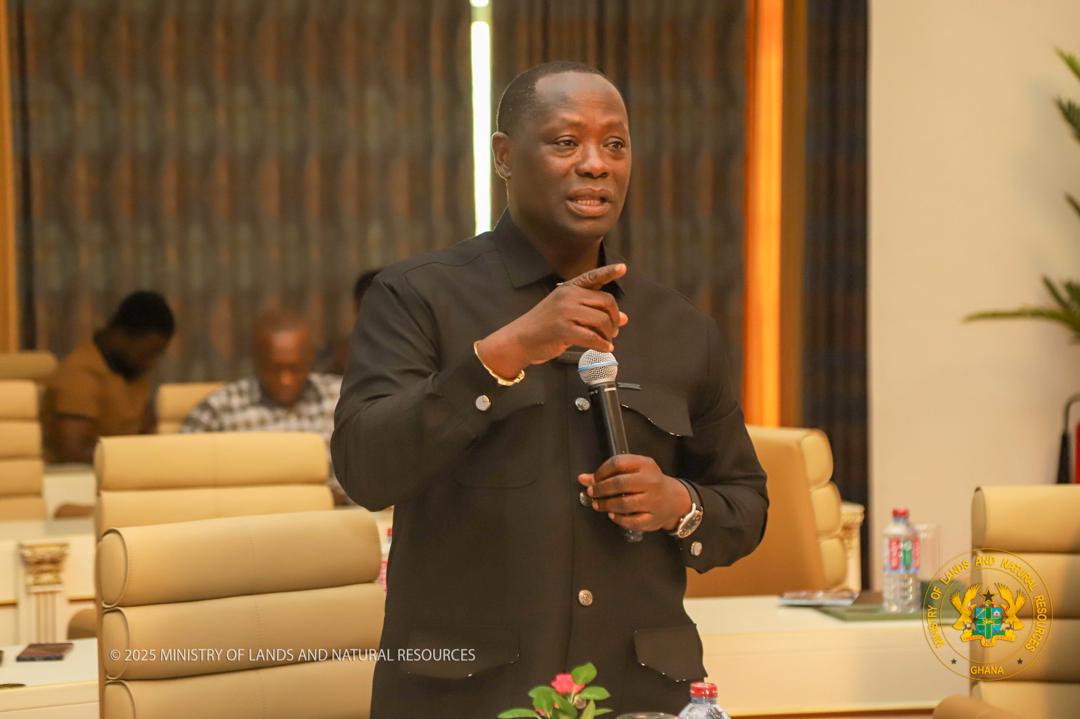
Speaking at the opening ceremony of the 21st Surveyors’ Week and the 57th Annual General Meeting, held in Tema on 26 February, the sector minister, Emmanuel Armah Kofi Buah, reiterated the challenges facing the country’s land system.
He said: “Land administration in Ghana is faced with numerous challenges such as indeterminate and conflicting allodial boundaries, lack of transparency, lack of investor confidence, and cumbersome procedures in title registration, just to mention a few.”
As part of the solution, the Minister explained that “the Land Bank and Digitalisation Project has been designed by my Ministry to address these bottlenecks. The project comes with several components to deal with specific bottlenecks as mentioned.”
He added that the Ministry has already begun securing Land Banks to support investors in the acquisition of large tracts of land for commercial agriculture, particularly for palm plantations.
In support of the initiative, the Ministry has secured 100 per cent retention of the Lands Commission’s internally generated funds. Of this amount, 67 per cent will be used to finance the Land Bank and Digitalisation Project.
Meanwhile, commenting on the Surveying Council Bill, the Minister revealed that it is currently undergoing the necessary processes within the Ministry for onward submission to Cabinet.
He described the Bill as a personal priority, stating: “I am fully committed to seeing this Bill translated into an Act of Parliament.”
He said the Bill is intended to strengthen professional regulation, enforce ethical standards, enhance public confidence in surveying services, and align professional practice with modern technological and governance demands.
He added: “I will entertain petitions that enhance the Bill and nothing else.”
Speaking at the same event, the President of the Ghana Institution of Surveyors, Kofi Obeng Ayirebi, emphasised the relevance of the profession to national development.
He said: “Surveying lies at the heart of national development. From land administration to valuation, quantity surveying, mining and aerial surveying, hydrographic services, facility management, and geospatial intelligence, our work forms the foundation upon which infrastructure, housing, ports, energy systems, and urban development are built.”
He added: “Without accurate measurement, there can be no orderly planning. Without reliable valuation, there can be no sound investment decisions. Without cost management and effective procurement, there can be no sustainable infrastructure delivery. The surveying profession does not merely support development, it enables it.”